



Transcript
This has been generated by AI and optimized by a human.
[00:00:00] The power of data is undeniable and unharnessed, it's nothing but chaos.
[00:00:09] The amount of data was crazy.
[00:00:11] Can I trust it?
[00:00:12] You will waste money.
[00:00:14] Held together with duct tape.
Doomed to failure.
[00:00:16] This season, we're solving problems in real time to reveal the art of the possible, making data your ally, using it to lead with confidence and clarity, helping communities and people thrive. This is Data-Driven Leadership, a show by Resultant.
[00:00:34] Jess Carter: Hey everyone. Welcome back to Data-Driven Leadership. Today I'm talking with Shailvi Wakhlu, and she is a data and analytics executive who has led teams at Strava, Meta, a whole bunch of other places. This one's got a little bit of everything for you. We talk about what it actually takes to scale a data team through hypergrowth using her time at Strava as the case study, where we look at a small analytics group and how it multiplied and how she got to kinda dip her toes into the strategy side of that business as well.
[00:01:02] We also talk about why data doesn't automatically mean better decisions and how we think AI is impacting everyone becoming a data leader, and maybe where there are some gaps and risks associated to that and how you can protect yourself from falling into those gaps. We also then pivoted at the end to talk about self-advocacy.
[00:01:21] She has done this really interesting work where she has coached over 500 people, specifically tech and data leaders, on how to advocate for themselves, which I think is really interesting. As someone who has been around the tech and data space but wasn't inherently one of the technologists on projects, there was always this assumption at some point that you needed a translator for the tech person to the executive.
[00:01:43] And I really feel like we've overcome that in the industry and tech leaders are capable communicators and that is becoming or has become an expectation. But it doesn't mean that we all are good at all of those things all the time. So she spent a lot of time coaching on that, and she has written a bestselling book on this subject.
[00:02:00] And so I'm just really excited to share some of her thoughts and expertise with you. We've got her website and her LinkedIn in the show notes. Let's get into it.
All right. Welcome back to Data-Driven Leadership. I'm your host, Jess Carter. And today we have Shailvi Wakhlu, who is a really experienced and super fun data leader, and we're really glad that she's here joining us.
[00:02:22] Welcome, Shailvi.
[00:02:23] Shailvi Wakhlu: Thank you so much for having me, Jess. I'm excited for our conversation today.
[00:02:27] Jess Carter: I am, too. And I was gonna say, I have a lot of questions for you because you have worked at some really interesting places. You've been at startups, you've been at major companies. And so I reserve the right to get right into it.
[00:02:39] Is that okay?
[00:02:40] Shailvi Wakhlu: Yeah, of course. Of course. Let's do it.
[00:02:42] Jess Carter: Okay, great. So your career arc is just really interesting. You've gone to these early stage health data companies, then you went to Strava and you went to Meta and you've done a whole bunch, rebuilding these data teams every step along the way in really different environments, different sizes, different stages, different cultures.
[00:03:00] I'm just really curious about what that experience has been like. Like, do you have a playbook that you walk through wherever you go, or does it just depend on the environment?
[00:03:10] Shailvi Wakhlu: Yeah, no, thank you. You know, one just feels good to sort of hear how my experience comes across to somebody else. And it's 'cause sometimes, you know, I often joke about this, that careers feel very intentional and they feel like this playbook that you're trying to get through.
[00:03:28] And other times it feels like a DIY project. You know, what am I in the mood for now? And, so it's been very interesting. I think the one consistent thread in my career has been I love subscription businesses. I have seen it from the consumer side, I have seen it from the enterprise side.
[00:03:49] But that theme started emerging in my career. It took a while for that to sort of solidify and come up as the theme, but I've been very grateful. You know, I've worked with FAANG companies, I've worked with startups. Startups are my jam. I really enjoyed being there. The chaos almost feels like home.
[00:04:08] I think some parts definitely, there was an inflection point in my career when I almost started working backwards from where I wanted to be. I-
[00:04:15] Jess Carter: Mm-hmm ...
[00:04:16] Shailvi Wakhlu: wanted to be in that head of data sort of role. And so I started steering my career in that direction, almost looking at it as what is missing in my experience set so that I can be eligible for those roles.
[00:04:30] And I've had those roles, you know, three times in my career. I've been very fortunate. It's been good, but I can't say that all of it was planned or all of it was part of a playbook. Once I'm in a new company, I know what I'm doing, but it's not until I decide what that next role is, there can be multiple directions.
[00:04:46] Jess Carter: That makes sense. I mean, I feel like my career also, my career definitely looks like a DIY project. I always thought that every startup was just innately riskier. And I don't think I understood that it really depends. Like, it depends on the, on the stage, it depends on the founders, it depends on the market fit, it depends on so many, your investors.
[00:05:03] Maybe that's one thing I'd ask you is when you say they're your jam, like is part of that the pace? Like, it does feel like there's a theme there of like failing fast and figuring things out, and things are messy. And is that, when you say it's your jam, is that kinda what you mean?
[00:05:16] Shailvi Wakhlu: Yeah, I think, um, the pace is definitely something that is attractive to me.
[00:05:20] You know, especially again, having gone back and forth with big companies, small companies, I think it's fun to be able to fail fast quickly. Also go after bolder ideas with more, you know with, you don't need 20 people to sign off before you decide to do something. Yeah. And I think the autonomy is something that I really value.
[00:05:42] In startups, I've often felt that people really look at you at your merit. If you are capable of taking ambiguity and turning it into certainty, like especially from a business perspective-
[00:05:54] Jess Carter: Yeah ...
[00:05:55] Shailvi Wakhlu: that is highly rewarded, and that is quickly rewarded. People are not waiting for you to be really senior up in the food chain to be able to accept your ideas.
[00:06:02] So I liked that. Like, I liked that sort of ownership mentality that everybody has, that you know, even an intern can make a difference in a startup. Like, I've literally worked with interns who've had their ideas become part of what's shipped to production in a very short time.
[00:06:20] So that kind of feels fun. Of course, it comes with its drawbacks that there's just a lot of ideas, and there's a lot of energy, and you're trying to sift through and stack rank and say, "Okay, like, how do I decide which are the best ideas to work on?" But I also agree with you. Like, startups are risky.
[00:06:35] You know, most startups don't survive. That's why you are stuck in a situation where you may think you're making a good bet. But honestly, where are you a year later? It's really hard to tell. So you also have to have that flexibility that like a lot of, a lot of my startup marriages only lasted a year 'cause after that it's like, "Okay, this is not exactly where I need to be today."
[00:06:59] But that's okay. You move on to the next one, and you learn from the previous one and go wherever it takes you in the future.
[00:07:05] Jess Carter: What I wanted to do is talk to you about Strava too, which is really interesting. Yeah. 'Cause when you joined it, it was still fairly small. So kind of in this world.
[00:07:13] Shailvi Wakhlu: Less than 100 people.
[00:07:14] Jess Carter: Right. And then you grew the analytics and machine learning from, like, eight to nearly 30. Is that right? Yeah.
[00:07:20] Shailvi Wakhlu: Yeah, that is it.
[00:07:20] Jess Carter: That's insane. So, you know, while you're helping rebuild the platform, can you talk to me a little bit about when you're building something like that from the ground up, what's the very first thing you look at?
[00:07:30] Like, how... Where do you begin?
[00:07:32] Shailvi Wakhlu: So when I was hired at Strava, you know, one of the interesting things was when I was being interviewed, my future boss, they warned me. They said, "Hey, you know, we really like you, but the team loved their previous manager. So, just be aware of that, that they really liked her."
[00:07:49] And so, you know, I was, I was coming in as a new person and I was like, okay, like that's, that's cool. Right. But it was interesting 'cause I do actually believe that when you're stepping into a situation where you're being hired from outside to lead a team that is already great, that is already, like, you know, they're smart, they're considered effective, you can't have that attitude where you're like, "Okay, I know best and I'm gonna come in and change everything."
[00:08:13] Every leader is very eager to show their flavor of leadership, their flavor of data, ideas, and things like that. But you have to take stock of the status quo and really come at it with the phase of, okay, this is where we are today. Here's what's working. Here's what's not working.
[00:08:30] And, you know, instead of that hammer looking for a nail, like really start with what are the problems here that need addressing? What is something that can really amplify the good work that we're already doing? And I think that attitude really makes a difference. 'Cause I do see, I have seen a lot of situations where people just kind of come in, they're eager to change everything and shake things up.
[00:08:53] I think one of the reasons I felt I was successful at Strava, that team eventually, by the way, did grow to really like me. You know, I think I heard that from them a couple of times. So I think it matters that, you know, you appreciate where things are today.
[00:09:08] Why they are the way they are. Even if something is not working great, like, you know, there's not judgment involved in, oh, why is this bad? But it's like, okay, how did it get here? And what is the challenge that is stopping it from being better? And I think that mindset of being humble and wanting to take people along to the next step is what makes a difference in those situations.
[00:09:30] Jess Carter: Yeah. That’s so insightful. And I think the other reality, I had someone else give me this advice too, which is like, hey, if you're gonna have sort of the DIY career path that we've chose, when you worked at a more mature firm, if you ever go to a less mature firm, ever,
[00:09:46] Jess Carter: To not being that guy or that gal that walks in and is like, "You guys don't have this. You guys don't have that." Yeah. I remember a guy that just beat me over the head, and he's like, "Just get yourself a little 97 cent notebook and write down all the silly things that you think are crazy, but decide which ones strategically actually need to be brought up right now."
[00:10:04] He's like, "You can write them all down. You can have those thoughts." But you can distract a business that's already drowning in ideas by just vomiting on all the things that they're not doing like a mature... Of course, they're not doing it like a mature business because they're not there yet. And so I think to your point, the discernment that comes into play, which is like, how do I unlock more value here?
[00:10:23] Or like what's keeping them, what's preventing them from doing even more? And prioritizing those ideas is pretty empowering for them, too. You like the autonomy. It gives them autonomy too, right?
[00:10:33] Shailvi Wakhlu: Exactly. Exactly. I think ultimately, you know, one thing that I always do anytime I am with a new team is that I run a career values assessment that we all do sort of together.
[00:10:45] And I think it's very helpful to understand what people's true motivations are. I mean, of course everybody wants money, you know, from their job. But people want recognition. Some people want impact. Some people want camaraderie with their colleagues. Some people want to work on cool things.
[00:11:01] Whenever people are willing to share individually their career values, I think that's fantastic. It's a great tool for you as their manager to really understand their individual motivations. But I think even that exercise as a group, that okay, as a group, what do we value? Is company-level impact more important, or is sort of the furthering of our industry more important?
[00:11:26] And it can ... You know, the answer can vary for people. So I think finding that common fabric that unites a team that we can all get behind as a goal that we have so helpful in kind of steering the ship in the same direction that everybody wants to go to.
[00:11:42] Jess Carter: Yeah. Yeah. Well, okay, and before we move on from this, 'cause this is so interesting, at Strava, you didn't just help build and scale that data team.
[00:11:52] You also helped shape their three-year strategy, and it ended up driving, like, some huge growth year over year. That's a step beyond where most data leaders maybe get pulled in. How did you go from running data to actually shaping the strategy at that level?
[00:12:06] Shailvi Wakhlu: Yeah. One, I'll say that Strava leadership was excellent in terms of being open to ideas and, you know, being...
[00:12:16] Like when I joined the company, they'd been running it for about 10 years. Kind of a household name already, especially after the pandemic. But one of the things when I was interviewing, I said, "Okay, I have a lot of experience with subscription businesses specifically and that is an area of expertise of mine.”
[00:12:32] And I was very grateful that even the founders, even the co-founders, they wanted to hear my perspective on some of those things. My boss at the time, he said something which I really liked. He says, "You have a very nice way of disagreeing with people." Which I thought was the nicest compliment everybody had anybody had ever given me.
[00:12:55] And it was, I think it was, that was what it was. That there was a little bit of things that we are doing which made sense for where the company was a few years ago. But, like, I collaborated with people who had that same mindset, who had that same, you know, who had similar ideas about where we wanted to be.
[00:13:15] Like Strava at that time was in a position to really pick a lane. Do we go deep in a few sports, or do we go wide to get a bigger thing? And again, I as a data person do not have a perspective, but I am just asking for us to do that deep dive. For us to actually gather the data to help inform.
[00:13:34] Like there's a company-level strategic decision. There's, you know, marketing has a perspective. Like there's all these different functions that are focused on their piece of the pie. And I felt that as data, we are going to showcase the trade-offs in the different options that we have. You know, how much penetration do we have in X area versus Y area?
[00:13:57] What is the total addressable market? Like all those things, I think they led to better decisions because we were not going on something that was just sort of a gut feel, but it was grounded in data. So certainly, it takes a little bit of, you know, luck and timing also, like who you talk to and who buys into your ideas at the right moment so that it's not shelved indefinitely, but it's something that becomes a company priority sooner rather than later.
[00:14:25] And I appreciated all the, you know, all of my peers who kind of helped shape that direction.
[00:14:32] Jess Carter: Yeah. Well, and I think some of it too is, I actually am curious about this. So, 'cause I, I do have questions I want to ask you about other topics. But in today's world, one of the things I'm finding really interesting is that there isn't a head of data in each company anymore.
[00:14:49] It's like with AI, everybody is kind of playing a role, and it's getting a little complicated. It's fun, and I think it's interesting. I feel like the chasm between companies that are not what I would call, like, are considered natively AI, or where they've really done the work to make sure that the tool stack they're using is interconnected, that there's interoperability between their tools for their AI to leverage it.
[00:15:10] Those who have and those who have not, that chasm is huge. I'm interviewing people, and they're explaining their AI expertise .And their super impressive use cases are like, "Here's the way I work around my company's gated AI to actually…It's not actually, it's not their fault, but it's not actually a really impressive story.
[00:15:32] It's about how they're overcoming limitations that they shouldn't have to face in the first place. And I'm watching all these people that are traditionally HR people or operations people or finance people kind of realize that they need to have, like, a data badge too. And so I'm curious how you are seeing, from your vantage point today, how is that impacting some of the businesses or the people you coach or interact with?
[00:15:57] Like, are you seeing this shift in a material way?
[00:16:01] Shailvi Wakhlu: I hundred-percent agree with you that every company is talking about AI. Every company has something that they need to do. You know, either it is to leverage its capabilities to help core business or at the very least to help make logistics easier, operations easier, something.
[00:16:21] And I think that that variation is very wild. It's almost like, I don't know, like I'm not old enough for when, I don't know, Microsoft Word was probably first introduced and everything. Right. Like, you must use Microsoft Word. Like, I'm sure that happened. You know, like again, why? Like, what is the why behind it?
[00:16:37] Is it integral to your operations? Does it replace something existing which takes too much time, and this is a more efficient way of doing this? Or is this something where you feel that this is a critical technology that everybody should know and understand and be able to use because if you don't, you're just gonna be outdated?
[00:16:55] So I do think that, as an industry, I feel there is a lot of chaos about the what and the why and the how and the who and the when and all of those things. And I think you're absolutely right that there is no function that can detach itself from these pieces.
[00:17:12] There is no clear playbook for how... Like, this one-size-fits-all of like, this is how every company should think about it. I think there are pockets. You know, you mentioned health care for example. Health care has specific things that they're trying to do with it. A lot of which requires pre-work.
[00:17:30] Like, okay, you know, you want to be able to leverage AI capabilities to find the answers to disease. But what is the underlying data? Where are you getting it from? How bad is the quality associated with it? Like, that stuff has not changed. Data quality, specifically in health care for example, we've been talking about it 20 years ago, 10 years ago.
[00:17:52] We're still talking about it now. And I think we'll be talking about it 10 years later, too. So it is something where you can try to follow the formats of your domain, your industry, and I think there you'll find specific things that maybe it's like, okay, at least let me ace this part and learn this part.
[00:18:11] Jess Carter: Yeah. Yeah. I like that, 'cause we're basically saying don't assume there's no frameworks.
[00:18:16] Shailvi Wakhlu: Yeah.
[00:18:16] Jess Carter: There are things people have done that we can leverage. But if there's some playbook that people are promising you that if you just go through exactly what someone else went through and it's perfect, that's...I'm gonna call a certain curse word about that.
[00:18:28] But that's just not true. And so I think, too, at Resultant too, there's been this really deliberate effort the last two or three years to be like, "What do people really need, and how do you right size that consultative approach to be like, 'Here's what you need.'" So I’m appreciative. 'Cause yeah, to my point, it's like data's everywhere, AI's everywhere.
[00:18:47] Everyone's becoming a data-driven leader. And but you still have your data and analytics team or your data, your machine learning or your data science team, and they have specific things that they're doing with access that they have that is different. So it's fun to hear you talk through that. One of my other questions is, when it comes to, like, what actually makes data useful to a business, not just what's available, but, like, how do you determine the highest value proposition or the right things to focus on when it comes to democratizing data or getting people the right priority items?
[00:19:16] Does that make sense, what I'm asking?
[00:19:18] Shailvi Wakhlu: Yeah, absolutely. Absolutely. You know, I think connected to that AI topic as well, that we're now in that situation where a lot of people are like, "AI can build your dashboards, and AI can get you all the insights that you need, and, you know, it can parse through data."
[00:19:32] And that is all absolutely true. Like, you know, even in my previous company we were... That was a big chunk of what we were aiming for. How do we automate a lot of the insights that we are trying to get about our business so that we can make quick decisions. And I think there, it's very obvious that, you know, the more you do this, the more you realize that we've always known this, that the framing of the question is so important.
[00:19:58] Like, it almost matters more than the answer. If you don't know what decisions you're trying to make, the answer doesn't matter. Like, it's like, what will I change when I have an answer which tells me to pick direction A versus B, whatever it is. So I think that is something which, at the moment, I think that is still something which very much requires human judgment.
[00:20:19] Leaders need to be very clear about the different paths that they can go down. Like, how do you frame the question? How do you frame the trade-offs so that you can get the insights that help inform those different opportunities? People who are actually doing the sort of hands-on work of getting the insights, again, you know, all insights aren't created equal.
[00:20:43] What is something that is showing you a signal? What is something that's noise? How do you sort of define those? And you, you can have AI agents that kind of do this, but you still have to give it that prompt. You still have to give it that, "This is what good looks like. This is what bad looks like."
[00:21:01] It's not gonna figure that out by itself.
[00:21:02] Jess Carter: Right.
[00:21:03] Shailvi Wakhlu: So I do feel that that piece of framing questions well, and then the people who are sharing the data having a strong story that resonates with the audience answers that specific question because that stack rank, you know, that you referred to, that there are so many things that you can answer.
[00:21:21] I have yet to meet a company that said, "We've answered all our data questions." Like, they're gonna keep asking more. But what are the things that are the most important to answer? Because they either increase the opportunities that the business is going after or they reduce risk. So there has to be some stack ranking that you have to be able to do.
[00:21:43] You can't answer a question just for the sake of curiosity. At some point then that just sort of wastes resources and wastes time and lowers morale.
[00:21:53] Jess Carter: So okay, you just dovetailed exactly into where I wanted to ask you next. When people ask for insights or they ask for data, I'm sure you never experience when you go to build it and realize the data that you'd build the insights off of is, like, not the highest fidelity.
[00:22:09] And so I'm curious if there's a moment in your own career where bad data nearly sent a team in the wrong direction, and how did you catch that before it did? Like, do you have a for instance?
[00:22:24] Shailvi Wakhlu: Oh gosh. I mean, where do I start? You know, I've almost made a side career out of just talking about data quality.
[00:22:33] I think I started talking about it a few years ago and it's just, it is wild because I think sometimes the moments are also really small. Like, there are these big efforts, like that effort that I was talking about at Strava where we were doing a deep dive and being like, "Okay, where, where should the company point over the next three years?"
[00:22:54] Like, that was a long effort. It took a while. It took a lot of people. It took a lot of diligence. And as we're doing it, you know, you find like, tiny things that need correction. Like, oh hey, this underlying metric is not very clear. Like we thought it said this, but it actually says this. Right. And you know, it shifted the thing directly.
[00:23:12] But that was an example of a project where there was a lot of depth to that. Like you're doing a lot of things and you know that it has big consequences for the company because everybody's kind of waiting for that output to decide like, where we are pointing for the next few years. I think it's almost funnier when some casual data output mentioned in a meeting kind of just anchors somebody really senior hears that and fixates on it and they repeat that metric or something like for years.
[00:23:47] It's funny because it's like the person probably who said it was not even thinking that it's gonna have all these downstream effects, that it's actually shaping somebody's thinking.
[00:23:57] Jess Carter: Yeah.
[00:23:58] Shailvi Wakhlu: And you don't realize it. And it's like, if that one was wrong, or if it was misleading, or if it wasn't even communicated in a way, um, that it was meant to, you've now shaped somebody's reality for God knows how long, and you don't even realize it.
So you know, it's, to me, those are actually the more interesting things. Like when you know that your decision is very critical, like your data is gonna be very critical in decision making, it's very different from you casually mentioning something or, you know, it's like a side note on a dashboard and somebody takes it super seriously and they don't actually clarify what that was supposed to represent.
[00:24:36] And I almost think like, those are the ones that are harder to catch. 'Cause, for example, once you put a dashboard out there, lots of people can access it, and you may have made your dashboard with this extreme clarity that this represents a moment in time, and this is just talking about North America sales, and somebody looks at it and they think it represents worldwide sales.
[00:25:02] And it's not your fault necessarily, 'cause maybe you put, you know, North America sales up front and center. But again, how do you prevent people from taking the wrong insight from what you're sharing?
[00:25:15] Jess Carter: Yeah. Well, and I think as we start to wrap, I think one of the things that I really appreciate, 'cause we haven't even gotten into the last topic I was really excited to talk about, which is that you also do a lot of work helping data and tech leaders advocate for themselves.
[00:25:30] And like you said, you've coached, like, 500 people in the last year. I have found that there's just this really interesting moment in time right now as AI is becoming more accessible. Multi generations are accessing it or trying to leverage it, that I feel like, truly, my conversations on this podcast about AI are changing.
[00:25:50] Yeah. And it's not so much about, like, did you build an agent? How did it work? What did you do? How did you access it? What tools do you have? We're realizing the kinds of layering that you just described is critical thinking skills that comes from a career where you did manually work on data, cleaning it and ETLing it, or ELTing it, or Data Vaulting it, whatever you wanna use and your process, to appreciate the nuance that goes into getting a simple number that's clear to say in executive meetings that someone will then latch onto and fixate on for years.
And I love that you're calling that funny, because I'm calling that like, either great stakeholder management or devastating. Like, either way, it's problematic.
[00:26:33] Jess Carter: But people think they're data-driven because they've presented a metric once and everyone's remembered it and not realized that metric is inherently temporal, and by 5:00 tonight it may be different. But then you give them the data in a dashboard, and if you don't give them the headline, everyone doesn't know how to make sense of that dashboard, to appreciate the range, the volatility of the data, to do the sense-making work.
[00:26:57] And all of that was in these jobs people would do for five to 15 years, to make sense of data before they would dump it into AI and get an outcome. And I do have real concerns in the next 10 to 20 years about data literacy. I am really concerned about how much of that is behind this AI curtain.
[00:27:18] And there are people like you and me who know how to leverage AI responsibly and give it the right context and give it the right information and tell it what to not do. Don't make any assumptions. Ask me questions. Make sure you behave in these...here's the skills I need you to have. And you add skills to your Perplexity tool so that it knows how to do these things.
[00:27:37] I have real concern about if those skills get adulterated and lost and companies make major missteps because they're, in the next five years, the stories change and there's devastating stories about trusting the data because AI told us to. What do you think?
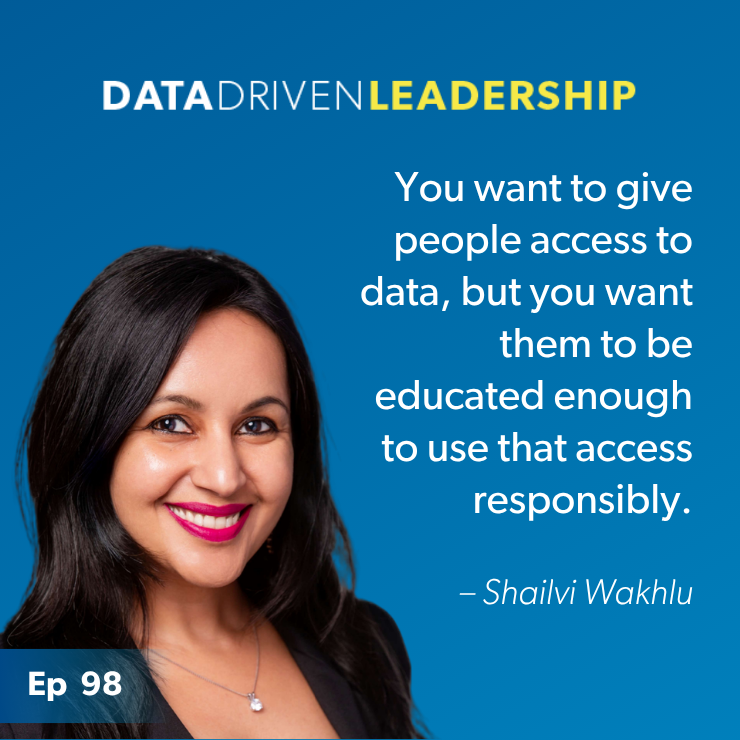
[00:27:55] Shailvi Wakhlu: No, one hundred percent, because I think again, garbage in, garbage out. And I have always believed that with data, I would almost like some version of a driving license exam, like, you know, before. You want to give people access, but you want them to be educated enough to use that access responsibly. 'Cause, you know, somebody saying like, "Oh, now I can just dump this in a..." You know, it's the same equivalent of somebody saying, "Oh, I can just dump this in Excel and it'll give me an answer." Okay.
But if you don't know how to write the formulas, if you don't know where the data has come from, if you haven't filtered it properly, if it's outdated, like all of those things still matter. So just because you have an AI tool where you can dump the data and it gives you an answer and it usually sounds very confident it doesn't mean that that is the right answer because, you know, you still have to do the work upstream to make sure you are going after the right things, you are getting the right data.
And so I do think that it is very important, you know, even for all of us who are in the industry, I think it benefits us if we get people to think about how to leverage AI in an effective manner because that is advocating for our industry.
[00:29:11] 'Cause, you know, again, five years later when things don't work or there's like this giant mess that people are trying to sort through, guess who they're gonna blame? They'll be like, "The data people didn't explain this to us," or, or “They didn't stop us from creating this chaos.”
[00:29:26] So I do think the sooner we come up with some guardrails, the sooner we come up with an education mechanism so that people understand what something should and should not be used for, what kind of information you should clarify before you try to do something with it, like I think that'll benefit all of us.
[00:29:44] Jess Carter: Yep. I completely agree. So we talked about the 500 or so people that you've been coaching in the last year. Are you seeing patterns in those conversations? Like are there common mistakes you see really smart, really capable people making when it comes to speaking up for their own work?
[00:29:59] Shailvi Wakhlu: Oh, absolutely. I think as a cohort of people who have got into this industry without necessarily any training on the soft skills, I see a lot of people who come in with that mindset that, you know, my data is gonna speak for itself, or my analysis is gonna speak for itself.
[00:30:18] And I think they forget that communication is a part of every single job. Just the data being out there doesn't mean you're gonna be able to influence the right things, because data people famously do not have authority. We have influence, we have a lot of the evidence, but we don't often have authority.
[00:30:36] And so how do you get people to pay attention to what you're saying, pay attention to your work, pay attention to the challenges that you face in your work, whether it's tooling, whether it's culture, whether it's collaboration with different functions. And I think that is something that I deal with a lot, where people do not know how to articulate the challenges that they're facing, the help that they need, and highlighting their work in an effective manner so that people trust it and people take it seriously.
[00:31:06] And that is something that I do believe it's a learnable skill. I think it's just, it should have been part of our education as we got into these technical fields. I don't feel it always was. But it is something that people can focus on intentionally and learn how to frame things in a way that resonates with whoever is on the receiving end of that conversation.
[00:31:28] Jess Carter: Amazing. Okay. Well, I have, I don't know, five questions and topics I've left at the cutting room floor. Before we go, is there anything else you wanted to talk about that we haven't?
[00:31:38] Shailvi Wakhlu: No, I mean, this has been a delightful conversation, and I hope your audience gets something of value out of it. But again, I also know, I think just interacting with you, I know there's 100 things we could talk about. But I think this was a great starting point.
[00:31:55] Jess Carter: Yeah. We reserve the right to ask you to come back and hang out with us again. Is that fair?
[00:31:59] Shailvi Wakhlu: Yeah, absolutely. I'd love that.
[00:32:01] Jess Carter: I've had a few people tell me, you know, when we first started talking about AI, I've had a few people who've come on the show that are like, "Can I please come back? Because every question you asked me two years ago, I would answer it completely differently now." And I'm like, I think that's really exciting. I think it means that we're all figuring stuff out and we're growing and-
[00:32:19] Shailvi Wakhlu: Yeah ...
[00:32:19] Jess Carter: I think it's, I think that's a good problem to have, you know?
[00:32:22] Shailvi Wakhlu: Yeah. I'll answer it differently next week.
[00:32:25] Jess Carter: Yeah. Right? Yeah. Well, this has been a delight. If people wanna follow you and kinda just see what you're up to next, what's the best way for them to do so?
[00:32:33] Shailvi Wakhlu: Yeah. I am very active on LinkedIn and hopefully easy to find. But I also have my website, Shailvi.com easy-peasy if you know how to spell my name, but I'm sure that'll be in the show notes, so.
[00:32:47] Jess Carter: We will go ahead and get your website and your LinkedIn in the links in the show notes for people so they can find it super easily.
[00:32:53] Shailvi Wakhlu: Awesome. Thank you so much. I appreciated this conversation.
[00:32:57] Jess Carter: Yeah. Thanks for joining us. Thank you for listening. I'm your host, Jess Carter. Don't forget to follow the Data-Driven Leadership wherever you get your podcasts, and rate and review, letting us know how these data topics are transforming your business.
[00:33:11] We can't wait for you to join us on the next episode.
Insights delivered to your inbox