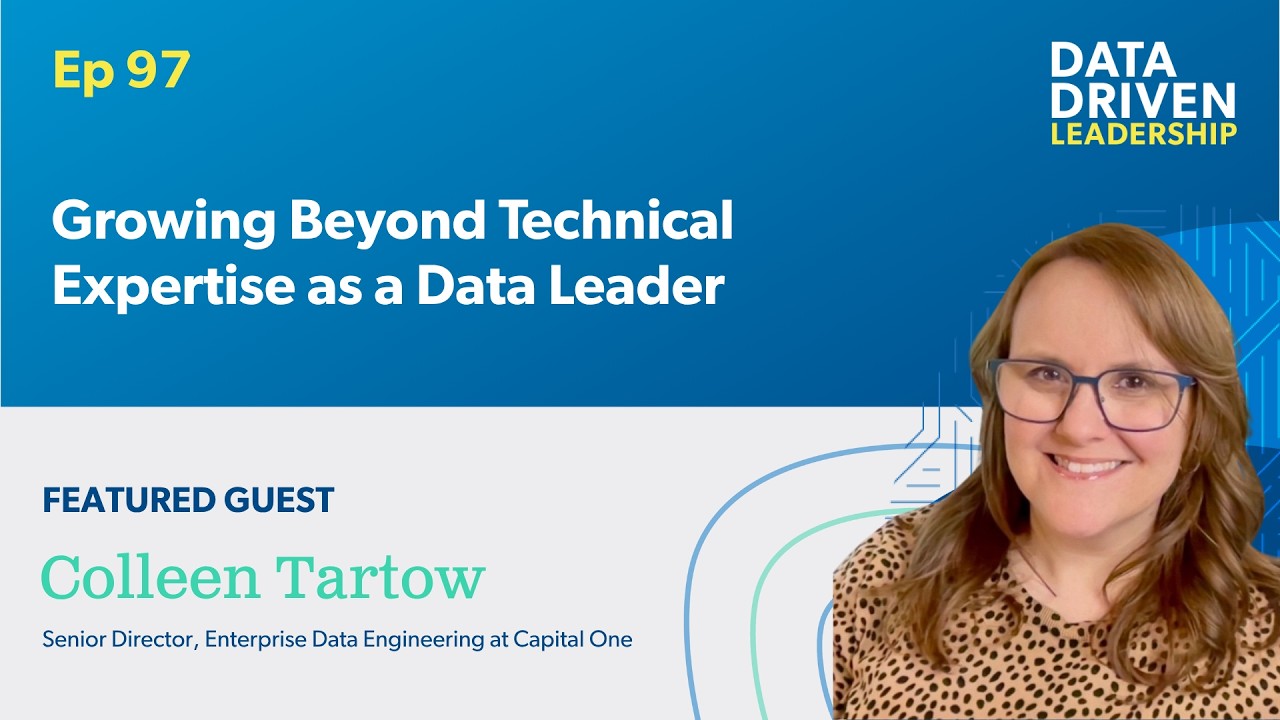
Growing Beyond Technical Expertise as a Data Leader with Capital One's Senior Director of Data Engineering
Listen On



Transcript
This has been generated by AI and optimized by a human.
[00:04]:
The power of data is undeniable and, unharnessed, it's nothing but chaos.
[00:09]:
The amount of data was crazy.
[00:11]:
Can I trust it?
[00:12]:
You will waste money.
[00:14]:
Held together with duct tape.
[00:15]:
Doomed to failure.
[00:16] Jess Carter:
This season, we're solving problems in real time to reveal the art of the possible, making data your ally, using it to lead with confidence and clarity, helping communities and people thrive. This is Data-Driven Leadership, a show by Resultant.
[00:00:33] Jess Carter: Hey, guys. Welcome back to Data-Driven Leadership. Today's guest has one of the most fascinating origin stories we've had on the show. Colleen Tartow started her career as an astrophysicist working with the Hubble Space Telescope. Yeah, that's the one that's responsible for those jaw-dropping images of galaxies that flood your feed.
Somehow, we fast-forward and her career ended up in leading engineering at Capital One, and she spent time building the most advanced data and tech organization in financial services. And we get into all of that, but we also talk about leadership in some really interesting ways. She has great advice about how do you establish and build trust quickly, and how much you need to be self-aware in order to do that.
[00:01:14] And we also talk quite a bit about how do you, kind of self-onboard, how do you get familiar with a new company and a new job quickly, which I think is really helpful. Lastly, she and I have a conversation that we don't have enough in this world, which is about, you know, in your first ten years of a career, you tend to spend, those career years deep in a subject matter or deep in skill development.
[00:01:37] And then you're asked to maybe step into a leadership role, and suddenly you need breadth to you, not just depth. And so she does a great job sort of reverse engineering what it was that helped her get across that bridge. And now that she doesn't just live in breadth, she has the discernment to know when she needs to go deep on subjects and when she needs to go more broadly as a leader.
[00:01:58] I really enjoyed hearing her share quite a bit more about Capital One and all of her passion about data and puzzles and problem-solving. One theme that runs through the whole conversation is the importance of listening, and honestly, Colleen is someone you'll want to listen to. Buckle up, this one's really good.
Let's get into it.
[00:02:15] Welcome back to Data-Driven Leadership. I'm your host, Jess Carter. Today, we have Colleen Tartow, senior director enterprise data engineering at Capital One with us. Let's get into it. Colleen, welcome.
[00:02:28] Colleen Tartow: Thank you so much for having me, Jess
[00:02:31] Jess Carter: Oh, I'm so excited. I don't, I think you're the first astrophysicist. Did I even say that right?
[00:02:37] Colleen Tartow: Yeah.
[00:02:38] Jess Carter: Holy smokes. I have…very rarely am I speaking to people whose career includes a title I can barely pronounce. So I'm excited to talk about what your life has looked like, 'cause that sounds amazing.
[00:02:51] Colleen Tartow: Oh, it's really fun. We should get into it.
[00:02:53] Jess Carter: Well, let's just do it then. So, my understanding is that you, like, literally used the Hubble Space Telescope. Is that right?
[00:03:01] Colleen Tartow: Yes, yes. I have used Hubble. I haven't used JWST though, which is like the new Hubble.
[00:03:06] Jess Carter: Me neither.
Colleen Tartow: But yeah, no, I used Hubble as part of my dissertation research a long time ago. But yeah, it was pretty cool.
Jess Carter: When you talk to somebody who has no idea what that life is like, what does it look like? What's a day in the life when you're an astrophysicist?
Colleen Tartow: I mean, it's funny because it's actually not unlike a day in the life as a data engineer. So I was an observational astrophysicist, meaning I wasn't just like, you know, modeling. I was also, like, going to telescopes and taking data from those telescopes. And so, I mean, this was the early 2000s, so I would, like, take data on a tape and put the tape in my backpack and take the backpack back to my office and then, you know...
[00:03:50] Um, but you would spend nights up on mountaintops, you know, observing cosmos with some of the most powerful telescopes in the world, or in the case of Hubble, it would just happen to do it on a schedule, and you would get informed that your tape was in the mail. Aging myself there, but, uh, yeah, so it was really cool though.
[00:04:08] I've used some of the biggest telescopes in the world and off the world, and it was really cool. And so you would take that data though, and then, like, then the hard part comes, which is taking those observations and, you know, cleaning the data and modeling the data and understanding what the data was telling you and making sure that you were looking at what you thought you were looking at, and if not, then what were you looking at?
[00:04:33] And you know, it was really data engineering in a lot of ways. And this, data engineering wasn't a field then that I was aware of. I had always been in academia and we were doing, you know, data science and analytics on the data that we had engineered. So it was like unknowingly preparing myself for this career.
[00:04:52] I think it's really telling that most of the people in my program, I mean, there aren't that many jobs for astrophysicists outside of academia, and within academia, most schools have, like, an astrophysicist, right? Like most small schools, if they have a physics department, they might have one person who specializes in that.
[00:05:11] And so I ended up realizing that the market was not as lucrative for astrophysicists as I had initially hoped. And so most of the people I went to grad school with actually ended up in data engineering because that's what we were being prepared for, you know. We all knew…
[00:05:28] Jess Carter: That makes sense.
[00:05:29] Colleen Tartow: You know, those skills and how to clean and prepare data and tell stories with it, which is really what, what this game is all about.
[00:05:35] Jess Carter: We will get into the data, but I refuse to move on yet because I'm like, the subject matter, I don't get to talk about space unless I'm reading to my child. And so like, can you tell me, like, what was the actual work? What was a project you were on?
[00:05:50] Colleen Tartow: Yeah. Have you ever seen the Hubble Deep Field where, like, Hubble just stared at a patch of sky and we thought it was gonna be blank, but it turns out it was, like, filled with galaxies? And you've probably seen those images, and JWST did a different one where they also stared at a patch of sky and found that it was like, you know, a deep, deep field of galaxies.
[00:06:09] And in fact, the Roman telescope, which is going to be launched soon, that is literally its job is to stare. It's going to survey the sky and, like, stare at patches of sky and cover the sky with deep images, like just stare at the same patch, absorbing photons that have been traveling for, you know, sometimes billions of years into our detectors, and then we can, like, map that part of the sky.
[00:06:33] So that's, that's really cool. But what's interesting is in those images, it looks like there's a galaxy here and a galaxy there, and there's nothing in between. And it turns out that's not true. It's that there's nothing visible to our naked eye in between. But there's actually stuff in between. And when I say stuff, I mean what we call metals in astronomy, which is anything heavier on the elementary scale than helium.
[00:06:58] So there's like hydrogen, which is proton and electron, and helium, which is slightly more complicated, and then there's more complex elements. And these more complex elements aren't found naturally. They're formed in stars. And so you might hear people say, "We're all stardust," and it's true. Like, the iron in your blood was possibly formed in a star, in a supernova, right?
[00:07:19] And so the question is like, how did that stuff get into the space between the galaxies, the intergalactic medium? And so part of what I studied was one particular transition of one particular element. I studied sodium. And sodium is very, very common. It's common enough that we can detect it, but we actually studied sodium absorption.
[00:07:42] So the sodium sits between you and something bright. And if you shine the bright thing, like a quasar or something, at the sodium and we're on the other side, it can, it absorbs certain wavelengths. And so that's what I was studying with spectrometers on telescopes. And you can tell how fast it's moving away from things because you can see that it's either red shifted or blue shifted 'cause the light is getting stretched or it's getting compressed.
[00:08:10] And so I studied that, and it was fascinating. But, you know, it was cool, like learning how to do that and then trying to make observations about the universe based on that.
[00:08:22] Jess Carter: This is like one of the cooler conversations I've had in my life. Everything you just said is like incredible and I, the looseness, the casualness in which you're like explaining what's heavy, metals are heavier than helium. And I'm like, "Yeah, no, definitely. I knew that."
[00:08:36] Colleen Tartow: Well, I mean, I studied it for like many, many years, right? So it's like, you know, if you study something like this for like eight years, then you'll also, it'll slip and roll off the tongue like for you too.
[00:08:47] Jess Carter: I just…it's amazing. That's so cool. Well, and then, so then you pivoted and you are in data. So what was that? It sounds like a lot of pattern recognition of the work maybe was... But what what was that like?
[00:08:57] Colleen Tartow: I used to vehemently tell people I was never gonna do software. And, you know, my parents would be like, "You should go into software." And I'd be like, "Ugh, no." Because in my mind, software was just sitting in a room by yourself coding, because that's what it had been for me in graduate school, was sitting in a room by myself coding, and I didn't want to do that.
[00:09:16] I wanted to be working with people. I wanted to work on things that weren't quite so esoteric and would really, you know, matter, and I wanted to work with other people and, like, collaborate. And, I enjoyed teaching, but I didn't know if I would be able to make a living doing that, frankly. And so, I got cold-called by a recruiter, and I'm gonna age myself some more.
[00:09:37] This was, he sent me to an ad listing on Craigslist, where he was like, "Look at the job listing on Craigslist." And back then you were like, "Ooh, that's legit," because I don't think LinkedIn existed back then. And so I ended up working at a company called Ab Initio, which was a data company. It's like a really stalwart of the industry.
[00:09:55] They've been around since the '90s, and it's an ETL software platform, and I ended up working there for a long time and learning that software is not sitting in a room by yourself coding. It's actually support. And so that's how I got into software.
[00:10:10] Jess Carter: Uh, that's incredible. And, um, for those who don't know, ETL is?
[00:10:15] Colleen Tartow: extract, transform, load. It's basically like taking data, extracting it from some system, doing stuff to it and transforming it, and then loading it into another system. And so that's typically how we take data from operational systems, move it around, and then load it into other systems so we can analyze it.
[00:10:32] Jess Carter: Thank you. You are an excellent teacher. That's why I'm putting you on the spot as much as I can to teach. 'Cause, you know, a lot of people, technical leaders know that. Business leaders who aren't so technical, I think there's a, like, just make the dashboard work for me. And I don't think that there's always an appreciation for, well, if the dashboard's in Tableau or Power BI or something else, you know, a platform, we had to take it from the source system of that data, and we had to load it and then transform it, or transform it and then load it.
[00:10:59] And there's Data Vault approaches. There's all these different ways to take data from one place and put it somewhere else in order to do something with it. And there's a thousand methodologies. But, and to your point then in your career, there's whole platforms that exist for that exact tool, and that's where you were.
[00:11:15] So then, so then you've worked in consulting cybersecurity, you've worked in food tech. I don't even know what that means. Storage infrastructure. You've done all these things. So, like, when you walk into a new industry, one of my, like, leadership-leaning questions is how do you get trust quickly? How do you develop trust quickly?
[00:11:36] Colleen Tartow: In my mind, I'm a pretty authentic person. I have no problem being like, "I have no idea what you're talking about." Like being vulnerable, especially when you're new at a company. And like I know what I know really well, and I'm totally fine being like, "Yeah, I'm an expert in data," right? Like I know ETL backwards and forwards, right?
[00:11:53] Especially if you're at a new job in that scenario, like you've been hired for a reason. Like I've been hired for my data expertise and my, you know, the fact that I know the things I know. But, nobody expected me to be an expert in cybersecurity.
[00:12:06] They knew I was an expert in data. And so, you know, the other stuff, I'm smart and I can pick it up, and I'm willing to learn, and I'm excited to learn, actually. I love going into new things. And consulting was like that. I got to learn... I was in every industry as a consultant, right? I got to learn about the oil industry and, you know, education and, you know, all these different things in different countries even, and it was fascinating, right?
[00:12:30] And it's like, you know, I use SQL and Python in each of those locations. So it's like there are the things that I'm an expert in which are common, and you can take what you've learned in one and apply it to another. But, you know, I didn't know anything about forensics, but I started doing forensic analytics, and it was fascinating, right?
[00:12:47] Like, how can we use data to prove this hypothesis is always gonna be the question, regardless of the industry you're in. So like just being confident in the things that you know and being curious about the things that you don't know.
You know, just listening, listening a lot, especially in the beginning, just learning and listening 'cause there's always gonna be like the acronym zoo that you have no idea what people are talking about and just, you know, write things down and, be really candid about the fact that, "I don't know what you're talking about. Can you teach me?" 'Cause everyone, everyone knows something that you don't, so.
[00:13:19] Jess Carter: Do you get feedback often that you are really approachable?
[00:13:22] Colleen Tartow: I do.
[00:13:23] Jess Carter: Okay. 'Cause I feel like that's a superpower to jumping in as a consultant. Like there's a level of trustworthiness that naturally comes with people who are just innately a bit more approachable.
[00:13:34] Colleen Tartow: Yeah. And I think sometimes it leads people to... I don't know if they underestimate me or if they just like, misinterpret my skills, but I definitely like, you know, I'm me. This is me.
[00:13:46] Jess Carter: Yeah. I ask because I also get that feedback, so I think about if you don't have that innate superpower, 'cause I think it does a lot more than I always realized, like then what advice would I give about building trust quickly without, without the approachable superpower. Because to your point, I don't mind being underestimated 'cause I can always surprise you.
I don't wanna surprise you if you overestimate me and I'm not it, right? And so, for…the other thing I'm curious what you think about is, you mentioned you write everything down, and I think that one of the things I'm picking up on too is, I don't know how to say this in an impressive way, so I'm just gonna say it: Not vomiting out every thought you have when you're a new hire. Like absorbing, writing down, and finding the right meetings and the right space and the right time to ask questions and to seek to understand and to build a rapport.
Like, I think when I was younger, I would just “happen” to a room. Whatever my thoughts were, I just said them. And I think the adulting, the leadership move when you're stepping in is also that sense of what you said, write it down. You know, be trustworthy. You establish trust by being trustworthy first, right?
[00:14:58] Colleen Tartow: Yeah. And I will say, like, there's definitely, there's some quote about this too, but my dad is actually the one who has always said to me, " You have two ears and one mouth. You should be listening twice as much as you speak." And I will also say it's often, and this is a quote that I wouldn't even pretend I remember verbatim, but it's something about the fact that the quietest person in the room is usually the most astute and the one who really knows what's going on because they're listening.
[00:15:29] And it doesn't mean you shouldn't contribute, but it does mean that you should know when to contribute and how to contribute, and you should also let other people rise, et cetera. So I mean, Zoom is amazing. You can mute yourself, right? Like sometimes I'm like, "I'm just gonna mute myself and, like, see what happens," you know, depending on the meeting and what's going on.
[00:15:45] But, you know, there's a trust formula and there's like, it's easier to gain trust one-on-one. It's hard to gain trust in a large meeting, right? but I'm always gonna respect the subject matter experts. There's always something to learn from everyone, right? You know, I don't know everything. No one does, so.
[00:16:02] Jess Carter: Well, and your ability to jump through with…you have the patterns and the skills that you have. It would be so silly of you to jump into banking and suddenly pretend that you're the subject matter, that you understand it all. But you, but you're confident in what you're confident in, and you're open to learning from the people around you who are more skilled in that, or more expert. And I think that there's a “know yourself” piece of the trust formula, right?
[00:16:26] Colleen Tartow: Yeah, like I bring value to the table and I know I do, and I've got years of experience at this point. And, I also, when people are interviewing, it's like, when people are trying to like, sell themselves to me, it's like, don't try to sell yourself into the role that I'm looking for 'cause you don't know what I'm looking for, right?
[00:16:44] Like, I know my world and you know you, let's see if those two things match. I've had people, you know, stretch the truth on what they know, and then it's like you hire them, and then it's obvious that they stretched the truth. And it's like, you know, you're not starting off on a great foot there, right?
This is like obvious to me what we need. And so just listen, right? Like interviews are a two-way street.
[00:17:06] Jess Carter: Yeah, Oh my gosh.
[00:17:07] Colleen Tartow: So the job, you should have been very candid about what you know and what you bring to the table, and trusting that the company knows what they need and that they're being honest about that, so.
[00:17:18] Jess Carter: Yeah, that's… No, this is great. This is really good advice. One, I…and the other thing I was gonna ask you, I think this is so kind of more on the leadership side, and then we'll jump. But, I think that so many people are trying to have this conversation right now, and I don't know if it's a reflection of where I'm at in my career or my age. But there's a lot of conversations about how do you go from being like a principal IC, which is a shorthand for me of individual contributor, to a leader.
And you've done that. You've been a subject matter expert, you've been a principal individual contributor, and now you are leading in a very serious way. I'm curious what that journey looked like, and maybe advice you'd have for someone else who's not quite made that all the way across the bridge.
[00:18:04] Colleen Tartow: Yeah. I mean, it's funny 'cause I don't think if you had ever asked me ten years ago, "Where do you think you'll be in ten years?" This is not where I would've put myself, right? Like, I never had the forethought to put myself into the role I'm in. It just kinda happened naturally. And I think part of it is that I've always been a bit of a cruise director, right?
[00:18:26] Like, even in grad school, I was always the one being like, "Hey, let's all go out. Let's all do this. Let's..." You know? And so I've always had a bit of that sort of leadership quality where I'm trying to corral people and get them to collaborate on big projects, right? And there are people who have that naturally, and I think that there are people who want to develop that, and then, you know, I think it can be learned.
[00:18:49] And there's plenty of advice about that out there, right? There's books that you can read. I do think that I recognized in myself that coding all the time was something I could do. It wasn't something that was particularly healthy for me in terms of like where my mental health would be. And partially because when things were working, I would get so excited and I wouldn't stop coding, right?
[00:19:16] Because they were working. And then when things were not working, I wouldn't stop until they did work. And so I became like a crazy workaholic, right? And it's like I would work until all hours of the night. And it's funny because I haven't done that in a few years, but then now that we've got Claude, I'm finding myself doing that again.
[00:19:32] Jess Carter: Yeah.
[00:19:33] Colleen Tartow: Dangerous. But it's fun, you know? It's just like it's fun.
[00:19:35] Jess Carter: I know.
[00:19:36] Colleen Tartow: I think the definition of success for me became bigger. It became not just that like this piece of code works, but that this project was delivered, that this value was delivered. And so, I think for me, you know, I can code my way out of a problem, but like, and I can micromanage technical solutions, but I also like, other people can do that probably better than me, right? And so like I think my job is more akin to storytelling, right?
[00:20:01] Like it gets back into that storytelling of like, here's where we want to go and here's the strategy of how we're gonna get there, and then how are we gonna execute on that strategy, right? Like I like putting that puzzle together, and thinking through like what's important in the industry, whether it's, you know, BI or, you know, now it's things like unstructured data that we're talking about and AI.
[00:20:25] And so it's like, you know, how do we define the vision, get the strategy to get us to that vision, and then execute on that strategy? I love that puzzle. So,
[00:20:35] Jess Carter: Yeah.
[00:20:36] Colleen Tartow: I think you got to kind of just be honest about what you're good at.
[00:20:40] Jess Carter: Well, and to your point, tell me if this, resonates with you. What I, again, what I'm kind of hearing you say that I find really interesting is it's like you, you were diligent about the things you were given, and you got really, really good at those things. And then as you got good at them, and maybe not just thought you were good, but had good feedback that you were good, there were checks and balances there. You started to get curious about the rest of like, what comes before you and what comes after you, and then there's this curiosity about how does it all work together? And so there's this like strategy side of your brain that's also, you know, hey, as an individual contributor, you can make that transformation, but you have to be diligent about what you're good at.
[00:21:23] You have to start to get curious about the rest of the process, and then, you know, you can't drop the ball that you're responsible for as you also juggle maybe some new things. But there's that peripheral vision that you're opening up. Your apertures are opening and you're able to see a little bit more broadly than you could have when you were just learning the skill sets that got you, you know, justified that you were in the space where you got to work. Is that fair?
[00:21:46] Colleen Tartow: Yeah, absolutely. And I mean, I think there's definitely the breadth and depth package that you can, you know, go as broad or as deep, and you can stay the IC track and just be super, super deep, and there's value in that. But then, even then you need to like understand more and more if you wanna grow in your career.
[00:22:04] And I think, um, for me, I'm like a curious person, right? Like, I like figuring out how things work, and I like puzzles and things like that. But, you know, I also like bigger puzzles and trying to figure out how like, you know, systems fit together, not just pieces of a system. So I think like as you grow in your career and you gain more and more insight, that's, that's a natural progression, right?
[00:22:28] Jess Carter: Yeah, I agree. Well, speaking of that natural progression, uh, let's talk a little bit about Capital One. Is that okay?
[00:22:36] Colleen Tartow: Yeah, absolutely.
[00:22:37] Jess Carter: I mean, it has this reputation of being one of the more technologically advanced banks in the country, and they've been building their own tech and investing heavily in data and AI for years, as I understand it. In your opinion, I'm kind of curious what sets them apart from traditional financial institutions. And how do you guys stay ahead? That's interesting to me.
[00:22:59] Colleen Tartow: Capital One has always been on my radar, right? Like, since I was a consultant, and Capital One was actually a client, like, many years ago. And it's always been on my radar as the more...it's like a tech company masquerading as a bank. You know, I've always been impressed with how Capital One was ahead of the rest of the industry in terms of technology.
[00:23:20] I mean, we were cloud-first really early on. I've always tried to stay at the cutting edge, right? Like, consulting was part of that, you know, working at vendors was part of that, like, building the products that I believe the industry needed. And so for me, it's funny 'cause, like, this is where I get super nerdy.
But like, governance has always been a really interesting problem for the industry. And like, five years ago when everyone was talking about data mesh, which is this, like, theory around, you know, how we should have decentralized, you know, data ownership but centralized architecture. It's like, we would talk about the four pillars of data mesh, and the last pillar was governance, and it was federated computational governance. And it's like, that was the last pillar for a reason 'cause it's the hardest thing to do, right?
I like hard puzzles. And so for me, you know, I always had on my radar that Capital One would always be at conferences and, like, talking about the way they're tackling these hard problems. And so for me, it was like when I started, you know, I had a friend who worked at Capital One who is a good friend of mine, and she's wonderful, and she was like, "You should come do these things," and like, "You have all this knowledge." And I was like, "No, no, it's too big. I'm a startup person," right? But the more I thought about it, the more I was like, they really are doing the cool things and, like, solving the hard problems.
[00:24:35] And so for me, that's why I joined Capital One. And I do think that, you know, my impression was correct, that we are solving, like, the really hard problems. And, you know, we're natively in the cloud, and we're historically tech-forward, like you said. My job here is not convincing people that data matters, which I think it might be elsewhere in the industry, right? Like, we all know that data matters, and my job becomes ensuring that these, like, massive distributed data pipelines all over the company are running seamlessly and securely and efficiently at this massive scale, right?
And so it's great because I do get to split my time. I don't have to walk around being like, "No, data's important," which, I definitely saw companies like that, where they would be like, "data-driven" was their tagline, but when it came down to it, it was not like that.
So now I'm able to, like...I don't have to have that conversation here. And so, you know, everybody agrees that data is really critical, and I get to think about things like people and strategy and architecture guardrails and, you know, future-proofing things. And I get to solve the hard problems and the fun problems in my mind.
[00:25:42] And like, I would say that like the regulation in our industry, in a lot of companies it might be a handcuff or, you know, something that's really challenging, but for me it's more of like a design constraint. You know? It's like, something that's going to force us to like, you know, drive engineering excellence in that one particular way.
[00:26:02] But like, you know, where in a startup you've got like, the move fast and break things world where you're like, "We don't care about governance, just get the product out," right? And like data governance ends up being an afterthought that you like clean up as a function of like, "Oh, we have to go to market, so we have to clean this up in order for this one customer to sign."
[00:26:21] And in enterprise finance, you end up with like, you know, governance and lineage and security and all of that are like part of the core feature set from day one, and it has to be one of the design constraints. And so like I think it's really, I don't know, I think it's really fun and it's really cool.
[00:26:36] Jess Carter: When people say data governance is especially interesting to them, I'm like, "You are a unique breed, and we need you in the world. We desperately do.
[00:26:44] Colleen Tartow: That is a kind way of saying that I am super nerdy and I appreciate it. No, I know. And it's like, it's so funny 'cause it's like I have always, like, tried to find like, hard problems to solve, you know? I like problems I think they're fun.
[00:26:57] Jess Carter: Yeah. I mean, that's, I think that's what we're here for. Like, I believe deeply in, you know, work is part of why we exist, is like to do things that are meaningful and to get to work hard is a privilege. And so when we get to have agency over the problems we get to solve, I think that that's a very real privilege and gift.
[00:27:18] And so, when I hear you talk about some of the work you do, so it sounds like—and I and that's a good distinction, is, hey, I have the privilege where I don't have to convince people that data matters. And I've also seen that. So maybe let me pause my other question. I don't know how to ask this.
[00:27:34] How can you tell when you're with a company and you're like, "Oh, data isn't…We're not really data-driven"? Like, what's the, what's the line of demarcation where you can discern that?
[00:27:45] Colleen Tartow: I definitely, as a consultant, saw companies where I would come in and I would say like, "Hey, you know, we've got this solution and we'd love to help you, like drive your strategy with data." And in theory, who wouldn't want that, right?
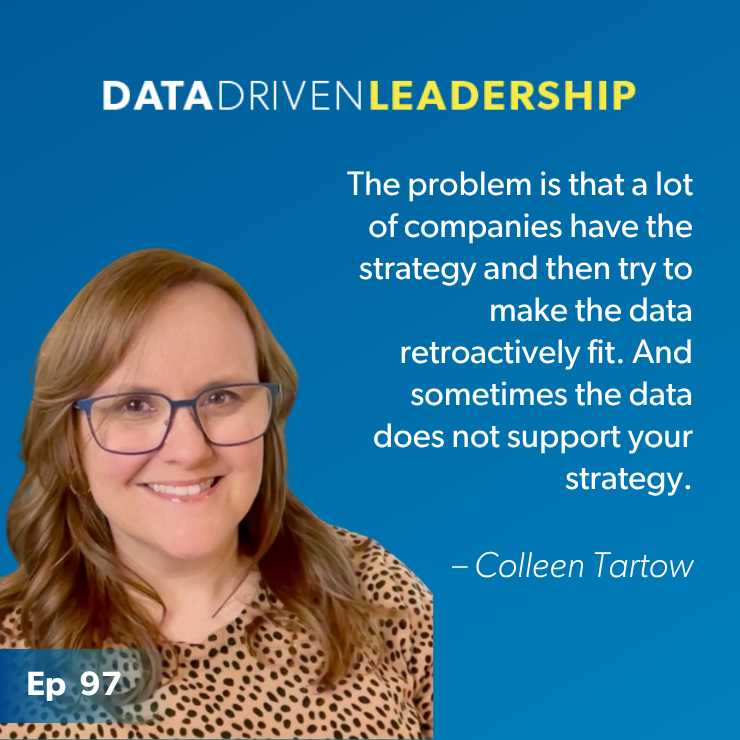
[00:28:02] Like, you know? But the problem is a lot of companies have the strategy and then try to make the data retroactively fit. And it's like sometimes the data does not support your strategy, and you can choose to like, ignore the data. That's your prerogative, right? But me as a consultant, I'm telling you that this is what the data says, and like the story you're telling is independent of the data sometimes, and that's okay, but you have to own that, right?
[00:28:30] And so it's just like, you know, people would be like, "Well, no, like let's look at the data a different way." And I'm like, "Dude, like then it's not data and that's fine, but like you have to be okay with that," right? And so there are some times when like a company wants to do what a company wants to do and like, I got paid either way, right?
[00:28:46] Jess Carter: Right!
[00:28:47] Colleen Tartow: So like it's fine. But there are definitely companies out there where like, they have their, you know, internal politics or reasons for wanting to do certain things. And if you come and tell them like, "You can't tell me what the data should say," then it's not data-driven, it's strategy-driven, and that's fine. But you know, you have to own that and be okay with that.
[00:29:06] Jess Carter: I think that distinction is really powerful though, 'cause it's a good like, self-reflection moment for leaders to be like, hey, you know, are we…like to me that verb of, are we listening to the data? Are we actually hearing it or are we in a smoke and mirrors environment where we're believing what we want to believe about our customers or about our patients or about our clients and our strategy?
And then maybe one other question, if you don't mind, is you said you've been in kind of startup world and this like much, much larger organization. In a smaller organization, you don't always have statistically significant data. So how do you…do you have thoughts on how to be data-driven when you are working with limited quantities of data?
[00:29:48] Colleen Tartow: I mean, that's a really good question. And I mean, even in a large organization, you know, sometimes your signal's really low, right? There's a lot of noise or maybe there's just not a lot of data in the first place, like to your point. And so, I have a lot of experience in my field, and there are a lot of people with a lot of experience around me, and so it's like I rely on that, right?
[00:30:10] Colleen Tartow: We don't work in a silo and like there's signal coming from everywhere, right? Like we are in information overload at all times, right? So it's like you have to pick and choose what is the important data. And sometimes you have to just say like, "We don't have the data to show this. Like we don't have that information."
[00:30:27] And you have to start thinking, "Okay, well, where can we get that information? Or do we have other information that can be a secondary signal," right? And so you gotta kinda try to use your experience and use the story you can tell to inform the story you want to tell. And you know, I would say there's a difference between that and ignoring data entirely, right?
[00:30:51] Jess Carter: That's really well said.
[00:30:52] Colleen Tartow: I had a client when I was a consultant, and I will not give any identifying details. But I did have a client where essentially we had some model and there was like a chart, and they were like, "No, the chart needs to be a scatter plot with a line through it." And I'm like, "That's not how this works."
[00:31:07] And so we like, you know, figured out a way to do that. And then, and ultimately, like they didn't like it because they thought that the dots were too far from the line, you know? And I'm just like, "Well, that's, that's the data. Like I don't know what to tell you." And eventually they were like, "Well, just remove the ones that are far away from the line."
[00:31:23] I'm like, "Okay, at this point we are no longer data-driven." You can't just say what you want it to look like, right? But that said, like there are other ways to tell a story to drive the strategy. And if you're really reaching at that point, like you need to rethink what you're, what story you're trying to tell, right?
[00:31:42] Jess Carter: I actually did have chills when you were kind of saying just the self-talk of what's the story I'm really wishing the data said, and is it what it's really saying? And also, like, to your point, I think there's some really interesting insights and anecdotal data is still data.
[00:31:58] Like, if you don't have statistically significant data, you work with what you have. And I think what I try to borrow—I had a board member that I just adore who introduced Bain's approach—then just call it a hypothesis. Your strategy is, here are the two or three hypotheses we're testing right now, and as soon as we have enough data to know if we're gonna fail fast and break things, then, then we'll pivot if our hypothesis is wrong.
[00:32:23] And it's, but it's just acknowledging with some level of, like, I can sleep at night knowing I'm not being overly confident about a thing I can't know.
[00:32:32] Colleen Tartow: Yeah, and I mean, so much of this is like, what are the vibes and like what are the vibes you're trying to get? And then like what does your data say and do those two things match, right? But I will say even back in the astro world, you know, there would be times when like, you know, I did…I was supposed to do like some survey, right?
[00:32:50] And I was…I had ten nights booked on a telescope in Northern California, and I was like gonna do this survey of, you know, 20-something galaxies. And I ended up getting snowed out on this mountaintop for like eight of the ten nights or nine of the ten nights. And so I ended up being like, okay, I can no longer tell the story I was gonna tell.
[00:33:10] Like, let's pivot and like figure out how can I still make progress toward this thesis statement that I literally have in...it was my thesis, but it was like, you know, this is the thing I'm trying to prove. I don't get all of those ten nights’ worth of data. I only get this much data. How can I, you know, rejigger it to tell that story? And it's like, all right, like I had eight nights to figure that out, right? So it's like you figure it out and like, you know, sometimes you have to be like, we don't have the data, but the next thing we're gonna do is try this other thing.
[00:33:47] Jess Carter: Yeah, that's just amazing advice. And your ability to weave telescope stories into this just all freaking day. I think it's so…I just, I'm a fan. I'm officially subscribing. Which, so speaking of which, are there other things that you wanted to cover today that we have not yet covered?
[00:34:04] Colleen Tartow: I don't think so. I mean, this has been a really fun conversation.
[00:34:08] Jess Carter: I agree. And I want you to come back and just talk about space.
[00:34:12] Colleen Tartow: Yeah. I'm in. I can talk about space all day. Especially I love that everybody's excited about Artemis and,
[00:34:19] Jess Carter: Yeah. My five-year-old is obsessed with Artemis, refused to go to sleep, it was like 10:40 at night, until they all landed on the big ship. He was, like, on my phone, would not stop staring at it. He's obsessed with astronauts. So, um, I also will pick your brain about ways to keep him engaged and interested.
[00:34:37] Colleen Tartow: I’m in. I was at a show. My husband's a musician, and we were in New York at a show, and there's a picture of me at the show watching the landing and watching, like, on my phone. And my husband's like, "You are so funny." I'm like, "But they're..." I'm, like, crying. I'm like, "They landed," and I'm, like, at the It's incredible Yeah, and my cousin was there, and she was just like,
[00:35:00] Jess Carter: Oh, yeah. Well, no, we are, we are officially gonna be friends. So, okay, before we go, 'cause I know we need to wrap, where, if people want to keep following you both for data antics and for space antics, what's the best way for people to follow you?
[00:35:12] Colleen Tartow: I'm on LinkedIn. Yeah. Uh, yeah, just find me, Colleen Tartow on LinkedIn.
[00:35:17] Jess Carter: We'll put your LinkedIn in the show notes so people can find that easily if they're listening. And I'm so grateful that you came and joined us today. Thanks for the conversation.
[00:35:24] Colleen Tartow: Thank you for having me. This has been really fun.
[00:35:27] Jess Carter: Thank you for listening. I'm your host, Jess Carter. Don't forget to follow the Data-Driven Leadership wherever you get your podcasts. Rate and review, letting us know how these data topics are transforming your business. We can't wait for you to join us on the next episode.
Insights delivered to your inbox