



Transcript
This has been generated by AI and optimized by a human.
[00:04]:
The power of data is undeniable and, unharnessed, it's nothing but chaos.
[00:09]:
The amount of data was crazy.
[00:11]:
Can I trust it?
[00:12]:
You will waste money.
[00:14]:
Held together with duct tape.
[00:15]:
Doomed to failure.
Jess Carter [00:16]:
This season, we're solving problems in real time to reveal the art of the possible, making data your ally, using it to lead with confidence and clarity, helping communities and people thrive. This is Data-Driven Leadership, a show by Resultant.
[00:00:33] Jess Carter: Hey guys, welcome back to Data-Driven Leadership. Today's guest gives us a peek inside a different industry than we've covered before: insurance. But just hang on. I know that may not make you super excited, but when you hear Mark, you will be incapable of containing your excitement. He is passionate, he is so curious, he's really invested in the next generation, and he does some work at the Ohio State University.
[00:00:59] And so you just see that passion for students and the next generation come out. While he's done all of this work in the insurance industry, especially around data governance and AI, I think what's really interesting is hearing him lead with passion for what's coming in the market around AI, around governance, around adaptability, and about what key skills he thinks are going to make or break careers in the future.
[00:01:22] I think it's pretty different advice than we're used to hearing or than I was raised to think was critical skills in the workplace, and I kind of agree with him. So I'm really excited for you to hear this one. He's passionate. The insurance industry is complicated, it's highly regulated, and if he can do some of the things he's done there, I don't know what could stop him.
[00:01:42] So let's get into it. I really hope you enjoy this
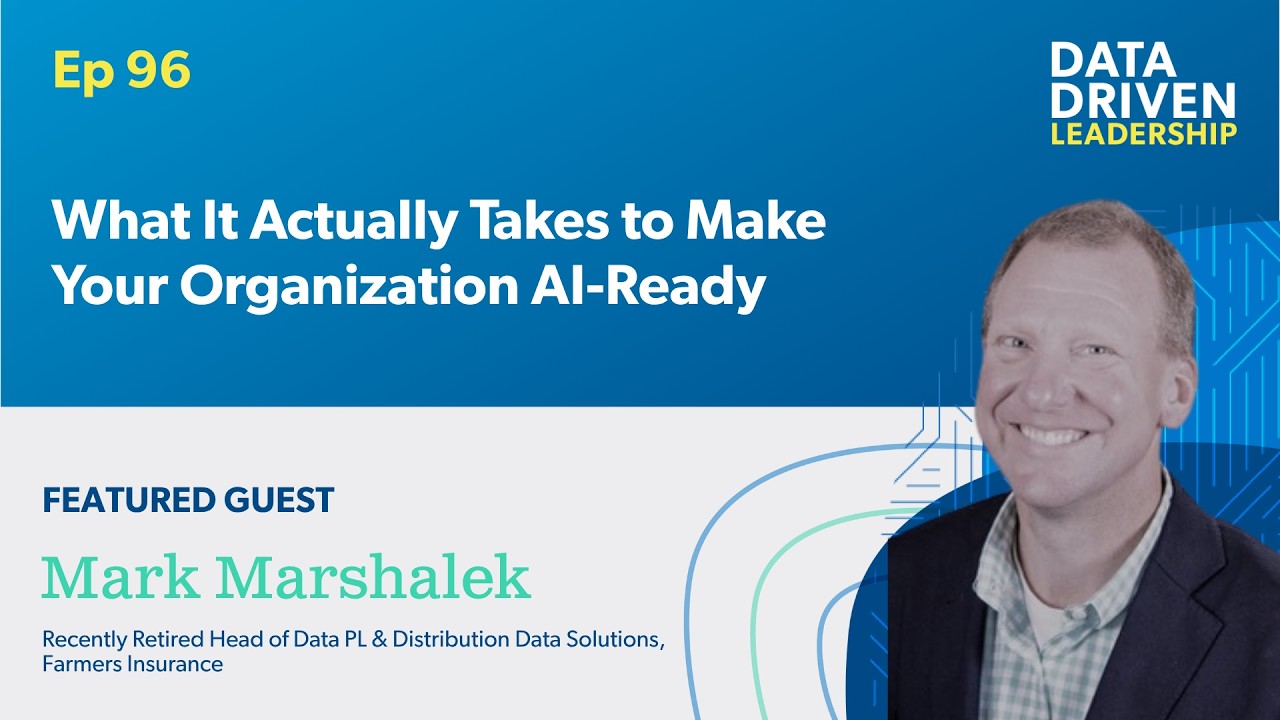
[00:01:46] Welcome back to Data-Driven Leadership. I'm your host, Jess Carter. Today, we have Mark Marshalek, the recently retired head of data PL and distribution data solutions at Farmers Insurance and senior lecturer at the Ohio State University.
[00:02:00] Let's get into it, Mark. Welcome.
[00:02:02] Mark Marshalek: Thank you. I look forward to the discussion. I'm very excited.
[00:02:05] Jess Carter: as a daughter of a Cincinnati–Hamilton–born-and-raised-dad, I have to say, O-H.
[00:02:13] Mark Marshalek: I-O!
[00:02:14] Jess Carter: That's right. That's right. Are you from Ohio?
[00:02:16] Mark Marshalek: I am born and raised, and have always been a fan of Ohio State.
[00:02:20] Jess Carter: Okay. That's awesome. My brother is, he just finished his freshman year at Cincinnati and loved it. And so we're just… we're in Indiana, but we just scoot over across the border and hang out, I guess.
[00:02:30] Mark Marshalek: you know, Cincinnati is another great institution. My wife and I love getting down there. It's a great city. It's a great college. We've got a lot of good programs.
[00:02:38] Jess Carter: You do. You do. That's right. Well, so I want to get into... There's so many topics we wanna talk about, and so I'm gonna do my best, but I reserve the right to wanna talk to you again. But I'm actually really excited about this, the data governance. And the reason I say that, I'm not gonna be offended if you haven't listened to 90 episodes of this podcast we've already had. Data governance comes up a ton, Mark, and I just feel like it's constantly in the eye of the beholder. Like, with project management, there's, like, the PMBOK and there's a methodology or you have SAFe Agile training or you have these frameworks and there are some frameworks to governance, but I just feel like, maybe I'm just not close enough to it, but I would love to hear. You have 25 years in insurance. A lot of that work, you know, you landed in the governance world. I just would like to hear a little bit about it.
[00:03:27] Mark Marshalek: Yeah. To be honest with you, I'm excited about where governance is going with this whole AI movement that we have going on. I'm sure we're gonna touch on that topic.
[00:03:37] Governance is resurging as a key capability. And what I love about it is people are finally starting to realize it's not just a governance person that's accountable for executing on the frameworks, the practices, the standards. Everybody plays a part. If you were to look at what I talk about in when I was at Farmers,
[00:03:57] the first thing I had in any messaging that I sent out is everybody plays a part. You just need to help, help in the role that you're playing, and my job is to make that connection with you.
[00:04:08] And yes, there are so many frameworks that are out there, so many processes.
[00:04:12] what I like about that, I can hit the core areas that I need to, but I can do it in a way that's meaningful to the organization. And so it's great. I actually like the fact that we don't have necessarily a tried and true framework that we need to all align to, cause I think it allows me that flexibility, okay, I know this is gonna resonate with my senior leaders and my frontline associates that are doing the work. Let me tweak some of that messaging and some of those processes so I can make it resonate with them. But...
[00:04:42] Jess Carter: Maybe that's like the beauty of governance is it can't be…I say this as a consultant. It kind of constantly has to be customized. It's always dependent on your business, your assets, your value, the current state of the data quality. And so it kind of can't just, it can't be under-engineered. It can certainly be over-engineered.
[00:05:01] Mark Marshalek: so much of that over-engineering is what gave us a bad name.
[00:05:04] Jess Carter: That's right.
[00:05:05] Mark Marshalek: In the historical, "Oh my gosh, you're adding bureaucracy." I just sit there and I'm like, "Well, it's not really bureaucracy that we're adding. It's necessary steps."
[00:05:15] Jess Carter: Right.
[00:05:16] Mark Marshalek: We probably didn't convey it in the right way or give the right process to properly adopt.
[00:05:23] What I love about the job, and, you know, you hear “data governance,” and everybody's like, "Ugh, it's bureaucracy." Number one, we got AI coming, so now we need better data.
[00:05:30] Jess Carter: That's right.
[00:05:31] Mark Marshalek: Number two, my job and the way I see my role, it's not necessarily doing all the technical things, but helping the people see here's what you can do to support our journey. So it's more change management. It's more communication. It's more aligning people to, "This is what I need. How can you help me get there, with the work that you're doing?"
[00:05:52] Jess Carter: Okay. This is…I'm not…I refuse to fast-forward this conversation because there's a… You're saying these things as if it's borderline obvious, and I think it's…I really think it's not, Mark. Like, I think, okay, I'm a trained project manager…
[00:06:07] Mark Marshalek: Yeah.
[00:06:08] Jess Carter: And if you're not doing that as a service, like that's the value you create. I've done that. I've also done it for big custom technical solutions or products. And in those worlds, you're not innately the value. You generate the value.
[00:06:22] And so I have been the value. I have also been a functional contributor to generate the value.
[00:06:29] I feel like governance struggles because it's not inherently ever the value, and your OCM piece is you're helping people understand why it's value. If you value AI, you need quality data at a level of sophistication in which you can use it reliably to trust on the outcomes and make good decisions for your business, right?
But I, I think to your point about, you know, like the over-engineering gave us a bad rap, I think there are people who get really excited about it and, and they are good at patterns, they are good at order, and that's really, that's a great person to be in charge. But there's like this coaching of to meet the needs of the business, not just to have an orderly dataset, right?
[00:07:08] Mark Marshalek: I think the shift in the world that we're seeing today is that the folks that would just be there programming, coding, and doing the data work, those individuals, unless they know the business, unless they know what's going on in, the organization that they're operating, they're not nearly as valuable as that person that can not only program or build a pipeline, but also understand I'm building towards this outcome and building something that's gonna create a product that can be reused on an ongoing basis.
[00:07:40] I think the world has shifted where it's no longer a check-the-box mentality, but now I need to understand the business. I need to be fluid in my thinking. And some people in that old mindset struggle with that. "Just tell me what I need to build, and I'll code it." Well, that's not...
You need to understand what you're building, too, so that you can take the right steps during that process. And that fluidity, I think, is, in my opinion, that's one of the skills that's gonna be needed for the workforce of the future. They need to be fluid. They need to understand the business. They need to be curious. They can't just go back and fall on what they've done in the past.
[00:08:20] Jess Carter: That's right. Well, and there's this, to your point about fluidity, agility, holding things loosely. And it's really difficult in this space, because I think people who are good at governance tend to be analysts, engineers, architects who are really good at that order. And then there's this innate frustration when leadership is asking them to pivot, and they're nine months into a ten-month project, and are we scrapping it? Is it worth nothing now?
And so I feel like, I don't know if you have any smart insights about if you're, if you find yourself working in governance, and maybe I'm wrong. In my head, the leadership around you that's supporting you and tying the governance work to the business value is of utmost importance, table stakes.
[00:08:59] Mark Marshalek: It is the most critical component of any successful governance program. And in fact, you know, my governance program when I've been working through it, it's not just managing and giving the folks that are doing the work the knowledge of what's needed in order for us to be effective, but it's really also sharing that information in a way that resonates with senior, "Here's what you're getting," as that outcome that you referred to.
[00:09:23] And so as a governance leader, you're really playing… you're kind of managing execution and the leadership because one question that I always get from senior leaders, "Well, tell me the ROI. Tell me the ROI of data governance." And I just sit there and I'm like, "Oh my God. Well, you tell me the ROI of you getting out of bed."
[00:09:41] Jess Carter: Right.
[00:09:42] Mark Marshalek: And well, I don't. There's no ROI. There is an ROI. You would not be doing your work if you didn't get out of bed, so how do you put, how do you put a price on those foundational items? That's that nut that I have not figured out how to crack in order to make it easier to convey that buy-in going forward.
[00:10:02] Jess Carter: I mean, okay, let's do a thought experiment where you and I…let's attempt to crack the nut that you, that we're saying we've never cracked, together. 'Cause, it's a reasonable question. As a leader, it's on your P&L, it's a cost to your business. It needs to be tied to an outcome, and I understand that. I don't think it's a value proposition that you can…it's not like margin. It's not like at the end of your month, here's your margin, it's killing it.
[00:10:25] Like, there's like a long-term asset value to it that is more about the directionality of your business, the trustworthiness of your data. But if a CEO is like, "Jess, there's got to be a reasonable..." Like, is there a percentage spend you'd expect to spend? Or like how much is too much?
[00:10:41] Mark Marshalek: And see, that's once again, where do you draw those lines? It is so dependent on the industry. It's so dependent on the type of data. It's… there are so many factors that go into that. The way I've been framing it now, and it's not an ROI, you know, it's not a here's that percentage, but what I try to convey to them is the timeliness of decisions.
[00:11:03] Do you wanna make quick decisions? Yes, I absolutely want that. You need to have properly governed data so that it's feeding into your dashboards, and you can take confidence in the accuracy of the information being presented to you. You'll make quicker decisions. Do you like that?
Or do you like, "Hey Mark, I've got this number on this dashboard showing me revenue, and I've got this number on this dashboard. Why are they different? And oh, by the way, they're vastly different."
[00:11:29] Jess Carter: Right.
[00:11:31] Mark Marshalek: Usually there's legitimate reasons for why there are differences, but it's that terrible discipline in calling something the right thing or the thing that it is instead of defaulting to, well, this is just easy for me to call it.
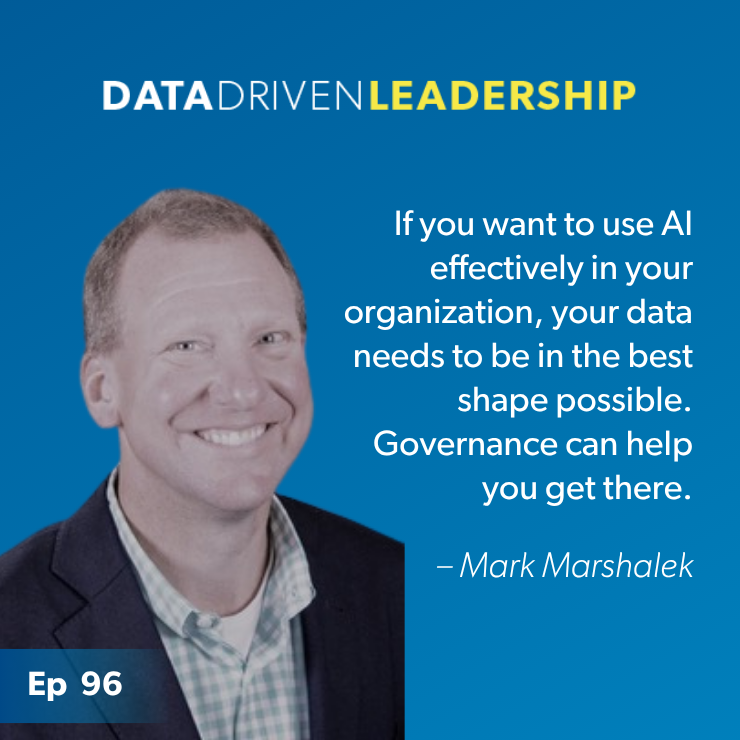
[00:11:48] And with AI, once again, getting back, we'll get there. With AI, I think it's even, if you want to use AI effectively in our organization, your data needs to be… do you want hallucinations? Do you want errors? Your data needs to be in the best shape possible going forward.
[00:12:08] Governance can help you, but then also you need to reinforce it's not just Mark doing the governance. It has to spill down through the rest of the organization.
[00:12:18] Jess Carter: That's right. I mean, that's got to be… I imagine that's a hard message right now for people to receive because, and I can release us, we can move on to AI, but which I appreciate you letting me stick there for a minute, 'cause, 'cause where I struggle a bit is I think was a fair point too is, “It depends,” is the answer to that original question because it also, what's the state of your business?
[00:12:37] If you're starting a business, I'm gonna say every time invest in good data quality now because cleaning it up, you'll never want to spend the money later. It's no one wants to spend it and you'll have to. And so it's like just spend the money now and set it up or go ahead and spend the money and clean it up.
[00:12:53] But I do struggle because I'm like when I think about, AI, if you have bad or low-quality data, low-fidelity data, you can't trust it to make an informed decision or to help guide. You can't democratize AI. It's a risk to your business.
[00:13:06] Mark Marshalek: Yeah. A huge risk. Huge. Huge.
[00:13:11] Jess Carter: But then you feel like you have to take two steps backwards to take one step forward and you have this FOMO and everybody else is getting ahead. I mean, I think this is really happening right now.
[00:13:19] Mark Marshalek: I could not agree with you more. And the one thing I would love to do differently with data governance is change the name, and I do hear of individuals changing the name. I actually think, kind of like what you described, new company, you wanna put the right practices in place from the start so you can..you don't have to course-correct problems.
[00:13:38] What I call sins of the past that I'm dealing with in a larger, more mature organization. but it's more... It's not governance that we're talking about, it's data discipline. We wanna be disciplined in how we work, how we manage the soil that our company is building.
[00:13:54] How do we manage that effectively with the right discipline so that we can make it democratized for everybody to use? And it requires you know, in my opinion, a couple things that you need to make sure people are applying the right practices as they're building it,
[00:14:09] Jess Carter: Yeah.
[00:14:14] Mark Marshalek: But then you also need to make sure the people consuming it have the right understanding and literacy so that they're not necessarily using it in ways that shouldn't, it should never be considered for.
[00:14:21] So it's nice, and I think all of that follows in that data discipline, that data governance space called, you know, call it that in the old. bBut data discipline is table stakes now based on where we are, with respect to the maturity of some of these capabilities out there.
[00:14:36] Jess Carter: Oh, a hundred percent. And, then, you know, so I think about you have a such an interesting vantage point because, like, you were at Farmers, how long were you at Farmers?
[00:14:45] Mark Marshalek: So I was at Farmers five years, but I was at Nationwide Insurance for over 25 years.
[00:14:52] Jess Carter: And did you guys have... Like, can you walk me through, as governance, you know, your experience working with governance and then AI? I mean, this is just, to me, this is a really exciting time for your career to go through all of these like, these things are coming out, and you're watching them develop and change, and now it's just exciting.
[00:15:09] Mark Marshalek: I love the time we are in. Number one, governance is becoming the new best friend of every organization out there, so it's nice to see people now interested again in doing the right thing in order to make dat, available at a high level of quality. It's nice to, it's refreshing to see that.
[00:15:27] I also think that where we are sitting, the demands of our workforce are gonna be completely different than what they were in the past, and I feel like we're in this pivot. We are in this pivot that I'm just... And I know when I had my team, I'm just hoping I can make my team ready to absorb, absorb this pivot.
And it's not just them, it's me as a leader that has to look at things different. And I was talking to someone today, and we talked about, how do we get people more comfortable with leveraging AI? Me as a leader, I have to be asking my folks, "Are you using it?" You know, "Hey, you're having this problem creating this semantic layer. What did AI, what did, you know, ChatGPT, Copilot," whatever technology is your tool of preference, "what did it come back with?"
[00:16:15] "Oh, Mark, I haven't used it." Well, I'm not gonna give you an answer till you come back with that answer for me. And getting them to think that way beyond “It's not taking your job.”
[00:16:26] In my opinion, it's gonna take away the tasks that add...they're burdensome and not a lot of value. I'm gonna get more from you with your thought leadership when AI comes in and helps with taking away some of those manual tasks that you have.
[00:16:41] Jess Carter: Yeah. Well, so, okay, this is so interesting to me for so many reasons. Okay, where to begin? so I just spent the last five months working with one predominantly, one university, but our team worked with about five or six different universities in Indiana helping them with their AI readiness.
[00:17:03] And it has been fascinating because you have these stakeholders, you've got some faculty are like, "You gotta do it, you gotta get in there, you gotta use it." Some faculty are like, "Not in my house." And you've got these students that are like, "Uh, I don't..." And so we had this really interesting…
[00:17:22] In Indiana, the Lilly Endowment had released these funds for, that were non-competitive for each university to really put together their AI strategy for, the universities from the president's office. So back to our, the beginning of our conversation, lead from the front, and I thought that was really neat. And it's hard and complicated because you also have tenured faculty, and you have students, and you have non-tenured, and you've got staff and admin who are really excited about the ability to think more deeply and not just do some of the rote.
[00:17:47] But like, Mark, it's like this moment in time is so interesting, and I was sit... I have to tell you this. I was sitting in this workshop, and these students were at one table. We were doing like an OCM thing. Faculty were across the room, staff were over here, and the students were so respectful, but they were like, "Hey, respectfully, we are getting on-calls for internships and jobs, and they're not asking about my major. They're not asking about my minor, my coursework. They wanna know how I've used AI. And we're two years behind. Like I don't, I haven't, 'cause I didn't know if I was allowed, and I was worried about doing the wrong thing.”
[00:18:23] Mark Marshalek: Oh, it breaks my heart to hear that because I do think if students aren't working with that technology today and universities embracing how can we incorporate, I think everybody's kind of working their way through this whole…universities that can help individuals see the power of these solutions, that's the one that I wanna go to because I know they're gonna position me for a job in the future.
[00:18:46] Jess Carter: That's right. That's right. And thank goodness for, for these funds and for this ability to say, "Hey, how do we figure this out?" And I'm seeing states, um, I think, um, oh, who is it? There's a university, um, Jen Shoemaker has been, she has a whole Substack she's posted about. She's the provost of, oh, it'll come to me. But she has a Substack of the last year and a half of her taking that university through their journey and just publishing it, being like, "Learn from me. Don't spend money doing this. Like, if this is helpful, I'm gonna make it totally public and be totally transparent. Here's what we did that worked. Here's what we did that didn't. We totally screwed this up."
[00:19:22] But I'm really excited about universities trying to wrap their arms around how do we help students prepare? Because to your
[00:19:28] point, you gotta-- this is not where you're gonna go get a degree and be this thing forever. You have to be agile. You have to learn how to be adaptable to the market's needs. That's what we have to train you in.
[00:19:39] Mark Marshalek: And the nice thing about generative AI solutions that are out there, it can help you with that reinvention. You're not starting from ground zero with having to go back to a university for a four-year degree.
[00:19:52] You can start to lay out a plan with the assistance of AI. And I still go back to here in Columbus, where I'm based out of, Nationwide Insurance just put up a one point five billion dollar financial commitment to AI.
[00:20:06] Jess Carter: Wow.
[00:20:08] Mark Marshalek: I sit there, and so I talk to people at Nationwide, and they're like, "Yeah, we've got the money, great. We need the people and the bodies.”
[00:20:17] And I sit there at a university going, what better way to get your folks from school, you know, graduate them into the workforce? Give them the skills because that's where the investment dollars are going right now.
[00:20:29] That seems like a huge, you know, eye-opening wake-up call. This is where you need to be, and this is what you need to do in order to get these folks ready. I'm excited about how this tool can help with people reinventing their careers more frequently.
[00:20:44] Jess Carter: Yeah. I mean, I agree with you. I don't know, and I really appreciate your, I don't think people know how challenging your question is of, “how are you using it?” Everyone's talking about it. There's this ethereal conversation, and I'm like, "How are you using it?"
[00:20:59] And every time that happens, it's like they're at least fifty percent of the people are like, "Ugh, I..." And I'm like, "Guys, we got-- Put your fingers on a keyboard
[00:21:07] Mark Marshalek: And have fun. I mean, a lot of people are scared of it, and I get it. But man alive, the questions you can ask, the things that you can do. I know when I was at Farmers, one of the things I assisted with was managing our data and analytic community at the enterprise level. So it was about 300 people, and I would be making posts in our internal like, Facebook site.
[00:21:31] I'd be making… I'd have AI, "Hey, I need a weekly post for this data and analytic community. This is what I'd like it to be. Here's the, you know, skill level and audience I'm targeting. What's a good post?" And the best one, the best one that I ever…at the holidays, I'm like, "Make it, you know, holiday-oriented."
[00:21:48] And so it came back, why don't you give them a prompt for whether or not Santa Claus can make it in a day to deliver all those presents?" And I'm like, "Oh, that's kind of cool." And then it, I gave the prompt in such a way that it gave the mathematical algorithms that,
[00:22:06] Jess Carter: Oh, cool.
[00:22:07] Mark Marshalek: And my leader, who I love the guy, he's still one of the best individuals I've ever worked for in my life, and I'll say that to my grave. My leader even did it, and he's like, "Here's what I got." and we were bantering back and forth. So he's like the epitome of somebody, hey, he's the one trying this stuff, and he's out there being in, leading from the front, like you had said. And it was just that's what people need to be doing in order to have some fun.
[00:22:34] You know, conversations with family. You can start, "Hey, help me understand, this is my family. They're a family of three. I want topics that are fun, exciting, and see what it comes back with." And then you can leverage those to have a great conversation as a family.
[00:22:50] Jess Carter: I am gonna geek out and tell you…can I tell you some of my favorite ways I've been using it? Is that okay?
[00:22:55] Mark Marshalek: Yep, I'm excited. I want to hear this.
[00:22:59] Jess Carter: I so deeply enjoy talking to you, Mark. So, okay. Let me…I won't do a bunch of them, but here's... So one is, I tell it that it's my 20-year veteran, functional organizer. So not just like a, not a designer, not an organizer, but functional, how I need my life to work because of how I live my life. And I have a five-year-old and a seven-year-old, so I'll be like, "Why is my mudroom always a disaster?" And it'll be like, "It's not actually your husband's fault. It's because his cubby becomes the place where your mail goes when you're hosting, and where all these other things kind of don't have a home, so you need..." And it's right.
And it's like, "Do you reset the mudroom on Sundays? You need to take the all the shoes but two pairs of backups." And I'm like, I've been doing it for six weeks. The house is clean. Mark, it's working." Or I used it for our kids, we built this workshop upstairs because of AI. I have again, five and seven And I'm like, I'm fighting the, waging the war on screen time, and we just made this whole craft workshop upstairs, and it's got beads, and it's got a cardboard cutter, and it's got a hot glue gun.
[00:24:00] And AI has taught me how to sew. Like, I now know how to sew. I know how to embroider because of AI. It taught me how to use my sewing machine. It was in my basement collecting dust for ten years. And I made an apron, and the first day I pulled it out, I made an apron for my son that was Mickey Mouse.
[00:24:15] I mean, this is like, it feels like democratized knowledge at our fingertips. It feels like a superpower.
[00:24:21] Mark Marshalek: It is absolutely a superpower. And, once again, how much of an effort did it take you to... next to nothing. Next to nothing, and you had the power of that technology improving your life.
[00:24:33] Jess Carter: Yeah.
[00:24:33] Mark Marshalek: The opportunities are incredible for people if they just get out there and start tinkering around.
[00:24:40] Which, once again, I think, you know, if, if there's... Getting back to the students, the more you can give those students curiosity and have them asking questions, their minds... I love the young mind. It asks so many questions. It's always trying to stitch together the world, and that's a fun and ener- it can be tiring. I've got... So you have two, I've got four on the other end, our youngest is 21.
[00:25:07] Jess Carter: Okay.
[00:25:08] Mark Marshalek: And I just sit there and the, questions they ask, and then, "Huh, I don't know the answer, but let me do this real quick in, you know, in Claude," which is what I use. Not pr- pushing one or the other.
[00:25:20] Jess Carter: Yeah.
[00:25:21] Mark Marshalek: And it's coming back with these answers and I'm like, wow, that took me next to no time to position myself to have a better conversation.
[00:25:28] Jess Carter: Right.
[00:25:28] Mark Marshalek: It's a scary time, don't get me wrong, especially, you know, you've got employees that are 30, 40. You know, for me, I was in insurance for 35 years, seen a lot of change. I know that I would be a little nervous if I was unsure of what's going to happen.
[00:25:42] At the end of the day, it's about your willingness to say, "You know what? I'm gonna look bad. I may make a mistake or two. That's okay. Let me move forward."
[00:25:52] Jess Carter: That's right. Oh my gosh. I feel, I do feel, to your point, some empathy for, you know, I've been in tech consulting for 12 years. This was just going to happen. It's not like I was gonna stand back and let it go by. But there's…I do have empathy for people who maybe aren't in tech, who don't understand it, who aren't as comfortable to be like, hey, to your point, this gives you a chance to learn something new again.
[00:26:15] And the invitation is to just, just play a bit. Just play. Don't be afraid of it. Don't fear it. Give it a shot, 'cause I think to your point, everybody has stuff they're avoiding getting to that's probably really important. Just start there. Start with the stuff you don't want to do anyway. You know what I mean?
[00:26:31] Mark Marshalek: And see where it takes you because you, because as long as you have that curious mindset, you start and, you know, you may start with it giving you information on how to change a mudroom, but it may take you into the planning your vacation, your European vacation for eight days at these locations, hitting these sites.
[00:26:49] you just start and then your wandering through the technology will take you to some very interesting places.
[00:26:55] Jess Carter: Right. That's right. But knowing that we need to wrap up pretty soon, one of the things I'm curious, so you spent all this time in insurance. Pretty regulated, right? Isn't that fair?
[00:27:06] Mark Marshalek: Oh, highly regulated.
[00:27:07] Jess Carter: Highly. Okay. Do you think that's a harder environment for AI to take root?
[00:27:14] Mark Marshalek: For certain tasks, it will be very difficult to enable some of the adoption of AI. For example, I don't think it's hard for us to get AI in to help be more productive as individuals.
[00:27:27] I think that is ripe for the picking and something that we can do right now. I think if you start to take AI into any of our pricing work, that's one there has to be an extra level of scrutiny.
There have to be a lot more reviews through the various committees that are out there in order to make sure that you're not doing something that might introduce bias, some discrimination. You just…we have to be…there are certain use cases, absolutely, I think it's gonna take shape and it's gonna be adopted.
[00:28:01] Some of those other ones will probably be a little more slow, a little more mindful of how we enable those in the ecosystem. And primarily because, number one, we don't wanna hurt in any way, shape, or form our customers. That is our number one priority is to make sure they're taken care of. And to do something unintentionally 'cause we just didn't fully appreciate the technology, we don't want that.
[00:28:21] So we have the right governance model in place that reviews those situations to make sure, "Yeah, let's go ahead and pursue this one. Eh, let's hold off or let's research, but let's pump the brakes on going forward with a full rollout or deployment.
[00:28:37] Jess Carter: Yeah. Put your toe in the water. I mean, I did about 10 years in public sector, like state agency. So a lot of PII, a lot of protected data, and again, I think in this season, and I think the age of your children, it's like as they enter the workforce, encouraging them when they don't have a cybersecurity degree to be like, "Hey, you don't just grab an extract of PII and drop it into AI." Like, let's, uh, to generative AI. Like, careful.
[00:29:02] Mark Marshalek: Oh, once again, pump the brake. Let's pump the brakes on that one.
[00:29:07] It is interesting, and I've had some conversations with other, with other organizations that are looking to adopt AI practices, and always the first question, you know, what's the level of knowledge? Oh, well, they've never used it.
[00:29:18] We've never, we don't even have an approved technology in here. Okay, well, that's red flag number one. You need to figure that out first so that you can make sure that you have the right guardrails around the technology. Number two, you need to make sure people are educated on what should you do, what shouldn't you do, and that sensitive information, anything strategic that you don't want out there exposed to the rest of the world, you need to be very mindful of what should you upload into these AI technologies.
[00:29:45] And I think we can always do a better job kind of educating those individuals.
[00:29:49] Jess Carter: Yeah. Well, and I think it's hard right now because there is that fear, in some people who are resisting, and so you want to be like, "Don't be afraid," but also be mindful. I like your phrase of be mindful. Be thoughtful aboutit. Cause some people, I see them get, they finally get comfortable with it, and I'm like, "Well, you still need to stop and check."
[00:30:05] Mark Marshalek: Yeah, I could not agree more... in addition to working in insurance, I have a CPA, and we always... you’ve got to apply a certain level of professional skepticism. You know, you’ve got to, "Oh, should I put that out? Let me think about that." And AI and leveraging it in ways you can't ever take away that level of professional skepticism that you have to apply.
[00:30:24] Jess Carter: Yeah. Oh, man. Okay. Mark, I'm so enjoying your energy. Before we leave, let me ask one more question. Okay. You have this passion for the next generation. I hear it in your voice, I hear it in your energy. I kind of am curious if you were to give, like, one piece of advice for them as they're embracing 2026 some of them are graduating right about now, starting their fir- first full-time job around AI, around governance. What's advice you're giving your kids? What's advice you're giving students? You know, what do you think they need to hear?
[00:30:53] Mark Marshalek: First and foremost, and I've kind of said this throughout our conversation, but stay… you got to be, you got to be curious. If you're not a curious individual in today's world, you're, you're not…and I hate to say it, and I always am brutally honest. You got to be curious. If you're not curious, you're going to be outdated. So first and foremost, stay curious.
[00:31:14] Second piece, and I say this to my team, and my team when I was retiring called this out, “What's on your development plan? If you have curiosity, what are you doing to make yourself better with the tools that are out there today?” I have a general rule: two hours a week, you got to have at least two hours that you devote to some sort of education, some sort of, "This makes me a little bit better."
Jess Carter: I love that.
[00:31:38] Mark Marshalek: They hate that. They hate it. They're like, "Oh, Mark, two hours? That's so long.” Like, two hours, that's like nothing. That's a TV show. It's nothing. And I'm like, "You're gonna thank me when these technologies come. If you've stayed on top of them, you're gonna be ready." And the last thing that I always tell everybody is be flexible. There's no perfect answer that's out there. There's only the right answer for the situation you're in, and you have to be flexible. I made a decision, I'm moving this direction. Ooh, I need to tweak here. Okay, you're flexible, you're gonna...
[00:32:14] You know the trigger that occurred. Let's go ahead and find a way to pivot. And those are the three things when I'm interviewing a lot of folks coming out of college especially, And notice it's not, "Hey, tell me about your Python skills." It, you know, "How much, how much knowledge do you have on SQL?" I can, I can tell you they can figure those out leveraging AI. I need to know, are you gonna be curious? Are you gonna be learning and continuing to evolve? And are you gonna be flexible? Are you gonna be, "I got to go this route"? Those are the things I feel are most important from, uh, folks today.
[00:32:46] Jess Carter: I'm so excited about this next generation because that isn't what we were told. We weren't told to be curious. We weren't…I mean, some, but like, it was like, "Get in, play your role. You're the bottom of the rung. You need to climb your..." There's a little bit of an invitation for this whole career thing to be so much more playful.
[00:33:06] Mark Marshalek: In my opinion, I think they're gonna have a better work-life balance and relationship than we've seen, 'cause I've come from that mindset…head down. Head down, don't cause problems, just do what you're told and move forward.
[00:33:18] And today, once again, leaders even have to...They have to be different. You know, they have... They're not gonna know the answers.
[00:33:25] They... You'd be amazed at how many CIOs I've talked to that they don't know what this whole AI thing is. They're still figuring it out.
[00:33:33] Jess Carter: Right.
[00:33:34] Mark Marshalek: If they don't know, then I can help shape where they go. I'm not gonna know it all, but I can at least play a part.
[00:33:40] Jess Carter: Yeah. There's that, Patrick Lencioni's, Humble, Hungry, Smart. It's coming back up: humble, hungry, smart.
[00:33:47] Mark Marshalek: I think that we will start to reconnect with those foundational principles that we had before, and they're gonna resonate a lot more now.
[00:33:55] Jess Carter: In these new ways, right?
[00:33:57] Mark Marshalek: Oh, it's exciting. I look forward to it. But but then again, I'm on the tail end of my career, a little bit of a tail end. I've still got some projects that I'm working on, but I’ve got time, but I can't wait to see, I can't wait to see what happens.
[00:34:12] Jess Carter: Well, I'm just excited to be in a world where you are actively engaging in these ways, 'cause this is so exciting. So if people are like me and they want to follow along and see what else you're up to, what's the best way to keep in touch?
[00:34:22] Mark Marshalek: So, most of what I've been doing lately, LinkedIn, I do a lot. So follow me on LinkedIn. I'm getting ready to launch a project that leverages AI for personal reinvention. I'm excited about that.
[00:34:34] Jess Carter: Yeah.
[00:34:35] Mark Marshalek: Nervous, you know, you put yourself out there, you don't know. But I, feel so strongly about how AI can impact lives that I wanna try to make that connection. But LinkedIn, and also on Instagram.
[00:34:48] Jess Carter: Amazing. Okay, we'll add your LinkedIn to the show notes so if people want to follow you, they can find it with ease. Thank you so much for joining us today. This has been lovely.
[00:34:56] Mark Marshalek: Oh, Jess, I reserve the right to come back if ever invited.So just so you know, that's the same promise I give to you.
[00:35:03] Jess Carter: Good. Good. I appreciate it, Mark. Thanks again for joining us.
[00:35:08] Jess Carter: Thank you for listening. I'm your host, Jess Carter. Don't forget to follow the Data-Driven Leadership wherever you get your podcasts, and rate and review, letting us know how these topics are transforming your business.
[00:35:19] We can't wait for you to join us on the next episode.
Insights delivered to your inbox