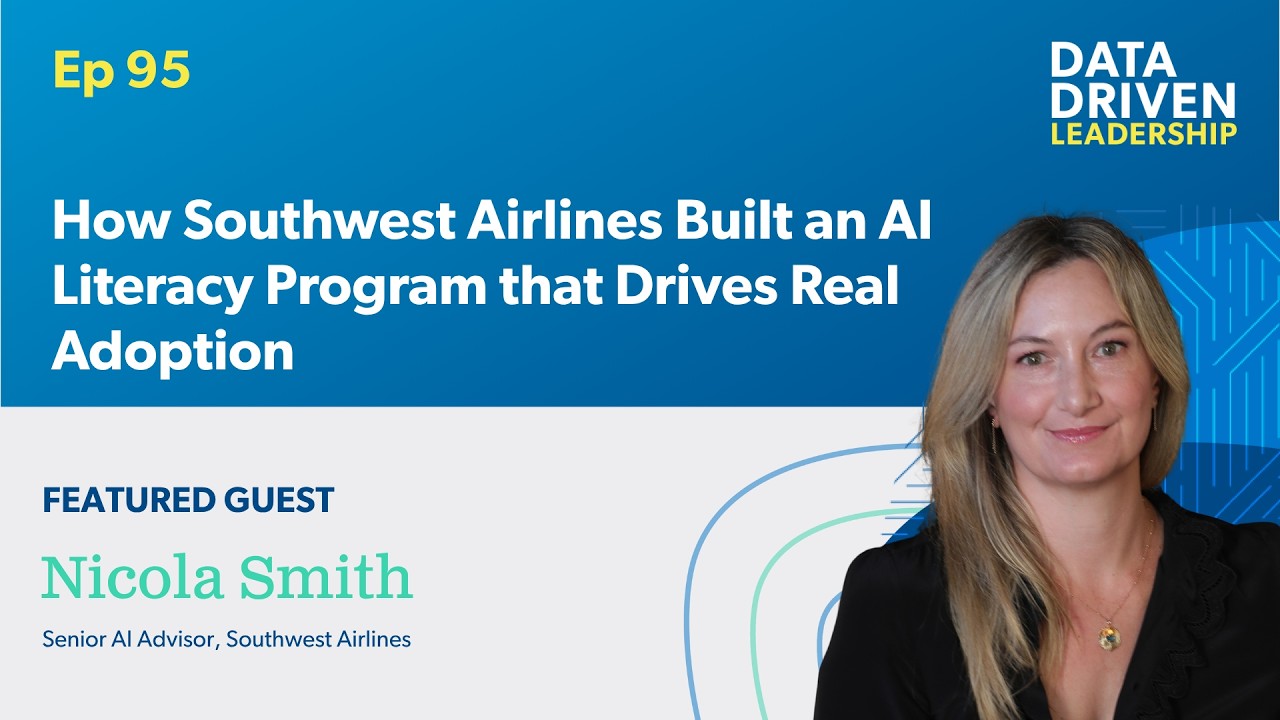
How Southwest Airlines Built an AI Literacy Program That Drives Real Adoption
Listen On




Transcript
This has been generated by AI and optimized by a human.
[00:04]:
The power of data is undeniable and, unharnessed, it's nothing but chaos.
[00:09]:
The amount of data was crazy.
[00:11]:
Can I trust it?
[00:12]:
You will waste money.
[00:14]:
Held together with duct tape.
[00:15]:
Doomed to failure.
Jess Carter [00:16]:
This season, we're solving problems in real time to reveal the art of the possible, making data your ally, using it to lead with confidence and clarity, helping communities and people thrive. This is Data-Driven Leadership, a show by Resultant.
[00:00:33] Jess Carter:
Today on Data-Driven Leadership we are joined by Nicola Smith, senior AI advisor at Southwest Airlines. And yes, this is our third guest from Southwest, but honestly, that does say something.
They're not just talking about AI, they're actively figuring out what it looks like to operationalize it inside one of the largest and most complex organizations and industries in the country. This conversation goes way beyond AI hype. Nicola is not sitting on the outside giving recommendations. She is in the middle of the work, helping teams across the business rethink how they operate, how they make decisions, and how they prepare people for what comes next.
[00:01:10] And that is a completely different challenge than building a strategy deck. We talk a lot in this episode about mindset. We get into why teaching people how to think is becoming just as important as teaching them how to use AI tools, and why organizations that approach AI with curiosity and adaptability are gonna move faster than the ones that operate from a place of fear.
One of my favorite parts of this conversation is how she approaches AI with an abundance mindset. So many organizations are focused on what AI might replace, while she's focused on what it can unlock, how it can expand creativity, improve decision-making, and completely change the way businesses operate when people are willing to lean in.
[00:01:52] If your organization is somewhere in the middle of this right now, which I imagine most of us are, maybe trying to move from experiential to real adoption, trying to get people comfortable with change, or trying to figure out what meaningful AI transformation looks like, this episode is for you. Let's get into it.
[00:02:10] Jess Carter:
Welcome back to Data-Driven Leadership. I'm your host, Jess Carter. Today we have Nicola Smith, senior AI advisor at Southwest Airlines. Let's get into it. Nicola, welcome.
Nicola Smith:
Thank you so much for having me.
Jess Carter:
Absolutely. Well, we had, is it, we had France and Justin on from Southwest and, I think Justin was the one that connected us with you. So questions are kind of like, you are a senior AI advisor at Southwest. also obviously Justin knows you. do you work closely together?
Nicola Smith:
Yeah, Justin is my leader, so I'm lucky enough to report into him and he's, bravely leading our team forward.
Jess Carter:
Awesome. So then help me understand, like what does senior AI advisor mean? What does it look like day-to-day? What is...you said something about enterprise AI strategy in your job description. What's that look like?
[00:03:00] Nicola Smith:
So my role is highly variable. It's different almost every day. I joke that I'm kind of a Swiss Army knife for Justin, that he can kind of deploy against various different initiatives or needs. But a lot of my role is focused on strategy, so supporting Justin and the rest of leadership as we're developing our overarching enterprise strategy for AI.
But also, going in at a department level and helping different functional teams define a vision for their own department for how they want and need to leverage AI, defining an ambition for what that really looks like, and then helping them really build a strategy and a plan for how they get there.
So it's strategy at the high level and then strategy at the department level. And then I also have a background in UX, strategy and design, so I've been helping to build out our AI product strategy capabilities, with a human design lens, basically. So, strategy in multiple forms.
[00:04:16] Jess Carter:
For context, can you give me an example of like, what a product is in your world?
Nicola Smith:
Sure. So, one of the products our team built is called LIAT or the Leading Indicator Alert Tool. It's basically a dashboard for the operational side of the business that is looking at over eight hundred data attributes in real time and is giving the ops side a real-time view into the health of the network.
So that's everything from planes to crew to pilots to customers to bags to each airport, each gate, the weather. And, we're leveraging AI in part to do predictive analysis so that we can actually identify any disruptions to the network up to twenty-four hours in advance. So that allows our ops teams to obviously be more proactive, to try and address any potential issues or to mitigate the actual disruption caused by those issues.
So we're building real, tangible products for the business.
[00:05:25] Jess Carter:
Yeah, and I appreciate you explaining that, 'cause I think for a lot of people, to your point, product can sound a bit ethereal in AI. And you're saying, no, this is really, this is something you can touch, feel, sense, leverage as an asset. ‘Ccause that was gonna be one of my questions too, is, does Southwest decide where to begin on this AI journey?
Were you around for the launch of all of this? And if you're gonna eat the elephant, where did you guys start and why?
Nicola Smith:
So I wasn't around for the launch of it. Really. Justin and the team that was in place were pivotal in building the foundation. I think one of the things that Southwest has done differently, at least from a lot of the conversations I've been having in the market with other folks at other brands, is, again, Justin and team really spent the last few years building a very strong data foundation.
[00:06:17] And that foundation, in partnership with a lot of the other foundational changes that our technology team has implemented, has really given us the ability to move quickly when going and building AI solutions.
We've also built something called the AI Common Platform, which again is, infrastructure, technological infrastructure that allows us to quickly build and deploy AI.
So, we spent a significant amount of time as an organization on that foundational work. The other foundational piece that the team really focused on putting in place, which I think is vital, is a really strong governance practice. And that's something that isn't really spoken about enough, in my opinion.
[00:07:03]
But, again, I think it's one of the reasons that we've been able to do some of the things we've been able to do, is having those guardrails, working in partnership with legal and cybersecurity, and really having a strong sense of, you know, what we can do, what we can't do, what are the risks associated with, building certain solutions in certain parts of the business, and going into that very clear-eyed.
Jess Carter:
Is there a use case at Southwest that has surprised you? Something that you didn't fully anticipate AI would generate value around? Or have you kind of been able, because of the strategic elements, maybe you've kind of anticipated where the value would be?
Nicola Smith:
We've been able to anticipate in broad strokes where the value would be, and we're working in partnership with our people learning and development department and organizational strategy teams. But what we're finding as well, and I think this is indicative of why AI is so different, is many of the most valuable use cases are coming from the bottom up. They're not coming necessarily from a stakeholder who says, oh, here's the primary pain point that we need to go solve for, or, here's where we think kind of the business value is.
[00:08:22] What we're seeing is individuals who are curious figuring out ways to use, especially GenAI tools that are kind of in their hands, in unique and interesting ways. And the ROI comes from taking those use cases and scaling them and formalizing them into your processes and workflows. So again, part of this is really a change management question, right, where it's about changing behavior.
It's so different from any other technology deployment that we've ever encountered because it's not just a software in the way other technologies are. This is an interactive, collaborative thought partner that you can actually go to AI and say, "I am in this role. I do this type of work. How can you help me?" And it can tell you what it could do. And that is an astoundingly different relationship to have with a technology.
[00:09:35] Jess Carter:
Yeah. Just slightly, right? To have a, a relationship of sorts that is, a little bit more humanistic than some people are comfortable. So, that's gonna be my next topic too, so I appreciate you going there, which is talking about AI trust. And I think you have some thoughts about this. But,did you build the Southwest AI Literacy and Fluency Program?
Nicola Smith:
Yes. Yeah. I built out the strategy and am working in partnership with some other members on our team who have operationalized that, and we launched, really at the end of last year, a lot of the tactical components of that program.
Jess Carter:
Was it hard or easy to sell the value proposition of that, in your opinion?
[00:10:14] Nicola Smith:
So I found it easy, but the reason I found it easy is that the way that strategy was built was through strategic collaboration with other parts of the organization. So I didn't build the strategy in a vacuum saying, "Well, you know, I'm in AI and I've done strategy work, and so I'm putting this strategy together and I'm just gonna tell people what we're gonna do."
I actually went out and did working sessions with employee engagement, corporate communications, change management, people learning and development, the talent development team, organizational strategy team, our technology comms team. So I basically went and on an individual and kind of team level, went and engaged those folks to say, "Here's what I'm trying to do. Here's how I think it could work. What role do you want to play? Do you have capacity to play that role?" And by the time I took it to leadership, all of these other groups were already on board and aligned and I think it helped make it easy to say yes, because the groundwork had been laid.
[00:11:30] Jess Carter:
If you launched at the end of last year, are you seeing the value proposition
Nicola Smith:
Oh, yes.
Jess Carter:
That was a quick yes!
Nicola Smith:
A hundred percent.
Jess Carter:
What does that look like?
Nicola Smith: We're seeing massive upticks in usage of our primary GPT tool, which is Copilot. I don't know that I can share numbers, but really significant, month-over-month increases in the number of people using the tool, the frequency with which they're using the tool, and really interesting variety of ways that they're using it. So lots of different use cases that we're seeing.
[00:12:11]
We're also just seeing, you know, through surveys, frankly, even prior to launching a lot of our literacy program, we were seeing that through survey, I want to say it was something like only about forty percent of the workforce at that point had used AI, but almost ninety percent were actually excited about it,
Jess Carter:
Oh, wow.
Nicola Smith:
And thought that it would substantively help their work and help them in their jobs.
So we had a relatively positive perception, at least within our corporate employee group, around what this technology could do for them. So I think that we kind of had that going for us as well, as we had, I think, done a fairly decent job of priming employees to view this as an additive versus, you know, something to be afraid of.
[00:13:05] Jess Carter:
I feel like a year ago, the constant conversation was, "It's coming for your jobs. It's coming for your jobs." And I'm still seeing data coming out today that seems to indicate like earlier career college graduate there is impact, or perceived impact. How do you all combat the fear? 'Cause to your point, it's not like it doesn't exist anywhere. How are you all handling that? Or if you were giving me advice at my organization about how to handle it 'cause it's coming up here, what might you share?
Nicola Smith:
I mean, I think transparency is key. Giving people as much visibility into your plans and your roadmap as possible. I think demystifying the technology itself, it feels like magic, and that can be scary. It feels like it's a replacement for humans. If you actually start to A, understand the underlying technology, but B, engage with it enough, you do start to see some of the limitations.
[00:14:05] You start to see where it's definitively not human. It's just very good at mimicking us. And then I think part of it is we've got to start telling stories about what that positive version of the future could look like. And I think this is true not just about AI, but broadly in the culture. I think we are so locked into dystopian concepts of where we're going that if we don't start to come up with more utopian visions of what is possible, we are destined to end up in dystopia.
So, like, part of that is, like, our job to say, "Here is what a positive version of this future could look like," right? We've got to start telling those narratives. We've got to start telling those stories. And I also think that, like, broadly, to me, there's a really big mindset difference in the way you approach AI.
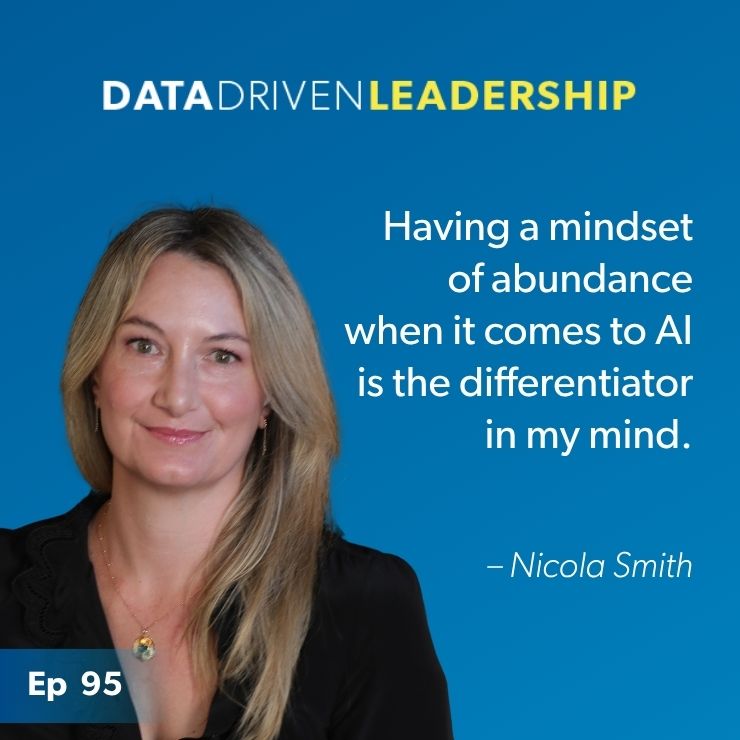
[00:15:02] And I hate to use this terminology 'cause it feels so, like, woo-woo to me. But having a mindset of abundance when it comes to AI is the differentiator in my mind, like at a leadership level, of how afraid your employee population is gonna be. And what I mean by a mindset of abundance is, you could look at your team and say we have three hundred developers right now, right?
We've got three hundred people writing code. A mindset of abundance would be, “We are gonna p- supercharge those folks so that they can do the work of 3,000 developers," right? Or you could say, "Nope, we are going to reduce that workforce of three hundred to thirty, and we're gonna expect them to do the work of three hundred." And those are two very different ways to think about implementing, leveraging, and kinda driving value out of AI.
[00:15:58] Do you want to just cut costs and reduce workforce, or do you want to grow as a business? Because if growth is your goal, then you've gotta have that mindset of abundance, and you've gotta think about it as a mechanism of supercharging the employee workforce that you have. And I think that can remove a lot of the fear, is knowing that leadership is thinking, you know, about growth and doing more with what we have.
[00:16:29] Jess Carter:
Well, this is so interesting that you went there, 'cause I…so Megan Sullivan is the head philosopher over the Delta Network at Notre Dame who's studying AI, and she has this great quote where she says, "Nuclear energy is innately neutral, but we rushed to negative uses."
Nicola Smith:
Yes.
Jess Carter:
All we want to do with AI is begin by thinking about all the good it could do. Yes, there's equity challenges, and yes, there's environmental challenges, and we need to consider the ways that we could use it for the common good.
Nicola Smith:
Yeah.
[00:17:03] Jess Carter:
So I feel like you're in that camp, which I am too. And I also think, you know, you went somewhere interesting too, which is as a consultant, I don't borrow solutions to problems for my clients within their industry.
I really loved a part of my conversation with Francis that I just thought was interesting at Southwest, was borrowing. They didn't try to make airline industry customers' experience better than their competitors. You went and learned from hospitality industry. You learned from who's the best. And as a consultant, that rings true to me. I don't try to solve my clients' problems by making them slightly better than their competitors. I want to go find whatever industry is phenomenal at X and help them innovate. And you can't do that with a constraint mindset. You have to have a mindset of abundance and innovation.
And so I think for me I don't know if this, do I really believe this or am I just saying this to you today in this conversation? I don't know. But I kind of have this hypothesis that what I like about AI is I think it gives people, if they know how to ask the right questions, it gives anyone the ability to be an entrepreneur and an innovator. Because you don't have to have all of these like tools and experiences. You just have to be able to ask the right questions, and you can innovate in your own space. And I was learning a lot about private equity and startups in my previous life, and it was really hard to figure out how the finances of all of those things worked.
[00:18:29] Like how they…you had to find somebody who'd been in investment banking or somebody who'd done private equity M&As forever and ever. I can ask AI and learn all of it like right now, Nicola. Like it just feels like knowledge is in all of our hands as, again, equity is a problem. The challenge is how do you know how to ask the best right questions of it? Does that make sense?
Nicola Smith:
It totally makes sense, and I think, oh my gosh, this opens up so many lines of thought for me. Because to me, one of the biggest challenges that we have right now, least in this country, is I don't think we educate people to be thinkers. Our educational system, it was not set up to create strategists and thinkers. It was set up to create workers who pulled a lever you know, standing at a certain point in the production line, didn't ask questions, were heads down, do what they're told.
[00:19:27] And we've now shifted very quickly into this world where the skills you need are not conformity, they're not doing what you're told, they're not...I mean, sure, still do what you're told at your job, right? But the power users of these new tools are people who are naturally challengers, people who naturally ask questions, people who naturally look outside of their own domain for inspiration and ideas. It's a really interesting challenge because I do think what we ultimately need to teach people to do is how to think differently, and that is a really different challenge than teaching people how to use a technology, Those are not a one-to-one exchange.
But yeah, I think, I think that's one of the biggest challenges we have is our entire education system is not set up to produce people who ask questions. That is not the intent of it as of right now.
[00:20:31] Jess Carter:
I was at a pediatric appointment with my kiddo and there was a sign that said, like, no cellphones, and we didn't have headphones, and she was trying to listen to this, like, educational story and she was so worried about the rules. And I realized I was having to educate my kid on when the rules don't matter. There’s nobody else in the waiting room. You're not harming anyone. You're not harming yourself. And if they ask you to turn it off or stop, we can. But it's interesting that it's, to your point, conformity has kind of become king, and I'm kind of here for some disruption of that.
I'm kind of here for some, just a little bit of rule breaking. There's ethics and morals involved, but I'm kind of like, let's break some rules.
Nicola Smith:
Well, it's interesting 'cause you talk about you know, kind of looking outside of your industry. So a lot of my background is also in challenger brand strategy, which is a very specific type of strategy that is not about your position in the market. It's not about being first or second in the market. It's about having a mentality as an organization where you are willing to challenge and break some of the conventions of your own industry in order to differentiate yourself as a brand, right? So in that type of strategic work, you literally say, "What are the rules of being an airline? What are the things we have to do?"
[00:21:51] Right? And then you say, "Which of these could we challenge?" Right? You're not gonna challenge safety or legal or regulatory stuff, but, frankly, Southwest has always been a challenger brand. It's kind of in our DNA, which is part of what attracted me to working here. But that was the type of strategic work that I actually came out of, was helping brands deliberately and strategically break certain rules or conventions to differentiate themselves.
Jess Carter:
Okay. That's so interesting. The other thing I was gonna ask you about was storytelling. You talk about it being a superpower of yours, which is is obviously true. I can confirm that you are a great storyteller. We talk about this all the time on the podcast, that, like, having the data…to your point, AI can do all the analysis often, and that's not the superpower.
The superpower is how you use that information, what decisions you may make based off of it, what story you're sharing about that data, and if it's accurate and ethical. One of my questions might be, like ,how do you keep the narrative honest and credible while still being inspiring enough to move people? Do you have any tips and tricks if somebody would say this is not their superpower?
[00:23:02] Nicola Smith:
I mean, part of it is thinking about your audience, right? Who are you communicating to? What's important to them? And how do they like to receive information? Because one of the things, especially in an organization like Southwest, it's massive, right? It's over 70,000 employees. And what I learnt pretty quickly by making some mistakes is, for example, our operational teams, they just wanna be told what to do.
They actually, they don't care how you got to the recommendation. They don't wanna see the data. They're busy. They just wanna know, what should we do and when? Okay, great. Our marketing team, they wanna know the whole story. They wanna know what study you did, how many people were involved, how you got there, what was your methodology.
[00:23:53] Like, so part of it is understanding the audience, even thinking through what is that story we're gonna tell, and how do I need to position it and frame it? Again, what do they care about? You know, you've got certain parts of the story you want to tell, but you've gotta understand that your audience may not care about some of those elements. So you've really got to hone in on what does this particular group or these particular folks or this team, what's gonna be relevant to them?
Jess Carter:
Yeah.
Nicola Smith:
And, again, I think transparency. I mean, the reality is with numbers, there's a lot you can do with numbers, right? If you got low numbers, but you show it as a percentage, well, then suddenly that might not look as bad.
So, you can still showcase the reality of it. Again, depends on your audience, depends on how much transparency or how much detail they're gonna expect to go into. And also, what do you hope to leave them with, right? What...if they were gonna leave with one primary message or thought in their mind or thing that they need to go do, what is that? And make sure that is very clear.
[00:25:02]
And then the other thing I would say is, especially coming and being part of a technology team, remove the jargon. Because unless you're speaking to a technical audience, people don't know what tokens are. They don't need to. They don't need to know what MCPs are. They don't...you know, most people who are going to use these tools do not need any technical knowledge about what's happening behind the curtain, it does not serve them to load them with all of that information. It makes it feel scary.
Jess Carter:
Right. I feel like in your…at the very beginning of this conversation, you talked about demystifying it for people. What did you mean by that? 'Cause in my head I was thinking, are you explaining what generative AI is, or are you like, no, that, that doesn't matter for them?
What did you mean by that?
[00:25:53] Nicola Smith:
So certainly, we have like a 101 that we've done. I will often just explain to people it's a language model, right? So it's basically just predicting the next most likely word. That's how it's writing. But more than that, I'll also take terms like prompt engineering. It's the one I pick on the most, and I feel like it is one of the most confusing and biggest misnomers in the industry, because there is nothing engineering about it. It is literally about clear communication.
[00:26:28] And when you say the word engineering, you scare people, right? 'Cause people think I have to have a technical background or an engineering background, or this means math or measurements or something that's beyond me. But if you just tell people a prompt is just clearly communicating with AI what you want and need it to do, pull the tech terms out and let's just replace it with common language that's easy for people to understand.
[00:26:52] Jess Carter:
That makes so much sense. Well, and then I would be remiss if I didn't ask you this, and it's okay if your answer is like, "No, not really," but, right now in 2026, the two things that come to mind when we talk about Southwest are seat selection and bags. Like, those are the big changes in the last year. Has your AI work, have you guys been involved in either analyzing that change initiative, planning, strategic planning around it, change management internally around any of the initiatives or products that probably exist around those two initiatives, or are you guys kind of helping with other things?
Nicola Smith:
Those two initiatives we weren't really working on. I mean, a little bit in the background, touching them here and there. But no, I mean, we've got a full slate of AI-specific projects that we're working on.
[00:27:42] Jess Carter:
It feels like you're building the infrastructure for the rest of the business to buckle up and jump in. Is that fair?
Nicola Smith:
Yeah, we're, we're doing a lot of building the infrastructure. We're also building some very specific new experiences that I can't really speak about yet but that are very exciting and should be coming out in the near term.
So yeah, we're doing a lot of things. It's an exciting time and, you know, frankly, Justin's mandate has been expanded. And so I think as we think about the growth of our team, and kind of where AI is going we're starting to really look at embodied AI, robotics, spatial web and active inference, digital twins. So there is a lot of new stuff coming down the line that falls into our space or is connected to our space in some way.
And I'm a sci-fi nerd, so I'm like, "Yes, bring me all the robots." so like...
[00:28:49] Jess Carter:
I was gonna say, we will have to demystify all of those things in another episode maybe.
Nicola Smith:
Yes, absolutely. Well, as you can tell, I'm passionate about it, and I'm digging in on some of that stuff already.
Jess Carter:
Listen, I'm a big George Orwell fan, but I'm with you on abundance. We need abundance, not fear.
But do love a good utopian/dystopian book. So, let's nerd out, again in the future maybe. Does that sound okay?
Nicola Smith:
Yes, that sounds perfect.
[00:29:11] Jess Carter:
Okay. Is there…before we do go, is there anything else you wanted to make sure we talked about that we haven't?
Nicola Smith:
No, I think we touched on everything.
Jess Carter:
Okay. All right. Well, thank you for joining, and if people want to follow you, the best...is it LinkedIn?
Nicola Smith:
LinkedIn is the best place. I do blog on there, sometimes somewhat contentious topics, mostly related to AI and culture.
Jess Carter:
I love contentious topics. Okay, great. So we'll put a link to your LinkedIn in the show notes so people can find you.
Nicola Smith:
Wonderful. Thank you so much.
Jess Carter:
Yeah, thanks for joining.
Nicola Smith:
Thank you.
Jess Carter:
Thank you guys for listening.
[00:29:45] I'm your host, Jess Carter. Don't forget to follow the Data-Driven Leadership wherever you get your podcasts, and rate and review, letting us know how these data topics are transforming your business. We can't wait for you to join us on the next episode.
Insights delivered to your inbox