



Transcript
This has been generated by AI and optimized by a human.
Jess Carter:
The power of data is undeniable. And unharnessed, it's nothing but chaos.
Show ID:
The amount of data was crazy.
Show ID:
Can I trust it?
Show ID:
You will waste money.
Show ID:
Held together with duct tape.
Show ID:
Doomed to failure.
Jess Carter:
This season we're solving problems in real time to reveal the art of the possible. Making data your ally, using it to lead with confidence and clarity, helping communities and people thrive. This is Data-Driven Leadership, a show by Resultant.
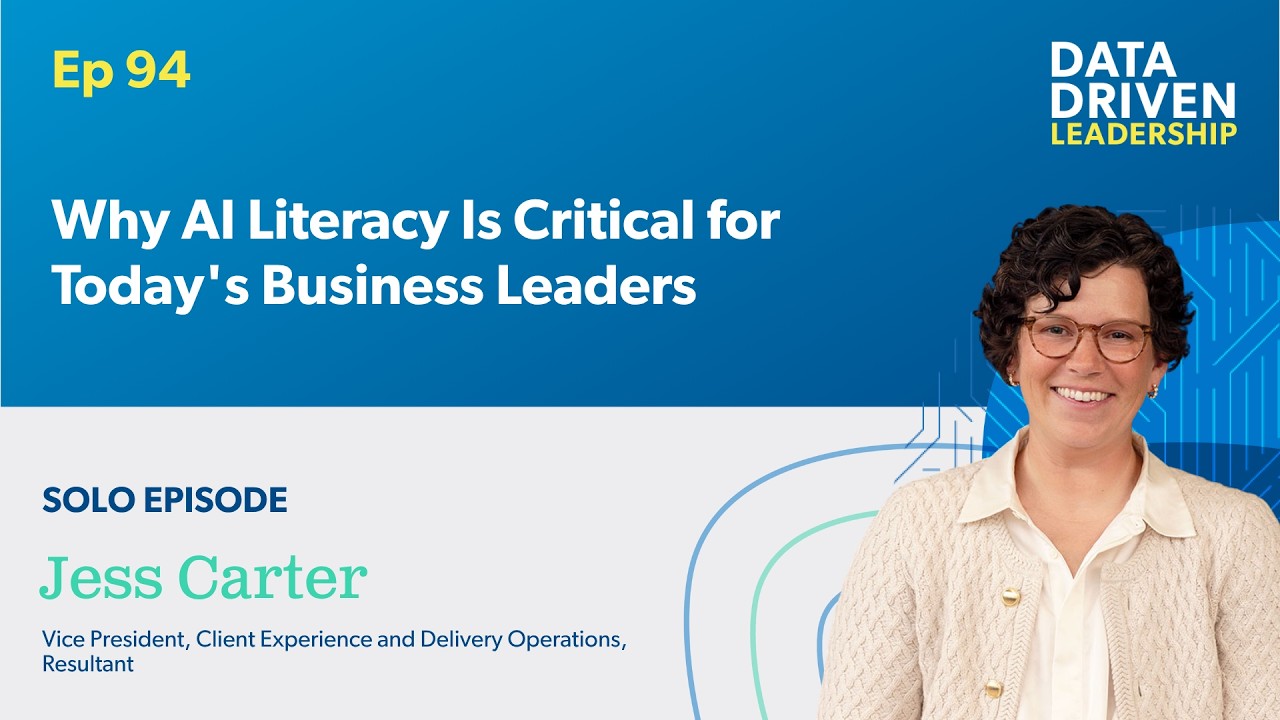
Welcome back to Data-Driven Leadership. I'm your host, Jess Carter. Today, we're doing a solo episode. I wanted to just reflect a bit on some conversations I've been having the last four, maybe five months, and share some things that might be helpful depending on where you sit in the business world. I've spent the last, again, four or five months talking to business leaders, IT leaders, and data leaders. And I have just been fascinated by how similar the conversations end up being.
(01:08):
So I just thought maybe there are some unique industries doing really unique things, in which case you should reach out to us and ask if you can talk about it on our podcast. But in the meantime, I just thought I'm going to share out the themes I'm seeing around what is going on in IT, data, and business that seems like we're all feeling a little bit isolated and alone, and maybe we're less alone than we think.
I've looked under the hood in about ten businesses the last few months, and again, in their tech infrastructure, in their data infrastructure, listening to their business problems. I've talked to businesses that are growing rapidly. I've talked to businesses that are struggling in this market to grow rapidly, and they continue to have really similar themes when we talk about AI. I'm going to talk to my IT friends first, and then I'm going to talk to my business friends, but you should not check out if you're in the other camp because you need each other so badly, because these conversations are so distinctly different when it comes to business friends and my tech and data friends.
(02:16):
So tech and data friends, there are two camps that I'm observing when I talk to my tech and data friends. Camp one are tech and data friends that are super AI-forward. They understand GenAI. They want more access. They want more budget for subscriptions or for licenses or for use cases. And they're having a hard time connecting with their business friends because the gap in data and AI literacy is so wide. So they're talking about these things from a tech point of view or a data point of view. And the business leaders do not understand, often, the value of these things, or when the ROI would come to really hit their books. So a few pieces of advice. If you're in that camp and you are brilliant and you're working super AI-forward, you have to connect the use cases, the licensing that you want in your budget items.
(03:18):
You have to connect those to the business' needs and you need to connect them in a way that is honest about where you really think the ROI is and when you think it would hit. It's one thing to say, if I have all these gen AI licenses and we build an enterprise tool into our tech stack and our infrastructure, everybody will have AI. Great. Is that something you think gives you a competitive edge in your business? If so, how and why? And how soon do you think you need to move in that way? What does it look like to keep up or to fall behind? And I think you need to look at it as if you were a C-level executive that is not a CIO or a CDO and say, how do I connect these value propositions to the business needs in a way that helps them really understand the outcomes?
(04:05):
So I'm not just listing line items in a tech budget that they're unfamiliar with. That's kind of camp one of my tech friends. Camp two of my tech friends are people who do seem to understand the business needs, but they are so used to being capacity constrained that they don't want to spend more time asking for things that they think they're going to be told no about. They don't think that they have the time to even investigate some of these things. They aren't forward themselves in GenAI or in the AI space and it feels overwhelming even to them. And then maybe you have a lot of SaaS products and those products are coming out with AI embedded and you're thinking, "We'll just double down on that. " There are going to be instances where that's fine. That's all you need. You don't have a super tech industry that has to be very tech forward.
(05:05):
I would argue that could also be a competitive advantage if you are in an industry that isn't tech forward to be tech forward. But what I would say is, and I say this often about this, it depends on what the right answer is for you. So it doesn't innately mean you have to go get tech forward. The answer isn't that everyone needs to adopt these things as fast as possible. I think that would be really silly and misuse of a lot of funds that could help a lot of people accomplish their missions and instead it would be a distraction. I think that you, practically, need to find a few friends that you trust either in your industry or in your market or in your neighborhood, people who are using GenAI or AI in interesting ways to help them solve business problems, and you need to get close to that.
(05:48):
I think you need to use these tools themselves. The number one thing I find interesting is when I have these conversations, I think I spend maybe 60 percent of my time, we will talk about the tools. And then when I finally say, "What has it been like for you to use them? What's your level, personally, of sophistication?" The range is wild. People who are deeply embedded and using these tools all the time, often people who are talking about them without having leveraged them themselves. Prompt engineering is a necessary skill. It's funny to be a podcast host right now. My husband had this light bulb moment the other day where he was like, "Oh, I get why AI has felt like a superpower for you. " And so I'm gloating in a weird way that I hope doesn't sound egotistical in any way, because I didn't realize this either.
(06:42):
He's like, "You're not an information expert. You are really good at asking questions." So having democratized access to information where all I have to do is be able to ask the right questions has felt like a superpower. I feel like somebody grabbed me a cape and handed it to me when I started using AI. And he's like, "It's because you're really good at asking questions.” So, how do we help other people around us, including ourselves, just get really good at asking questions and building great prompts?
That's going to help unlock our own opinions, which should be part of this conversation. So for that second camp in the IT world, I would encourage you to use the tools, develop opinions about the tools, and have advisors around you that you're open and willing to learn from to say, there's so many different places in society right now where I see workshops and trainings and chats in IT communities about how people are using AI in finance or in marketing and sales, what are the SaaS tools doing?
(07:40):
Get engaged and develop your own opinions, but have some advisors around you so you can start to chip away at this without it feeling overwhelming, distracting, daunting. You should be able to chip away at this. So for my IT friends, tying it back to the business, understanding the business need, appropriately level-setting your asks in your budget for these tools to accomplish the things the business needs and getting comfortable yourself with what they are and how you think you ought to use them. Those are going to be really valuable pieces of or themes I'm hearing come up in conversation.
The business friends, it's a very different conversation because again, there's a range of business friends who are using AI, and in some cases more sophisticatedly than their IT teams, which is so interesting. My big piece of advice is, again, having access to play a bit in your budget, like let's try some tools, but let's start to narrow quickly on value propositions and what we keep spending money on is a good piece of advice.
(08:40):
Go quickly, fail fast, and be precise in the things you're learning so you can document value proposition alongside your use cases when you're asking for budget. I also think understanding that one instance of a GenAI tool is one instance of a GenAI tool. So when you hear friends talking about how they're using a GenAI tool in their business, they may not have an enterprise license. They may have an enterprise license. So they might be doing something really cool and you're like, "Well, why can't I ask it to tell me to generate insights off my Tableau dashboard with a link and instead it says it doesn't have access?" Well, that's because you maybe don't have an enterprise license. So these tools and the way they're implemented matters in order to understand what information it already has access to and what information you have to feed it to generate access.
(09:31):
And if you're going to feed it your P&L, or you're going to feed it anything that has sensitive data in it, you need to be very aligned with your business's protocols on security for clients, for patients, for students, and make sure that you are not putting critical information into a GenAI tool that is not behind some kind of protected infrastructure.
(09:56):
Speaking of AI, everybody's feeling the pressure right now. Your IT team team gets it. The business is asking for it. A few high performers are already proving the value, but how do you actually eat this elephant without drowning in licensing costs and a dozen competing platforms? That's where Resultant comes in. We sit down with your IT team to understand your current state, on- prem cloud, where your data lives and how it's really being used. Then we look at the business side, where are you overperforming, underperforming, and where data could be doing more work for you? We overlay the two and we meet in the middle. What you walk away with in a quarter or even just a few weeks, depending on the context, is a clear prioritized roadmap for the highest and best use of AI in your business. No wasted subscriptions, no confusion, just direction.
(10:39):
If that sounds like something you need, head to resultant.com and we'll get you connected with someone who can help.
(10:47):
While I just explained these different variants of what I'm seeing in the marketplace in these multiple use cases, when you do have the budget, I think it's going to be really important that you are thinking innovatively about these things. This is not just about how to do things more efficiently. And so what I wanted to spend just a few more minutes on is how could you think so much more vastly and generate so much more impact to your own businesses with these tools and maybe push the envelope on what you've considered in the past.
So, if you are in the higher ed space, it could be really interesting to think, we want to provide the most concierge experience for students we possibly could. How do you use GenAI to say, what are the industries that have the most highly impressive, concierge, standard marketplace experiences like high-end hotels?
(11:51):
How do you start to leverage from other industries for which you are unfamiliar to really think about how to make your business uniquely differentiated in your space? So now we get to borrow knowledge from completely different markets or industries that you don't have access to and you're not an expert on, to make what you are in control of and have authority over better. I also think leveraging it to help you think differently about or prep for conversations. One of the things I always will use is I will tell it in my prompt engineering, "You are a 20-year veteran at X. I want you to show me the holes in my argument, help me understand what I'm not seeing that I should be in my talk track for a conversation I'm going to have later today." Leveraging it to help you think more deeply, more broadly is going to be really helpful for you and anticipate things that might come up so you are more prepared when they do and not caught off guard.
(12:53):
I don't think that you can think too broadly with AI, which is what's fun is that the constraint is time. How much time do you have to think things through? I know everybody has said, "Think about the things you hate doing or you wish you could delegate and start there." I've said that too. That's fine. But I also think as humans, there's a role the tedious work plays in breaking up your deep thought patterns. And so I think looking at it as a thought partner in some of your deeper thinking can be really helpful too, but you still have to think about how to direct it in those conversations. And that's why I'm saying, "Hey, in this conversation, you're a 20-year veteran at sales. I'm about to have a conversation with this prospect. What are my best points I'm making and how do I make them more concisely?
(13:44):
Or how do I ask Socratic questions to really get more information about their context to make sure my solutions are the right ones for them?" So these are some of the conversations that I've been having. I genuinely hope that these are helpful to you all and I'd be really curious to hear when aren't they helpful, but I could talk deeply about whether you need a unified data platform, if you don't already have a warehouse, how to have one, we could talk about governance. All of those things matter, but depending on the size of your business, the margins associated in your market space, I think those conversations, what's neat to me is those conversations are more custom and personalized than ever before. The old saying of the big four, the consulting firms are going to grab slide deck 43 off of their library and give it to you when you have a need because they've already solved it.
(14:43):
That game is over, in my opinion. Finally, consulting can actually change because access to knowledge or experience is no longer the problem. What you need is custom, to overuse the phrase, concierge support on exactly your industry context and the details behind it to appropriately plan for when it makes sense to make some of these investments for you. I mean, even being on the cloud isn't really essential anymore. It is helpful depending on your consumption costs. But before there was kind of this, well, if you're on- prem, you got to get to the cloud. And once you get to the cloud, you can do the ... I just think we live in a world where it is your oyster now. And what I want, and I'm attempting to say in this conversation, is do not let that overwhelm you because everyone is in that reality. And what I am seeing are a bunch of really well-intentioned people, passionate experts in their field, but they weren't born yesterday as experts at AI.
(15:48):
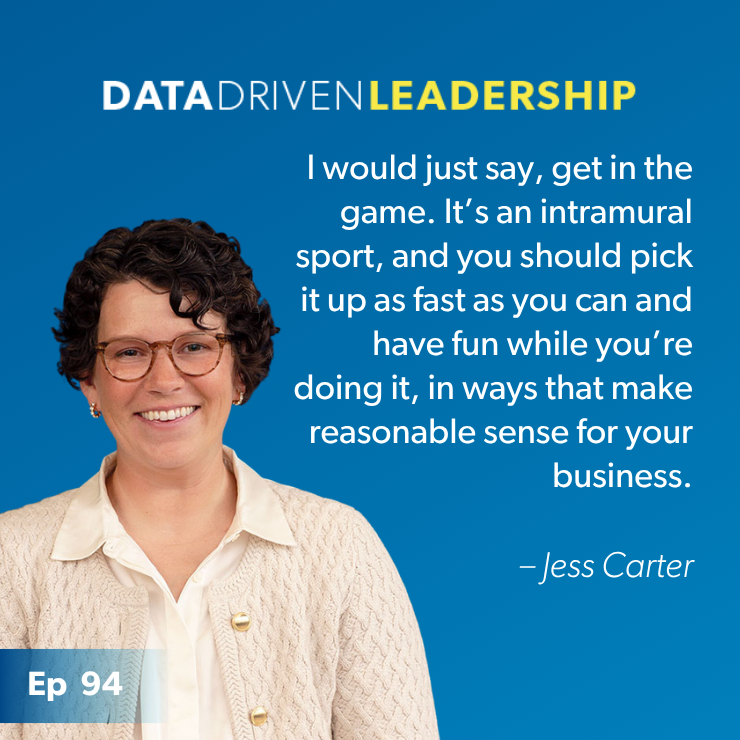
And everyone has a little bit of FOMO and a little bit of imposter syndrome about AI. And I laughed with a prospect yesterday because we were having a conversation and he had been told by his son, who's a machine learning expert, if anyone tells you that they're an AI expert, they're lying. And now there probably are at this point a few AI experts out there, but there's just a few. So I would just say get in the game, it's an intramural sport and you should pick it up as fast as you can and have fun while you're doing it in ways that make reasonable sense for your business. So I think that is where I'm going to leave you guys today. I hope this has been really helpful. I would love to hear from companies and friends of this podcast that have fascinating, insightful stories or opinions that show kind of this uniqueness of the personalized approach that AI can now be providing in the marketplace and how you're plugging and playing in interesting ways.
(16:44):
So thank you for listening. I am your host, Jess Carter. Don't forget to follow the Data-Driven Leadership wherever you get your podcasts, and it would be so helpful if you took just a second to rate and review it and let us know how this podcast is helping transform your business. We can't wait for you to join us on the next episode. Thanks.
Insights delivered to your inbox