
Your AI bill can’t explain itself
This summer, Accenture launched Accenture Tokenomics, a service that tracks AI token spending and ties it to the teams, workflows, and outcomes behind it. The Linux Foundation also launched the Tokenomics Foundation to set standards for measuring AI costs and returns, with Accenture, JPMorganChase, IBM, Oracle, SAP, and ServiceNow among its 30 founding members. These efforts extend beyond spending visibility into optimization, accountability, and governance. Organizations evaluating them still need to decide who approves AI use, who owns the results, and what evidence justifies continued spending.
The CFO at a financial services client called us after her company’s first full month of using AI in day-to-day operations. Her AI provider’s bill came in at three times what their pilot projected. When she asked which internal team ran up the bill, no one could tell her.
On its own, a bill can’t answer that question. Every token traces back to three decisions: a use case someone approved (or never did), a model someone chose (or, more likely, defaulted to), and a workflow someone designed without pricing what it would cost to run. Track the tokens without those three facts, and all you have is spending data without enough context to judge business value.
Making those decisions on purpose is the work of AI governance, and cost belongs in every part of it. Get the governance right, and spending stays in line without slowing down the people building with AI. Skip it, and no dashboard will tell you which spending to keep.
When finance can’t explain the bill, every AI project is at risk
When finance can’t split the bill into the AI work that’s paying off and the work that isn’t, the entire AI budget is at risk of being cut. Finance can’t cut the workflows spending tokens with no return, because the bill doesn’t show which workflows they are. That uncertainty can lead finance to freeze the whole category, putting workflows that were paying for themselves at risk alongside the rest.
That CFO’s situation is common. Most organizations put AI into production before they set up AI governance: making the decisions about how AI gets rolled out, which uses get approved, who can use which tools, and how that use is monitored and reviewed. In Grant Thornton’s 2026 AI Impact Survey of 950 business leaders, 78 percent of respondents lacked strong confidence they could pass an independent AI governance audit within 90 days, and 46 percent cited governance and compliance failures as a leading cause of AI underperformance.
For AI to provide ROI, organizations need enough governance to know what’s working, with a light enough touch that they don’t stifle innovation. With too little, costs climb and no one is accountable for them. With too much, teams aren’t motivated to use it because it can’t do what they want.
You’re making cost decisions far earlier than you realize
Two of those three decisions, the model and the workflow, get made at build time, long before the first bill arrives.
Model choice can materially change the bill. Tokenomics Foundation Executive Director J.R. Storment sums up why model choice matters in one line: “A token is not a token is not a token.” Different models charge very different prices per token, and they don’t all split text into tokens the same way, so the same work can add up to very different bills.
Teams may default to the most capable model for every task, even if it’s one a less robust model would handle just as well. That’s why the model belongs in the budget, decided when a use case is approved and revisited on a schedule. Model prices change, and they don’t always go down.
Workflow design is the easiest decision to miss. Take an analyst who asks an AI agent a question about margin. If the business has never written down what margin means, the agent works it out again on every query, from table names and whatever context it can reach, and every pass costs tokens. Defining and documenting meanings and relationships once in a shared library simplifies and clarifies an AI workflow’s process. That’s also token optimization, with the savings compounding for as long as the workflow runs.
A common objection is that falling prices will take care of this. Goldman Sachs Research projected in May 2026 that token consumption will grow 24 times between 2026 and 2030, driven largely by AI agents. The same research notes that chipmakers are cutting the cost of running AI models by 60 to 70 percent per token each year. That’s a cost decline for the companies that sell AI, though how much of it reaches your bill depends on what your provider charges.
The bigger issue is volume. An AI agent that plans, does its own research, and checks its own work uses far more tokens to finish a task than a chatbot answering once. The price of each token can fall and the cost of each completed task can still rise. What you control is how much you use on which model, decisions you make before the build.
Run cost belongs in the business case, before the build
In our engagements, we estimate what a workflow is worth and what it will cost before we build anything. Value is the time and errors it saves, converted to dollars, plus new revenue when the leader sponsoring the workflow commits to a specific figure. Cost has two aspects: what it takes to build, including implementation, change management, and data cleanup, and what it costs to run every month for as long as it’s live.
Run cost is the part business cases most often leave out. We estimate it from how much material each run reads, how many steps it takes, and how much it writes. Counting it makes the return look smaller, but finance can check that number, and a number finance trusts is the one that gets funded.
Once the workflow is live, we measure what it costs to run and compare that to the estimate. That comparison only works if the expected cost, the expected value, and the owner accountable for results are documented before the build.
This fall, we worked with a professional services firm whose first approved use case was drafting sales pitch decks. A deck took two days to produce, and the team wanted a draft that was 90 percent finished in two hours. We first estimated run cost assuming the AI could pull approved content from one shared library, assemble it, and draft. During discovery, we learned that a confidentiality rule keeps each client’s material in a separate workspace. That confidentiality requirement changed the proposed architecture and prompted us to revisit the run-cost estimate, including how approved content could be retrieved and reused within each client’s workspace.
The expected value stayed the same, but the run-cost estimate rose. Before choosing a model or writing a prompt, the team had to decide where a shared, approved content library would live.
Most of the run cost isn’t tokens
Part of run cost has nothing to do with tokens, so no token dashboard can show it. Across the AI work we’ve delivered, the cost of running the models was the smaller share. Human review, monitoring, and handling the cases the AI gets wrong made up most of it.
A workflow that needs a person to check every tenth output costs mostly that person’s time, which doesn’t show up on your AI provider bill. A business case can include the cost of the reviewer’s time and the monitoring alongside the tokens. A billing console shows only the token charges, which are the smaller share of the cost.
Cost belongs in every pillar of AI governance
In our view, AI governance has four pillars. Cost informs the decisions in every one, and token spend is only one part of it.
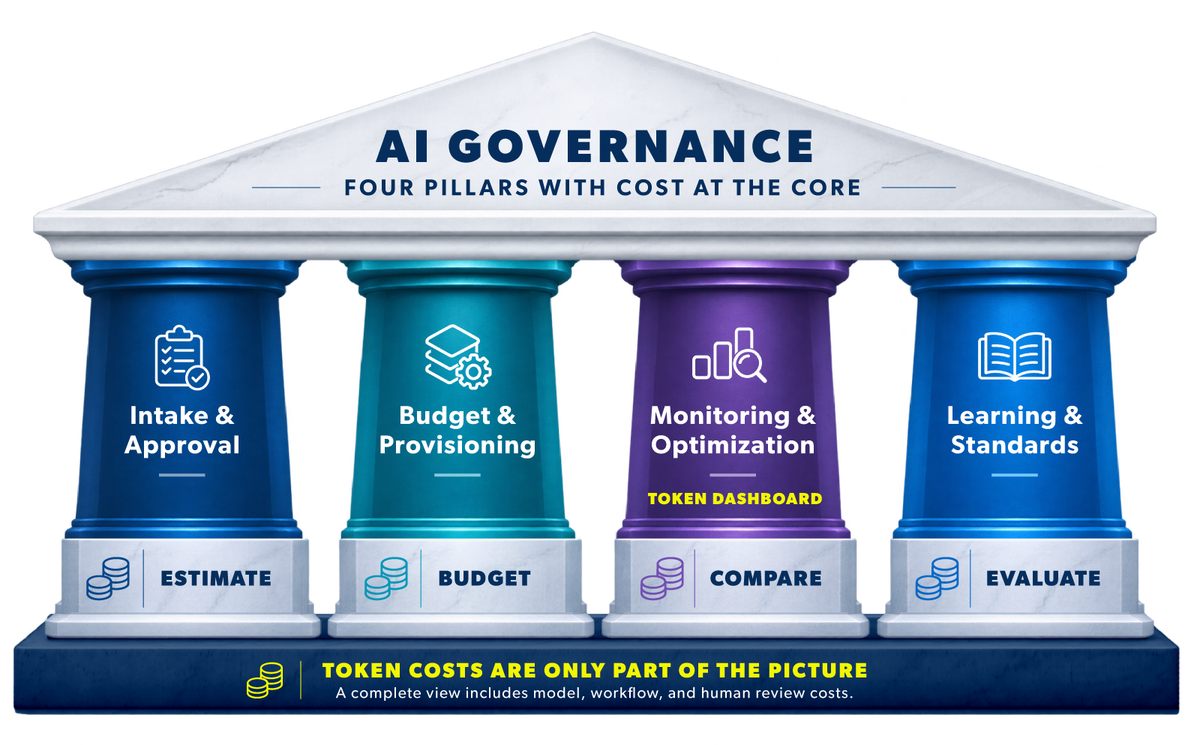
A token dashboard belongs in the third pillar, and it’s worth having once the first two are in place. Without them, it gives you what the bill already did: spending data without enough context to judge business value. Worse, people may perceive it as a leaderboard, where the team spending the most tokens looks like the team getting the most done.
AI governance needs one owner and a mandate from the top
Finance owns the AI bill, but no single person owns the decisions that produce it. Finance sets the budget, IT decides who gets which tools and tracks usage, legal decides how risky each AI use is, and department heads decide how their teams use AI. Each owns a piece, so no one owns the whole system. That doesn’t present as problematic until something goes wrong, like a bill three times higher than planned.
Fixing that takes someone with authority over all four functions, such as the board, the audit committee, or the CEO, to require a single AI governance process with one person in charge of it. That person works from a written playbook. The test comes by asking a year later whether that person can still run the governance process without the people who set it up, including us.
That’s also why we put governance first. When we assess a client’s readiness and governance isn’t in place, we spend the first quarter setting it up. The winning use case waits for the second. We’ve told more than one client that the process they want automated is the second thing we’ll build. The first is the groundwork that includes a named owner, the evaluation step, and the evidence standard that make the build defensible under scrutiny.
Four questions come before the dashboard
Before anyone shops for a dashboard, we’d ask four questions:
In our experience, most organizations can’t answer the first three, which is why they can’t answer the fourth either. Set up the governance first, and the dashboard will have something to measure.
About the authors