Health Care

Proactively address operational inefficiencies to improve care delivery, reduce waste, and reduce costs.

How we help

“Do more with less.”

This is the mantra health care organizations have been forced to operate under for decades. Meanwhile, every regulatory and legislative change seems to increase the expectation of “more” delivery while decreasing the “less” of available resources.

The good news is that your organization likely has the building blocks that are key to thriving in this climate: operations and health data. What if your data plus predictive analytics could accurately forecast staffing needs, optimize patient throughput, and reduce readmission rates?  

For more than a decade, we’ve connected systems and applied advanced analytics and machine learning to solve complex challenges. We know that AI and analytics solutions are only as good as the data behind them; we prioritize data quality and governance. Our team stands ready to guide you as a trusted partner at the intersection of health care and technology.

Impact Story

CHA Leverages Resultant’s Data Assessment to Save Over $2M Annually
Our team has 25 years of experience driving better patient outcomes and business operations. Talk to us.

TACKLE BARRIERS TO PROGRESS

Operational inefficiencies cost more than just dollars.

From readmission penalties to empty beds, idle specialized staff to unnecessary overtime, employee burnout to suboptimal patient outcomes, healthcare organizations pay the price.

Staffing Shortages

Unpredictable workloads, insufficient coverage, and last-minute scrambling reduce care quality and are leading causes of chronic stress and exhaustion.

Staffing shortages contribute to many other operational inefficiencies: long waits, extended stays, readmission penalties, and more.

Predictive staffing proactively anticipates patient demand to avoid reactive firefighting when crises hit.

Care Quality Shortfalls

Specialized staff working below their licensure can’t direct full attention to the patients that need them most. Systems that don’t talk to each other delay connections that can better inform care.

Likewise, unoptimized EDs, ORs, imaging, and labs result in patients waiting for the care they need.

Predictive models can identify care demands and patient risks, enabling earlier, more effective preventative intervention.

Financial Waste

Avoidable readmissions reduce reimbursement and can trigger penalties. Poor discharge planning increases length of stays, using resources without adding revenue.

Meanwhile, temporary staff and overtime pay increase labor costs. Empty beds and idle ORs generate no income.

Predictive, AI-powered analytics bring efficiencies; even small boosts compound into big savings.

Transforming an organization requires a partner who can both develop a strategy and execute it to create value


Strategic data solutions bring real business value

Data-driven insights streamline operations, improve patient outcomes and employee satisfaction, and increase revenue through decreasing costs.

  • Leave behind legacy systems that keep data siloed in favor of scalable tools that integrate your systems for effective analytics.
  • Enable record linkage for one source of truth for each patient to facilitate holistic care while removing redundant administrative work and chances of error.
  • Generate and circulate reports, dashboards, and other analytics to all business units, enabling strategic data insights across the organization.

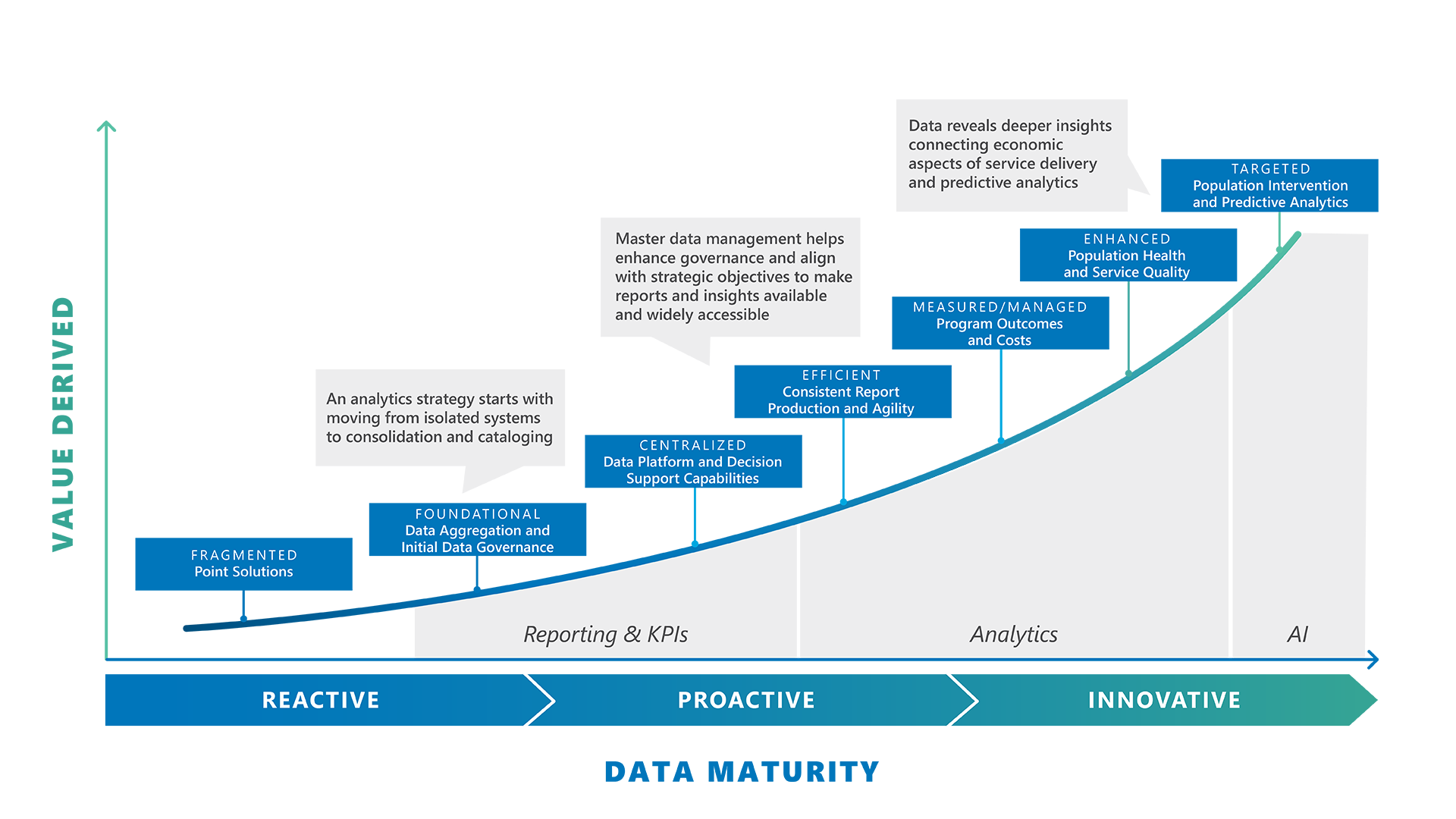
Wherever you are in your data maturity journey, we can help.

Streamline Operations and Reduce Costs.

Replace manual processes with automated workflows that save time and money. Get real-time insight into resource utilization, staff scheduling, and supply chain management.

Modernize Your Technology.

Move beyond legacy systems to a modern data platform that enables advanced analytics and predictive modeling, seamlessly integrates EMRs, delivers automated reporting and real-time dashboards, and ensures regulatory compliance and data security.

Drive Revenue Growth.

Improve visibility and analytics to identify missed revenue opportunities, reduce claim denials, and optimize reimbursement rates. Gain understanding of service line profitability and make data-driven decisions about growth opportunities.

Improve Patient and Staff Experience.

Give your clinical teams the insights they need to deliver better care. Track patient satisfaction in real time and identify improvement opportunities. Help prevent staff burnout by optimizing schedules and workload distribution based on actual demand patterns.

Scale with Confidence.

Standardize data across locations, integrate new facilities smoothly, and maintain consistent reporting enterprise-wide with solutions that scale with you. Break down data silos between departments and facilities to create a single source of truth.

Meet your team

SVP, Professional Services

Director, Private Healthcare Sales

Commercial Health Strategy Director

Healthcare Portfolio Leader

National Healthcare Vertical Lead

FAQs

Does working with Resultant mean outsourcing to other countries?

No. We are based in Indianapolis, IN and Dallas, TX, and all our consultants are in the United States. Likewise, your healthcare data stays in the U.S. and meets all security and compliance requirements.

We have a lot of data but aren’t sure if it's good data. What can we do with it to show our executives we’re trending the right way in our business?

This is a common challenge in health care. We start with a quick data quality assessment to understand what data you have and how reliable it is. We then build executive dashboards focused on the metrics that matter most, like revenue cycle performance, patient volumes, service line profitability, and quality scores. Most importantly, we help you establish processes to maintain data quality going forward, so you can trust your metrics and make confident decisions about your business. The key is starting small, proving value quickly, and building from there.

I hear AI everywhere, but don’t know if we’re ready for AI. What can it do for us and what processes can be automated?

We take a practical approach to AI, first evaluating your data quality and current processes to identify the best opportunities for automation and advanced analytics. Common starting points include:

  • Automating routine reporting and data aggregation
  • Predicting patient volumes for better staffing
  • Identifying revenue cycle optimization opportunities
  • Analyzing clinical patterns to improve care protocols
We’ve grown through acquisition and merged a few different companies into one. How do we define what our data roadmap should be for the future?

We specialize in helping health care organizations standardize and integrate data after M&A. Our approach includes mapping data from different systems, creating consistent metrics across facilities, building automated reporting solutions, and establishing scalable processes for future acquisitions. We've helped clients reduce post-merger reporting time by 50% while improving data accuracy.

How do I get a better handle of doctor and nurse capacity in hospitals so they can gain efficiency that prevents burnout?

Using historical and current data and predictive analytics, we help you better match staffing to patient demand. We create dashboards that show real-time capacity metrics, predict upcoming bottlenecks, and identify opportunities to improve workflow efficiency. This helps reduce overtime, improve staff satisfaction, and maintain quality of care.

What's your typical timeline for solution implementation and ROI?

Most clients see initial results within eight to twelve weeks, varying with the scope of work. We focus on quick wins that demonstrate value while building toward longer-term transformation. ROI varies by project but typically includes reduced operating costs, improved revenue capture, and staff time savings. We'll work with you to define clear success metrics at the start of any engagement.

A lovely, confident female leader smiling

Podcast

What Data Means for the Future of Pediatric Hospitals

In this episode, Jess Carter talks with Theresa, who recently transitioned from CIO at Cook Children’s Health Care System to a new role at symplr. Theresa recalls her unlikely path from transplant nurse to technology leader and shares how those dual perspectives influenced the way she thinks about data, trust, and patient care.

Listen Now

Connect

Our team brings firsthand experience from clinical operations, public health, surgical practice management, IT, and organizational change inside hospital systems.

Contact us for a free Healthcare Analytics Ideation Workshop.


Insights delivered to your inbox