




Transcript
This has been generated by AI and optimized by a human.
(00:04):
The power of data is undeniable and, unharnessed, it's nothing but chaos.
(00:09):
The amount of data was crazy.
(00:11):
Can I trust it?
(00:12):
You will waste money.
(00:14):
Held together with duct tape.
(00:15):
Doomed to failure.
Jess Carter (00:16):
This season, we're solving problems in real time to reveal the art of the possible, making data your ally, using it to lead with confidence and clarity, helping communities and people thrive. This is Data-Driven Leadership, a show by Resultant.
Jess Carter (00:31):
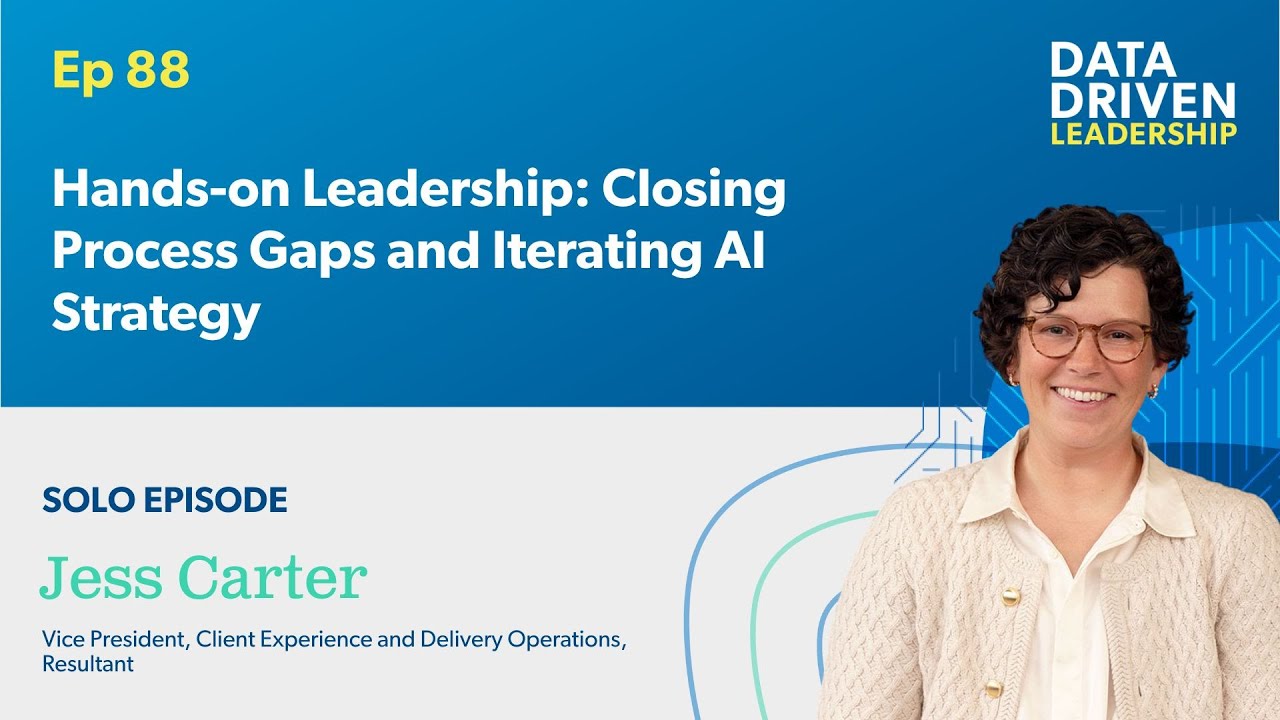
Hey guys, welcome back to Data-Driven Leadership. I'm your host, Jess Carter. Today I want to talk to you about a couple different topics. If you follow me on LinkedIn, you've seen me post about these recently. It's a relative nearness of where my mind's been at lately and some of the work I've been doing, talking to leaders in education, healthcare, enterprise organizations. And so these are real based on pragmatic conversations that are being had and I thought I would share them with you because we know that leadership can be lonely and sometimes it's nice to know that you're not alone.
(01:05):
The first thing I was reflecting on recently is just the problem of leadership distancing you from the real work. And I have been thinking about this a lot lately because I did step back into more of a hands-on role the last six months. And it has been helpful. There are things that I've noticed while I've been doing some of this work that I wasn't aware of, extra steps that maybe didn't need to be had or a lack of documentation about something that we should probably have written down somewhere at some point. There's amazing people in a lot of our organizations who cover up, with best of intentions, maybe some gaps in our processes. And when I stopped to think about it, I was like, "Well, this is so crazy. Why hasn't anyone mentioned ... Honestly, if there's a problem to be had, these are really minor things we can fix with ease." And I thought, why aren't these coming up?
(01:57):
And as I reflected, I had this realization that as a leader, you're asking your team, what can we be doing better? What needs improved? And there's this fallout of these little tiny, nitpicky, paper-cutty things that it would be kind of silly for someone to bring to you. That is probably something that we should find a way to make sure we're assessing. We have employee engagement surveys, we have client surveys, we have feedback sessions, we trickle up and trickle down data and communications. And I think there's just a different set of eyes and different things that I'm seeing that I'm thinking, "We can fix that. We can fix that quickly." I just needed to know it needed fixing.
So I think the big idea here is pretty simple, but it's just this encouragement for those data-driven leaders around that if you want to make better data-driven decisions, you have to understand what's really going on in the first place.
(02:50):
And I think that there's just a few things to maybe encourage our friends around, which is things like what patterns do you see across the organization when leaders ignore small problems until they snowball? When are problems being brought to you? Are they being brought as theories of what might happen? Are they being brought to you after they're already bright red and creating glaring issues in the business? Are you getting a little bit of both? And I think that some of those reflections will help understand if there's some opportunities for you to better understand what I call OFIs, or opportunities for improvement and processes. When I approach some of this, I am a Six Sigma black belt. So I was taught the Six Sigma DMAIC way to find, measure, analyze, improve, and control. And so it's very methodological of like, hey, walk through the customer journey, walk through the journey chronologically, walk through your deal process from a lead all the way to a close, walk through your delivery process.
(03:47):
If you're an SI, a systems implementation team, from acquiring that deal closed won to kicking off, what is that experience like? Or to go-live implementation. And so I think that process is the only way in the 15 years I've been in the workforce that I really catch 80 percent of the stuff that gets filtered out of my line of sight. When you click every button and you walk through the actual process, because even if you ask people like, "Hey, walk me through the things that you think we could improve." They auto filter out the stuff that they, "Oh, let me just do a couple of these clicks really quickly here. You don't need to see this. " That's actually the stuff you want to see because you're thinking, "Well, if you don't know why you needed to click those buttons other than you had to click those buttons, why are we doing that?"
(04:34):
So I do think I'd encourage a chronological walkthrough and I posted about this, but I think you should do it every year. If you're not hands-on-keyboard doing the work of the people you're leading, at the very least, I think you should be the customer, be the undercover boss is what I said in my post. Be a recipient of the services or the processes that you are measuring KPIs around.
I also think people aren't going to bring you paper cuts, nitpicking things if you are judgmental as your initial response, "Oh, just deal with it. That's why we pay you the big bucks." That doesn't really fly in a culture of openness and growth. And I learned this from a recent leader that I've had for the last half-decade, is you build credibility to be a fixer of some of those pain points by actually fixing them.
(05:20):
So when someone brings you something, fix it and fix it fast and make sure it got fixed, close the loop on it getting fixed, but that's going to create a culture where people feel like they can bring you things. Now, you still have to be a little bit of a discerner when some of this stuff is not top priority, but I closed the loop on that, too. "Hey, really appreciate it. Not sure I'm going to be able to get that one resolved anytime soon, but please bring it back to me in the next X weeks, months, year, whatever, so that we can make sure we do get it prioritized appropriately when possible."
I'm also saying all of this, realizing it's a little bit of a reminder for me that these things are important. And if you haven't started a new job recently, if you've been the leader for a longer period of time, this is a really cool invitation to say you also can rebrand a little bit with your team.
(06:09):
And by showing openness, willingness, a desire to walk through some of this, you build credibility in a whole new way and you sort of awaken your team. You'll just see them get excited in a new way about what you might be able to improve upon or what they can.
The last thing I was going to say about this is just the ability to democratize. When you can, why are you the one making the decision about itty bitty paper cuts? Are there other people you could delegate some of this to say, “Oh my gosh, I don't have time to get through all this, but it needs addressed and needs addressed faster than this.” So who can you give that access, that decision making authority to say, "I trust your judgment. I need you to correct some of these things. I want you to be the point person.
(06:51):
Go, fill me in when it's happening." So that be a invitation for anyone listening to walk a mile in their client's shoes or their team's shoes and let me know how it's going. Let me know what you learn. Did it help at all?
The other thing I wanted to talk about today, this is like a total shift in topics, but it's just stuff that's been on my mind. This is crazy. I think about when I first started posting about and writing about AI more theoretically than ever, talking about New York Times and OpenAI and what it might mean, I am now seriously spending the majority of my working hours helping institutions and organizations build their strategy, policies, statements, and approaches to how their organizations leverage AI. That is what I'm doing full-time the majority of my time, which feels crazy to me. I blinked and it happened. And so I've now done this for a handful of institutions, I won't say like a hundred or something, but for several institutions.
(07:54):
And I'm doing a bunch of research and reading up on stories of other organizations that have gone through these kinds of transformations in the last year because again, there's not 10 years’ worth of data really. It's just all very recent. And so I just have some thoughts I'll share and I'll probably do this pretty semi-regularly because it's where I'm at and I imagine it's where a lot of you are.
So just a couple of things I want to talk about on this sort of AI adoption roadmap that we've all found ourselves on. As a leader, the one thing I'm hearing from almost every organization I talk to is if they don't have a passionate leader at the top in the C-suite who has a really strong opinion driving their approach, their strategy, their adoption models and plans around AI, then what they've done is like nervously democratize it.
(08:45):
Well, whoever, whatever director level can decide and here's the budget you have or don't have and figure it out. That is sending really conflicting messages to the firm and it's really creating a whole bunch of different confusion. There are teams that are super excited, leaning in. Other teams, you're probably losing resources because they want to work with AI and they're leaving to go work somewhere else with AI when your organization didn't say no. They just didn't have a leader that was really gung-ho about it. There's attrition happening that is voluntary and not ideal because of some of these situations. There's also just this confusion. I mean, in universities we're hearing this one professor will be extremely open to AI and in fact be a computer science or engineering professor who says, "You got to know how to use it to be effective in your industry or market." Then you go to a different class and they don't want you to use any AI.
(09:39):
And so this is a mixed message of what's good use look like. We can't even agree as an organization about what good looks like. And so I think there's just a whole bunch of challenges that organizations, institutions, businesses face. And I think just for what we can control, not everyone listening is on a C-suite, but you are a leader. So what I would ask is in the realm of your control, a couple things I might suggest.
One, write down, like pen and paper, just for kicks and giggles, write down what your philosophy on AI is. Before you talk about the pragmatics, do you think it is good for certain conditions? What are situations in which you would highly advise you don't use AI? I would encourage you to go through this process because a bunch of you are going to be in the C-suite if you're not already, and you're going to be asked to have a developed opinion about AI use.
(10:29):
And so write it down now, measure it, sharpen it, so that if you're not already in that seat, when you're in that seat, you know exactly what your opinion is in the context of your business or your organization or your nonprofit, and you know how to drive in that driver's seat towards the right behavior and adoption.
The other thing I would encourage is the openness to acknowledging that no one has it figured out. I'm super tired. I don't know if you're tired. I'm fatigued by the people who talk on LinkedIn like they know exactly what everyone should be doing with AI. Acknowledge that part of your philosophy is like you don't know and you're going to figure it out and you're going to constantly evolve your sense of what's appropriate for AI. It's going to be a learning pathway that as you think of more ways that you can leverage it or that you tried and you shouldn't, you're going to write those down and you're going to kind of commit to your own strategy, philosophy approach.
(11:19):
I think that those are going to be really helpful ways that you, one, don't fear it, two, actually feel more confident engaging in the conversation and in leveraging AI pragmatically. But I also think that there's this like, real sense of leadership, strategy and policy that we're all going to have to start driving towards ethical use. And I'm encouraged by the amount of energy in the news that I'm seeing, dollars that are being spent thinking about the ethical use of AI while so many people have started to adopt it. So I just want to encourage that we're all thinking deeply about our own as leaders, ethical use of AI.
An analogy I used with a friend the other day was, I would never use AI prompts and outputs to just parent. I will use it to try to give me ideas about specific things I think are good for my kids, but I always am the human in the loop processing how much of that I want to adopt or not and why.
(12:18):
And frankly, by thinking through my own philosophy, I can feed that into AI and say, "Here's where I would like to use you. Here's where I have no interest." So don't even try to give me suggestions in these spaces. I'm not going to listen to them and it's not valuable use of AI.
Maybe the last thing I'd say is, where do you see truly human dignity? What work and non-work, what effort exists that is worthy of human dignity only? And where is that still, for lack of a better word, sacred? And a lot of people look at AI as a efficiency game. It gives you your time back. You don't need other people to help you with a whole bunch of other things you're not as good at or that waste your time and you can think more deeply about these things. Of course, of course.
(13:01):
But I also think that there is a place for AI and really innovating some of our environments and spaces, but we want to do that in ways that honor human dignity and keep space for the things that are sacred. And I think that's just my invitation. So some feedback, I'll keep you in the loop, too, on how some of these thoughts are growing and I hope you guys would share some of those thoughts with me too. This is a little bit raw, a little bit unfiltered, but I hope it's helpful.
As we always talk about these things, please leave comments and help us understand how you're using this podcast and what else you'd like to hear about. We can't wait for you to hear us in the next episode.
Insights delivered to your inbox