Insights From Our Latest Episodes: The Link Between Mission, People, and Data Decisions
Listen On





Transcript
This has been generated by AI and optimized by a human.
Show ID (00:04):
The power of data is undeniable and, unharnessed, it's nothing but chaos.
(00:09):
The amount of data was crazy.
(00:11):
Can I trust it?
(00:12):
You will waste money.
(00:14):
Held together with duct tape.
(00:15):
Doomed to failure.
(00:16):
This season, we're solving problems in real-time to reveal the art of the possible: making data your ally, using it to lead with confidence and clarity, helping communities and people thrive. This is Data-Driven Leadership, a show by Resultant.
Welcome back to Data-Driven Leadership. I'm your host, Jess Carter. Today I'm taking a deep dive to share key lessons from some of our recent episodes, including conversations with leaders in AI, workforce insights, cybersecurity, health care, project management, and more. Let's get into it.
(00:51):
One of the questions that we've been discussing is what does data-driven leadership mean to me today and how have these recent episodes sharpened that definition? And there's a few topics that have sort of naturally percolated throughout our show. So I just wanted to talk through kind of how I've seen those.
First is this concept of how important it is as an organization when demonstrating data-driven leadership to be mission-first always. We had two or three different episodes that really hit on this. Jeremy Bhatia from the Eddi conversation, the Workforce Solutions for North Central Texas with Phedra and Jacob. And then I think Theresa Meadows, when we talked about her being a CIO, but also coming from nursing is just so interesting. Something that stood out to me in all of these conversations is how important it is as a data-driven leader to know your “why” extremely well.
(01:41):
And I think someone who did a fantastic job of this was when we talked to Phedra and Jacob, their rich and deep understanding of their region, the areas around their region, the unique needs each of them have. It was just extremely impressive to me. And I think even they would admit, Jacob I think was more of a technologist, but Phedra wasn't naturally in that role her whole life, but she was such an effective leader because she knew she needed a Jacob, she knew what she needed from a business perspective first.
And I'd say as a technology consultant, one of the most concerning moments is when we work with a client and we start asking them what's their vision for their company? What's their vision for their department? Where are they seeing it going? What are the challenges they have? If they don't have a finger on the pulse of what's going on in the business and what they really need, there just are limits to what the technology is going to be able to do for them because we do have to follow the need of the business.
(02:38):
And so that was really exciting to me. And then Theresa Meadows, I kind of always wondered, is there a actual difference in how a hospital runs, whether it's a pediatric hospital or not? And when she was able to explain, well, think about the agency you want for your patient, and in some cases if they're underage, how are you advocating for their wants, desires, needs? How are you appreciating their developmental place in this world and then their parents’ or guardians’ approvals and the paperwork and the documentation, how important all of that is. It's not just paperwork. It's honoring the desires of the patient and the needs that they have for their care. That was just a concept I'd never thought about before, and I thought it was really interesting. And again, it demonstrated this rich understanding of their business, in this case a hospital and their clients, in this case, a patient that's mostly underage, how incredibly important that is.
(03:36):
So those are some of my thoughts about mission-first, always. As a data-driven leader, making sure you are checking in with yourself quarterly, monthly, weekly to wake up and think, okay, what am I doing and why? And is it still working or not? And where should I have technical counterparts and where is it okay not to have those for now in order to be data-driven?
The next sort of theme that we saw emerge in this the last few episodes was how important people are. And I think that's really interesting. While we're talking about AI, I don't know every six seconds on a podcast or the news or social media. And so Jeff Foresman talked about cybersecurity breaches and how common those are happening because of humans, not firewalls. And I realized that that makes an argument that humans are a problem. But I think what we're admitting is sort of this collective understanding of your humans can be an incredible gate or can be a gate that is falling apart.
(04:34):
It all depends on how much you invest in their knowledge and abilities around cybersecurity.
Veronika Durgin talked to us about stakeholder buy-in and how it's really the number-one deciding factor on whether a data strategy succeeds or not. Allison Grayson equally talked about change management and how important the people part is because people fear what they don't understand or what they don't see coming next.
And so something that stood out to me was there's this tragedy that we didn't talk about collectively of how hard people are trying to do some of these things and how infrequently we get it right. There's sort of this broken-heartedness I feel, where if you're a cybersecurity person, no matter how hard you push and push and push for cyber awareness in your company, if leadership doesn't buy in, if stakeholders don't buy in, as Veronica said, you are not going to be able to shove cybersecurity knowledge down a hundred or a thousand or tens of thousands of employees' throats.
(05:34):
So the collective understanding of what's important to your company and your culture becomes really, really pivotal to change and to being data driven.
I also think people can really sniff out inauthenticity. So when you're doing change management, I think different cultures of companies have to really reflect on what is the culture that works well for their company and how do you manage change with the most sincere voice in that culture? Some cultures are highly regulated because they're in a highly regulated field, and that's okay. That doesn't mean that it's wrong, but I think you can't just take a one-size-fits-all approach to the style of culture and the impact it has into change management. I also want to say sometimes I've used AI to help me generate emails or different documents or artifacts around change management. Here's what we're doing, here's why we're doing it.
(06:24):
A PowerPoint presentation, whatever it is. I have started actually, even if I use ChatGPT, I will remove those em dashes because even if I gave it a really sincere prompt and I'm just using it for a quick grammar check or logic check, those can be a distraction. If people are sort of cynical and they can see, oh, they didn't even write this themselves. I just think it's important to take that out of the conversation, it's an unnecessary distraction.
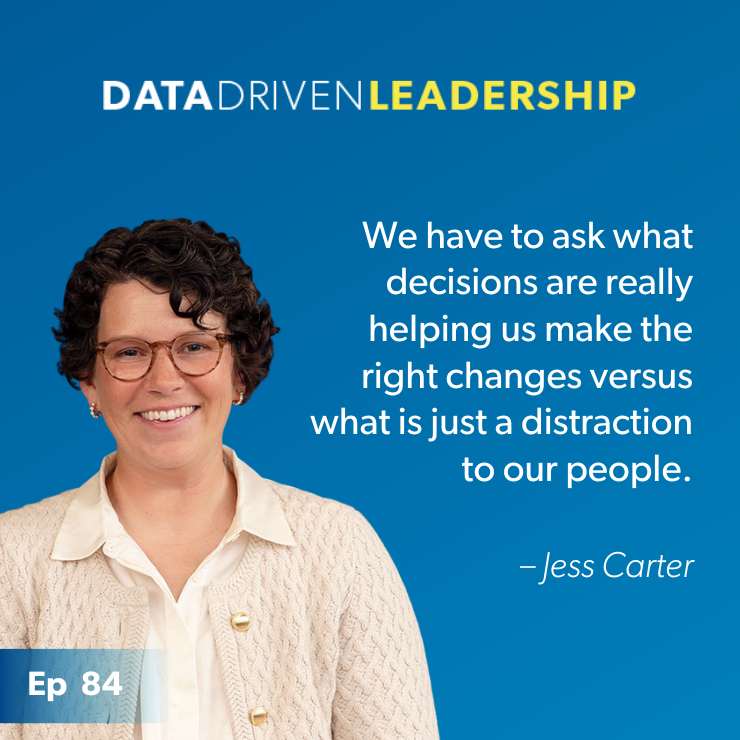
This likens back to in my early twenties, you can laugh at me for this. I had a nose ring and I actually removed it because I realized it was distracting for some of the roles I was getting into. And now, man, I wish I kept it. I think it's very acceptable in our culture, in our society, but there's some components of leadership where it's like, what are we doing and what decisions are we making that are really helping us make the right changes versus what is a distraction to our people?
(07:21):
And that requires listening and really understanding and asking for feedback authentically. So just encourage data-driven leaders in that way. I think that these conversations really helped me have a better understanding for the important role people play.
And then I think lastly, the other theme we've seen is this concept of structure and culture, build sustainability. Sort of back to that phrase, and I think we said it on Mike Hughes' episode, of “Culture eats strategy for breakfast.” So I think Kelly Vega was just, she's so authentic and so genuine when she talks about project management as a backbone and how important it is as a value proposition. It's not just a must or a necessary evil, which I think a lot of people see it as that, but it can actually, with the right PMs, it can be a strategy to quality assurance on your projects and not just an overhead expense.
(08:14):
Rob Seaman from Slack, I really was sharpened by that conversation. He talked a lot about data-informed versus data-driven leadership. What I took away from that was this concept of sometimes we have the luxury of being data driven. Sometimes we have data, we're informed, we have a leading indicator, we have a hypothesis, and we don't have time to wait to see if the statistically significant data is there. We will find out and we will pivot if it's not.
I saw something on a social media video recently that talked about how multiple anecdotal items do not roll up to statistically significant data. So just because you hear something from three different people, it can start to create this sense that this is really a theme and going on and just a reminder to our data-driven friends: That means three people talked to you. That doesn't mean it's a theme.
(09:06):
That might mean it's important. If those people are really important to your culture and they're leaders and they're identifying things have been rolled up to them thematically, then it's worth exploring. But we just want to keep in mind it's okay to make data-informed bets. You don't have to wait for all your statistically significant data, and a lot of you are in future-forward fields where you can't afford to wait. That's okay. But I just try to write down my hypotheses each month or quarter and come back and say, which ones are still good bets and which need to be adjusted.
I think the other thing I would just encourage everybody to understand is I'm on this journey with you, and so I think what's really neat to me is that we're all learning about data-driven leadership together, both the technical side, the non-technical side, and it's evolved an enormous amount since we started this podcast.
(09:49):
So I think I get really excited at the feedback we get on the podcast solutions and what you guys find valuable. But I also really think it's been interesting to talk to people with so many varied experiences from Southwest and Kelly Vega and our own data scientists or EVP. There's so much to learn here. I think I'm surprised three years in that there's so much fodder for really rich conversation between the business and the tech coming together to be this powerhouse for change. So remember your why. Remember how important your people are and keep that strategy at the forefront of your mind.
Thank you for listening. I'm your host, Jess Carter, and don't forget to follow the Data-Driven Leadership wherever you get your podcasts and rate and review, letting us know how these data topics are transforming your business. We can't wait for you to join us on the next episode.
Insights delivered to your inbox