


Transcript
This has been generated by AI and optimized by a human.
(00:04):
The power of data is undeniable and, unharnessed, it's nothing but chaos.
(00:09):
The amount of data was crazy.
(00:11):
Can I trust it?
(00:12):
You will waste money.
(00:14):
Held together with duct tape.
(00:15):
Doomed to failure.
Jess Carter (00:16):
This season, we're solving problems in real time to reveal the art of the possible, making data your ally, using it to lead with confidence and clarity, helping communities and people thrive. This is Data-Driven Leadership, a show by Resultant.
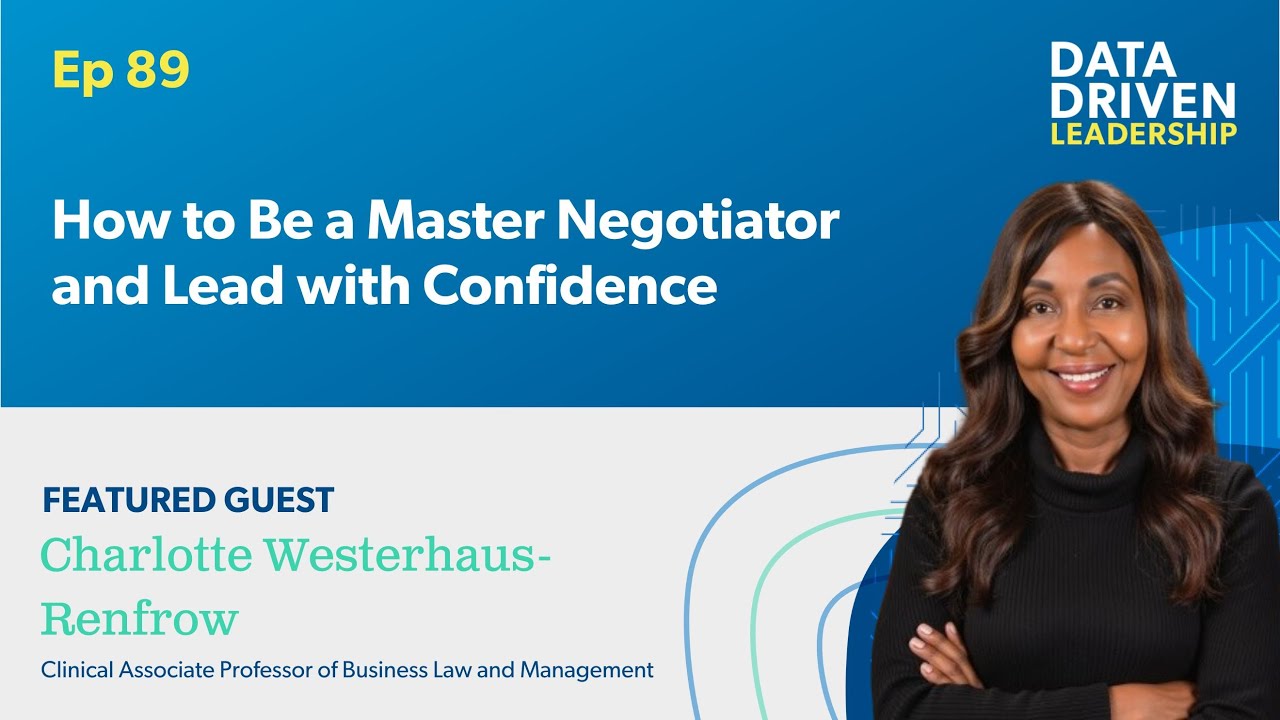
Jess Carter (00:33): Welcome back to Data-Driven Leadership. I'm your host, Jess Carter. Today we have Charlotte Westerhaus-Renfrow, clinical associate professor of business law and management at the Indiana University Kelley School of Business. Let's get into it. Charlotte, welcome.
Charlotte Westerhaus-Renfrow (00:48): Thank you. Glad to be here.
Jess Carter (00:51): Oh, I am so excited. I have admitted to you already, and I will admit to everybody listening. I am a fan. So I don't know how often you talk to people who would just describe themselves as fans of yours. Does that happen to you often?
Charlotte Westerhaus-Renfrow (01:04): No, no, not often, but I'll take it. I enjoy it. Thank you so much for being a fan. I look forward to sharing things with you, especially in the light of fandom. Let's do that.
Jess Carter (01:16): That sounds great. Well, I was so excited 'cause I'd heard you speak a couple of times now at the Tobias leadership events the last couple of years, they have these tuneups in the fall, and I immediately thought that we have Data-Driven listeners and they need to hear what you have to say on several topics.
Jess Carter (01:43): So this year you talked about negotiation and strategic thinking. What I loved is it was academic, but it was also really pragmatic. It was very clear that this is not a topic that you have no experience or limited experience. You do it all the day, all times. You recognize it, you leverage it, and you can tell when people maybe are good at it or need some coaching.
Jess Carter (02:07): So, in the program we had like a little, self-assessment on your negotiation styles. Before we get into that, so just bookmark that I wanna head there, could you share a little bit about, how do you go from law and education to coaching executives at some of the world's most data intensive companies? Like you have this amazing career. How did this all happen?
Charlotte Westerhaus-Renfrow (02:30): I will say that it was somewhat strategic and somewhat by chance. I realized early on in my career that I really enjoyed teaching individuals. All my jobs, I really enjoyed giving them instruction, and I also got feedback on that I was really good at it.
And you do what you love to do. I was courageous enough to go to where the opportunities were. I really enjoyed being an attorney. I didn't go to law school initially until I was in my thirty-somethings. Because when I was in my twenties, I honestly didn't have a lot of confidence about my skill sets or people giving me a sense that I could actually do this, even though I had it in my heart and in my gut.
There's a lot of societal pressure saying, you know, first person in my family to get a high school diploma, first person in my family to get a college degree. The first person that said I wanted to go on for a master's. And believe it or not, a lot of people kind of doubt on why you wanna continue to do this sort of thing.
And then I was extremely fortunate to meet my late husband. I've remarried, but my late husband was a colleague of mine at work and heard me speak during a work function and he became my coach.
(04:00) He saw a lot in me in regards to being persuasive and motivating and a little rough on the edges, so he recommended for me to follow my dream and I wanted to be an attorney. He had gotten three degrees from IU. We met in California, and he said, “I know the perfect school for you.” After we got married, he adopted my children.
And then I decided after being, you know, somewhat successful in law school to work in a large corporate firm and was surrounded by absolutely brilliant attorneys at a firm called Foley and Larger.
And we decided to go to Milwaukee because we didn't want to go places where…there was Chicago, I had offers in Seattle and DC, but in Milwaukee it had a family environment. We always put family first. And once I got in this great law firm, guess what? I missed being on a university campus. And to the chagrin and surprise of many individuals, I decided to go back and use my master's degree, which was in higher education administration.
(05:00) And he was fully supportive of that. Salary cut in half, the whole nine yards. And I loved the higher education field. I love the atmosphere, the climate, the mission that we take individuals from one place in their lives. It's kinda like a starting line. They all want to hear the gun and go, but we take it from one place in their lives, and they would like to, some way and somehow, be transformed to be a better self.
(05:30) Analytical thinking skill sets. But they come to college typically 'cause they have a goal and they want to move in a direction with the help and support of teachers, professionals, and staff.
I love the diversity of thought and talent, and that's where I thrive, and that's where I stayed. And so I wanted to work with leaders that I really, really respected in the field of higher ed, and there were university presidents at Purdue, that I really wanted to work with in that environment.
(06:00) When I went to the University of Iowa and I had to seek these out, my family supported me. We moved from Indiana and then we moved to Iowa of all places, people were like, why do you wanna be in Iowa? But if you look at the professional history of Iowa, the university presidents, the provost and presidents who go to Iowa usually go on to bigger and better things.
The president who hired me, Mary Sue Coleman, she left Iowa and she went on to Michigan. After her was Davis Gordon, who mentored me in a great way. And he went on to eventually, after higher ed, became the president of the Smithsonian. And now I think he's chairing or head of the American Association for Medical Schools.
And then I was hired by the late Miles Brand, who was the infamous person who fired Bobby Knight, but was a great leader as a provost at the Ohio State, and a president at the University of Oregon, and then president at Indiana University.
(07:00) So I'd never been a person that was afraid of taking a risk that was going to help me grow professionally. And so I've really been blessed and fortunate to be mentored and supported by some awesome, awesome university leaders, including when I came to, at that time, IUPUI. The chancellor was Charles Bantz and he was the one who said, you know, I think we have something perhaps for you to do here and maybe you might wanna think about teaching at the Kelly School of Business. But I also wanna make sure that this wasn't by chance.
(07:30)I was pretty strategic. I did a lot of homework, but I also took the risk, you know. When I went to the NCAA, I had never even been in the building before, but I knew I was, I had done a good job at Iowa, and I was like, well, why not? What's the worst that can happen? I can go back to a great staff and a great university and a great president at Iowa.
So, a little bit of taking, I say, calculated risk, but having an awesome coach and always trying to find for me, where I work best is in higher education, where I have respected leaders who also have a reputation of being really good coaches who have high expectations, kinda like Coach Signetti.
I mean, you know, when you have a great coach, they're not always saying, “Great job!” Sometimes they tell you, “Let's not do that again,” but they also encourage you. They always want you to know not that you made a mistake, but what did you learn? How can you be better for it?
(08:30) So I've been fortunate to have some outstanding leaders, some outstanding coaches, and also having, I think the forbearance of knowing that if you're gonna move somewhere, just be strategic about it. Know where you're going, and not just interview for a job. Interview for a place where you can grow, interview for a place if you're successful you can help others grow. And I really do thrive on that.
I really do thrive on not just where I can grow, but the biggest thrill is going somewhere where you are part of a person's growth in an educational institution.
Jess Carter (09:05): I don't know if it's appropriate or not, I feel like I just listened to you walk through like, the analogy a cat has nine lives. Like just hearing you take one step and then the next and then the next and how much changed and there's life happening while there's career happening and there's salary sucker.
And I'm, I'm pretty risk-averse myself and so it's really helpful to hear you sort of acknowledge that. You had a season that way too, and then kind of came out of it and, found your confidence, found your voice. I really appreciate that. And how important mentorship is.
(09:30) And so it's just been really meaningful to me to have those voices and to be cognizant of them. I had somebody ask me once, like, how do you get a mentor? And I remember at one point thinking. You know, there's some people I really wanna learn from and there's some people I'd be like, will you be my mentor? And I actually realized it was intimidating to someone to be called “mentor.”
So I started to just write down who are the people I really respect? What do I respect about them? What do I wanna learn from them? And they don't have to mentor me in some like they make no errors way. But in this exact topic, I wanna learn from this person and for this exact topic I wanna learn from this person.
And I started to put together, I think I've talked about it in other episodes, but sort of my like advisors of life where it's like when I'm going through something tough or interesting, I'm like, where are the right voices for me to pull down and be like, what do you think?
You know what I mean?
Charlotte Westerhaus-Renfrow (10:23): I've also found that my mentors enjoyed mentoring. They really enjoyed it. I mean, this is something they were looking for, and this is like for me, being a teacher, I enjoyed teaching, they were selective. But if you really looked into their history, one of the things they did was try to find the right person for the right job or the right spot, but they also actually had a heart for mentoring.
And I think that's important as far as aligning yourself with a mentor. Not always the most successful person in the organization, but someone who has a track record of mentoring and pulling people along. Not everybody, I mean, and also being selective, and not being intimidated, because perhaps they won't select you.
And then also the mentors I had also were awesome advocates. And when I wasn't around, they used their influence to advocate for me because in all these positions I had as I moved up, I had to have references and recommendations.
So mentoring is a person who teaches you skill sets. Then your mentors also can be awesome, just wonderful advocates for you.
(11:30)But also make sure that you are cultivating your advocates.
The advocates don't always have the skill set to teach, but boy are they impressed with you or impressed with your work and they can speak for you. Maybe they've heard you speak, maybe they've seen your work. They're not in the mentorship business, but wow, are they awesome advocates.
They have the ability to be in rooms that you are not, and they're impressed with your abilities and they can advocate and speak on your behalf about your abilities. So I think one of the things that's also helped me, or aspects of my career, is having those mentors who then served as advocates and or having advocates that maybe weren't the best mentors before they had the ability to speak for me when I wasn't in the room to help me move my career forward.
Jess Carter (12:21): Oh, that's a, that's fantastic. I really appreciate that. I need to do some work on my advocate mapping, so I'll do that. So, you kind of walked through a framework when you spoke and you had this kind of four quadrant, and you were explaining people who have these styles and where they move. And for me it was the first time that something I've sensed in life was on paper in a framework that made sense.
So I sell and I deliver and I'm a consultant and I do technology consulting and AI consulting and it's a mess 'cause nobody knows what they're actually doing right now because it's all made up and no one's an expert. And so we're figuring it out by doing it. And, I think one of the things you'd said was, hey, you might have a certain negotiation style and if you completely flip to kind of the opposite style 'cause it's getting late in the game or you're feeling stressed for time, it comes off as super inauthentic.
That really resonated with me and I don't know how to, you know, tee you up more, but if you could kind of walk through what you meant there, that was so powerful, to understand a little bit more about styles and that we don't all have the same ones and figuring out how to stay authentic.
Charlotte Westerhaus-Renfrow (13:31): Well, wow. Thank you. That's a huge compliment. I never know what, you know, resonates with folks when I meet with them, but I put these into the categories of strategies and also styles. We all have different styles, and being authentic to your style is important, but there are situations where your authentic style may not be the best strategy.
And it doesn't mean you're not being authentic to yourself, but in negotiations, you have a goal. You have objectives, and I talked about this as well. There are things that you really need to have, and they fit those needs and those interests. They're the why of the negotiation. And there's positions of what you need to have out in negotiation.
So sometimes our natural style or strategy, and for me it's being competitive. I'm very competitive. But there are times where being competitive may not be the best style or strategy, to accomplish or reach my goal or my position or satisfy my needs. And so knowing when to switch in order to be more collaborative, which is very necessary in higher education setting.
When I was an attorney, representing my client within the various ethics I had sworn to as an attorney, I was going to be competitive. I was going to win regardless of the relationship with the other side.
(15:02) But in higher education, the mission is extremely different and we have a variety of schools who have perhaps the same overall mission as a public institution, but separate individual missions depending on the academic discipline. And as a former chair of our undergraduate department, you are working with other chairs. The competitive style is not going to to be the best style overall if you, if you are trying to accomplish the university mission.
The switching is knowing that I need to be a little bit more collaborative. I need to want to actually be very cognizant of having good relationship, and then making sure it's a win-win for all of us. And that's not being disingenuous to myself. It's actually picking up a different tool that I can use.
Just like if I were right-handed or left-handed, I could do both. Other times I have to be more, or I think it's best for all of us to be a little more accommodating. We give up what we want because we really, really want this relationship. At the end, that relationship will help us get our goal. Other times we might even wanna avoid.
(16:00) I mean, if there is no conflict, why have a negotiation? You know, if you really, when you think about it, it's not necessary and other times we may have to compromise. These are all tools based on your objective. But I do think that in the area of being, let's say, accommodating and you are giving and giving 'cause you want this great relationship, and I think you alluded to this.
You accommodate, you accommodate. And I call this…from a regional standpoint—I was raised in Ohio and Cleveland, but I've lived in Indiana for 20 years—we're very, very accommodating.
(16:30) And this is research-based, that women tend to be more accommodating in negotiations because they want that relationship. They may give up more of their position. But if you're accommodating and accommodating and you're using it in a way to put a person at ease with you so that you can switch and then be competitive? You've lost trust. If you're giving in and giving in and giving in until they are really close to you and trust you, and then all of a sudden you believe you have the power now to just win at all cost? You could really, really, really ruin some real good personal and business relationships.
So, if you can be consistent as much as you possibly can. If you're very competitive and you've got this competitive reputation, then all of a sudden you're gonna try to be accommodating, people may not trust that.
(17:30) And I advocate this because I've studied the best negotiators out there. They are skilled at a variety of strategies. They're really good when need be as competitive, they know when to pivot. They know how to compromise, knowing what the other side really needs in order to get the negotiation to continue at an impasse. They know what to avoid. I think the best negotiators, this is what I said, as a skill set, you can go into a negotiation and use all of these strategies in one multilayer negotiation.
The skill is, and the strategy and the planning is, what is the best approach and when to pivot. And I use the analogy of basketball and if anyone out there's listening knows anything about basketball, they understand in basketball you may be moving in one direction or you want the other side to think you're moving in one direction, but you change directions so sharp that your shoes make a squeaky noise on the floor.
It is a cut. And that usually is a sharp pivot. Sometimes in negotiation you need to pivot and you need to know how to pivot if the strategy that you are using is not realizing your goals. But I do also think strongly that—and the research backs me up on this—the most effective strategy, and we call “claiming value” or “value creation” is collaboration.
When both sides understand that there's gonna be give and take. And both sides understand that I will give and you'll also give back. When there's collaboration, the outcomes for both sides tends to be larger, quantitatively and qualitatively, and a stronger relationship. However, collaboration only works well when the other side wants to collaborate.
Charlotte Westerhaus-Renfrow (19:27): And if you go in with a collaborative mindset and the other side is not going to be collaborative, now you have to make a decision on a change in your strategy. Are you going to accommodate? Are you gonna be accommodating? Are you gonna compromise? But what I love in teaching and negotiations is going into classrooms, and typically it's with seasoned professionals who, because we are in this great country, basically we win when we're competitive.
Like I said, I love sports. I'm very competitive. I am extreme. I don't, I don't wanna beat you by a little, I wanna just beat you by a lot. However, I realize that if I am collaborative in negotiation and the other side is collaborative, we both usually win. It's a win-win situation. And we both usually win and our relationship is stronger at the end. And that is good in business too, to have ongoing relationships with individuals that you're negotiating against. So yes, these styles and these strategies are very important.
My biggest challenge is teaching competitive folks like me the importance of that's not the only winning card you have in your stack. You have the cards of collaboration, you have this card of accommodating, you can avoid, you can compromise…it's not the only card that's gonna win. And I can show them that in class. Quantitatively, then people start thinking, well, wow, I have more tools in my toolkit besides just being competitive.
Jess Carter (21:04): So that is exactly what your talk did for me. So I'm gonna self-confess. Okay. This will, I think this will make you laugh a little bit. So, when I took the self-assessment, I showed up as like mostly collaborative. but the one I was the lowest on was avoiding. And I am a Chicagoan, so I am probably more competitive than that showed up. 'Cause I remember when I moved to Indiana and I was like, I think, I think people think I'm being like blunt or mean and I'm just being clear. And it, I had to kind of adjust ten years ago. But you know what's been really interesting, Charlotte, is I've, you know, avoiding is definitely the one that I'm the least sort of aligned to. However, it has become a really rich tool.
So when it comes to boundary setting in personal life and relationships at work, if there's an issue, the ability for me to say, must I go take this on, walk all the way, 90 percent to that other person to hound this out right now? Or can it wait and could I just let it sit while I take care of my larger priorities and see if it comes to me?
I'll deal with it when it comes up. I've got the skills and competency to do so, but like there's a little bit of just me learning to say, hey, I don't have to do this right now. Maybe it would serve me to just take a minute. Like there's also this interesting instinct, there's this human instinct and high amounts of emotion in negotiation.
(22:30) Like it's really easy for people, they feel, again, we both use the word “disingenuous.” Oh, they turned into such a, you (insert word here) when they got really competitive. People take it personally fast. And it's really been interesting to kind of go back and read these descriptions and think, okay. How do I just stay level headed?
So if I'm gonna switch, I want it to be a strategy, not a reaction. And that's been really powerful to me to say. I think it's helped me, you know, in some of my recovering people-pleaser sense of life, It's helped me to feel more self-assured, to recognize what my priorities are, to not feel like I have to go take care of everything that everyone might think of that should land in my…
I got it. It's okay. I'm gonna handle it when I think I need to. And that might not always be when you think I need to, but it's been really powerful.
Charlotte Westerhaus-Renfrow (23:19): Almost always in my teaching or presentation, I remind people that negotiation is an emotive sport.
Emotions are involved in it. It all depends on the type of negotiation. But, I always ask a query to a new group of individuals or class, how many of you all avoid negotiating? How many of you all enjoy it? And there's a good number of folks who don't, they either have to take my class or they wanna get better about it, but, the sense of being maybe rejected, or the tension, the sense that there's gonna be a disagreement. They equate negotiations by totally win-lose, and they feel that there's a lack of their communication skills and there's anxiety about being judged for wanting to get what you need, not just what you want, but what you need.
But what you've just described is something I also try to teach, and it's a tactic called “go to the balcony.” And when you feel the stress and anxiety and this tension, it's space to have a little bit of forbearance and wait and act as if this situation or this negotiation either you're in or will be, is a play and there's a stage and you and the other party or parties are on the stage.
And pull yourself out of your body and go to the balcony and look down on the stage and what do you observe? And this can even happen if you're doing this on a computer or via Zoom, but what do you observe? How are you feeling? How does that affect your voice? How's that affect your nonverbals and your face?
(25:00) Are you showing these emotions? Because if you are showing them, you're probably experiencing them. And if you're experiencing them, the part of your brain that deals with emotions, which is your limbic, it’s totally taking away all the blood and resources from the frontal lobe here for logic. And all of a sudden you forget everything you said I plan to do, you completely forget it.
So having that forbearance and ability to go to the balcony and look down upon yourself and assess yourself especially in high emotive situations. And this could be a, this could be a happy situation. Have you ever made a decision that you probably shouldn't have done when you were extremely happy?
We've made decisions in negotiations when we, you know, when we probably should have thought about it. And the other side, seeing you being emotional. Matter of fact, if they're skilled negotiators, they're gonna try to get you to be emotional. They're gonna say, hey, you know, here's the job offer and you have 24 hours to accept it. And you're thinking, this is the only job offer I have. What am I gonna do? So just having, as you said, a sense of just taking the time, understanding clearly what your objectives are and why you have them, and then be able to come back.
And I think I've talked about this, too, as well as have some alternatives that you may be able to use so you're not actually have to accept the situation that you're in. But thank you for referring to that. And you actually still have a copy. I am so impressed. So impressed!
Jess Carter (26:30): I try to be a good student, but I, it was, you know, it was really meaningful and I think, you know, to your point, I don't know if this works, but I tell myself it does, is if I do start to feel that limbic system turning on, I do math in my head.
And it feels like it turns off the emotion and lets me get back here. That could be not true, but it works for me where I'm like, at least I can just get into the right frame. 'Cause especially if it's face-to-face negotiation. If somebody can see you, and to your point, they can read you, just to make sure I'm trying to calm it down to stay fully present is important.
But it is, to your point, it is really interesting to think negotiations and emotions are, I think people innately think they're bad. They're not all bad. It's beautiful. It can be fun. You buy a house that's really exciting. You don't buy ten houses in your life. Like that's really, we've bought one house and it's really exciting.
Right? And there's a contract and it feels scary. But I really appreciate your comment too, on if you feel stuck and there's only one option and there is this pressure on the other side, a time, money, whatever, you're gonna lose it if you don't take action. That ability to say, okay, I have other options.
Charlotte Westerhaus-Renfrow (27:39): Yes.
Jess Carter: Help me, let me think through what my other options are. I could say no, and if I say no, what happens next? What else can I do? But that, like, I don't do well when I feel like I don't have agency in my life and I get offended. Like that's where the emotion takes over. And it's like for me to be like, no, no, no, no, no. I'd super appreciate the option of which I have a menu of a la carte options I can decide from. Thank you so much. And I think it's just, it's helpful to have those reminders.
Charlotte Westerhaus-Renfrow: Yeah, I, there are situations where I know people don't have the, I usually say options or alternatives, and then you're in a bad way. I mean, you're in a bad way. And the best thing to do, of course, is to have, the strongest negotiators have alternatives where they can walk away and say I don't have to take this, or I have another job offer, or there are other houses I can buy, or there's other house, you know, there's something else like, oh, you know, people who wanna buy my house.
(28:30)If you have alternatives, you do have more power. There are situations where, that you are in negotiation and you may, this may be the only job offer you have or the only house that you can afford, or the only car that right now at this time that's ready for you, or whatever it may be. So I recognize there are times where we called a WATNA, the worst alternative to negotiated agreement. People don't have alternatives, but if you can, prior to going to negotiation, have alternatives and pick the best one.
And sometimes, having alternatives takes time. Maybe you need to have alternatives before you even go into the negotiation or even you go into that situation.
But I wanted to bring up something else about negotiation to being emotive sport. And I'm gonna bring up something it has to do with AI. Really quickly, because a lot of times people now send so many messages via email or text, and you can get a sense sometimes when there's a little bit emotion sometimes in these messages.
And so I also have advised folks now and the realm of AI that if you have a email or something in writing, whatever it may be. It could be email, it could be a contract, whatever it is. And check on the tone. And you can do this simply. I don't encourage people going to AI and having them write their responses.
I encourage people to write their response yourself, especially when it's an emotive response. Either it's too happy, it’s too angry, whatever the extreme may be. And then you write it. Now you write it, and then you can ask AI to help it make it more engaging. Make it more convincing. Make it more confident. It has to be your voice, but sometimes a little icing on the cake doesn't hurt.
So if you're writing one of those emails where you just wanna tell somebody, I'm gonna tell you all, I'm really upset with you. I, I think the forbearance and going to the balcony saying, wait a minute.
I've had students who've done some egregious things as far as go against our code, honor code, and yes, I'm not happy with that particular student, but I, I think I would go to AI now and say, how could I make this an educational moment? I might have to give the student a F.
But instead of me saying, you know you were wrong, and you know it's in the syllabus. You know you have an honor code and now I'm gonna give you an F. My goal as a educator is to make this a teaching moment.
I would slow down and say, well, even though my consequence is going to be the same, what is the goal of my conversation? Is it just to give the student the grade they deserved? For either plagiarism or some honor code violation, or is it to teach them the consequences of their behavior? I think sometimes AI can be very helpful crafting your message, especially when you're emotional, when you're disappointed, when you're angry.
Crafting it in a way that does more than just talk about the consequence and crafting in a way… you can even say the AI, you know, this sounds, this is coming across pretty angry. What do you suggest the tone is now? And don't change the message, change the tone. So, I found AI negotiations as far as tone has been pretty effective if you are in an emotive moment when you are writing something to someone.
Jess Carter (31:52): That's really helpful. I have a friend who jokes often about, if they ever leave their company, their draft inbox is gonna be really entertaining for the IT team because that's where they just vent, that's where they write all the emotive stuff and then they run it through AI and send it. So
Charlotte Westerhaus-Renfrow: We don't, we don't,ever advise anyone to, to vent. I, I say take some time. It may, it may, it may feel good in the moment.
Jess Carter: Right.
Charlotte Westerhaus-Renfrow: But life is more than moments, right? People ask me now, so what can we do with AI? And like I said, I think you should write whatever you're feeling, but remember your goal and what always brings feedback especially in the context of working—I think we're the one of the best. We are one of the best, if not the best. We're the best, you know, business school. I truly, truly believe this—in the country. And so even in those moments where there might be disagreement, what's my tone in a way that I don't close the door on further relationships, I make this a teaching moment.
I reconcile and I leave the door open for more negotiations for relationship with the person on the other side, even the cases where I have to say no.
Jess Carter (33:02): I was gonna point that out. 'Cause I was gonna say it's obvious through your story that you've done that, and it was evident that you had the relationship structures in place to say, obviously, I feel more courageous and I can try these things because I know that there are places I've left a, you know, some good work and relationships behind, and if I needed to, there'd probably be an invitation to return.
And I think that life is too short for things that are moving too fast. And I think that's maybe where my collaborator comes in as I'm like, we're doing stuff that's way more important than the stuff we're doing. Relationships are part of, like, really what all this is about and getting that right matters.
Charlotte Westerhaus-Renfrow (33:38): Yes. Relationships are extremely important. I mean, I had a wonderful working relationship with my staff and, at that time, the president of the University of Iowa. My boss, I reported directly to him. We had a great relationship and I just felt in that time in my life, I wanted to go to the next level.
I had this goal to be a vice president of something and it matched my interest, and I respected that time the late Miles Brand, but it was difficult telling him. And I remember when I met with my staff, and I kid you not, my director burst into tears ‘cause we worked so well together and trusted one another. But it was how I said what I said, and how thereafter I continued to stay in contact. Holiday cards. Congratulations when babies were born, letting them know just how much I missed them. It wasn't about our relationship, it was about me growing.
And then there was a point in time when I was in the midst of grief, and oh, those people, the former people I used to work with who I had to say goodbye to, oh, they came through big time.
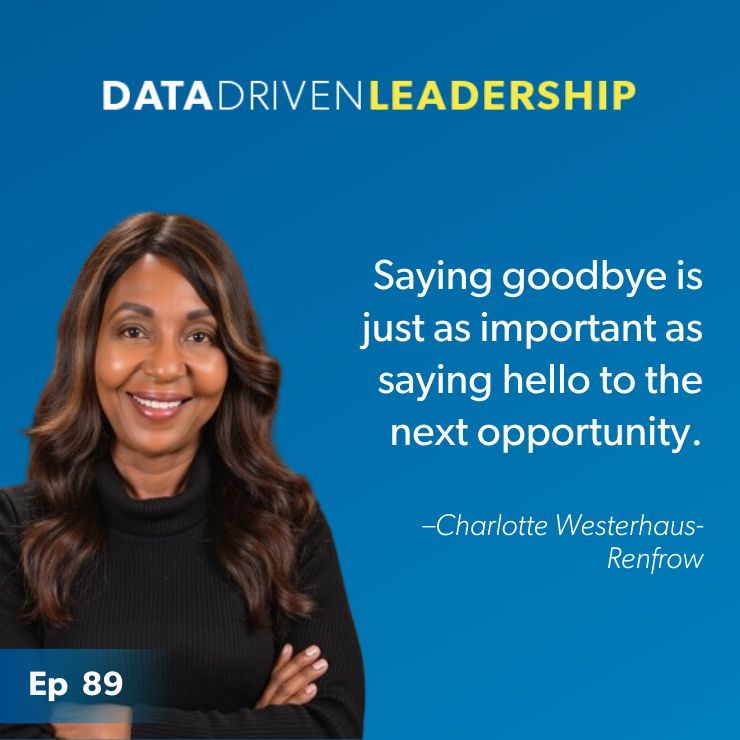
(35:00) Cards, letters, emails, visits from former employees were a tremendous help to me. So yes. Saying goodbye is, you know, is just as important as saying hello to the next opportunity. I mean, this is not absolute. There may be some times when there's some bad feelings.
You've gotta make sure that as you leave you, you kind of make sure there's still a connection and an appreciation. We've heard it even today. I've talked about my former bosses with so much appreciation 'cause I wouldn't be here, you know. As a matter of fact, it was Mary Sue Coleman at the University of Iowa.
When I took the job, she asked me, so is there anything else that you really wanna do besides this job? And I said, yes, I wanna teach in the school of business. And she said, you'd be perfect. And she, in her presidential suite, there was an area for, you know, to have meetings and lunch. She arranged for the dean of the business school at that time, the Tippie School of Business, and her and—it was a he—and him to have lunch in her office to introduce me. She could have sent him an email but she, she got us together and formed this relationship.
I'll never, ever forget that. And the late Miles Brand when I was at the NCAA, he said, “I see you were teaching at Tippie. Do you still want to teach?” And I said yes and he said, “Well, not for the first year.” But after a year I started teaching sports law at the Mauer School of Law where I got my law degree.
And the same thing when I came to IUPUI (when it was IUPUI) I contacted Charles Bantz and I had references, now, I did have references and recommendations, and I had quantitative evaluations of my courses. It wasn’t like I said, hey, I want to teach. You have to have evidence of excellence. And the former chancellor Bantz said, “I think we can find something for you here, too,” as well.
But it all started with former president Mary Sue Coleman saying, “Is there anything else I can do?” And the way she arranged it.
I've had some wonderful, wonderful, awesome. And effective mentors and advocates. I give them all the praise.
Jess Carter (36:25): That's amazing. These stories, these stories I think are really helpful to make some of these conversations sticky, like really help people see it through and understand why. If people wanna follow you, do they follow you on LinkedIn? What's the best way to keep up with you?
Charlotte Westerhaus-Renfrow: Best way to keep up with me is LinkedIn. I also like to keep up with me as far as what's happening with me with the university. Indiana University Indianapolis Kelly School of Business. But I think LinkedIn is the way to go.
You can leave me a message at the school. You can have my email address, as you probably can garner people have no problem finding me. Uh, the problem is finding time. I'm still teaching.
I truly can say it's, I'm doing what I love to do because the people I work with. And the development, from the time they walk into my class and the time they leave, it sounds so corny.
When I was younger, you know, do what you love. Part of that saying says, do what you love, you never have to get paid. Now I know I wanna get paid. Let's be clear. But still, still. I love education. I love teaching, and I'm so happy you asked me to be a part of this podcast.
It's been a real thrill.
Jess Carter (37:28): Oh, I am so glad. Well, we will get this out to everybody and then we'll add the self-assessment to our show notes. So if people wanna take a self-assessment on their negotiation styles. And then again, the goal isn't to have one and double down. It's to understand where your primary is and then build some of the skills around it.
I love it. Okay. Thank you so much for being on today, Charlotte. I so appreciate it.
Charlotte Westerhaus-Renfrow (37:58): Thank you for having me. I have had, I have had a blast doing this. Thank you so very much.
Jess Carter: Thank you guys for listening. I'm your host, Jess Carter. Don't forget to follow the Data-Driven Leadership wherever you get your podcasts. And rate and review letting us know how these topics are transforming your business.
We can't wait for you to join us on the next episode.
Insights delivered to your inbox