How Hungryroot Built Data Ownership and Its Impact on AI with Ben Ganzfried
Listen On




Transcript
This has been generated by AI and optimized by a human.
(00:04):
The power of data is undeniable and, unharnessed, it's nothing but chaos.
(00:09):
The amount of data was crazy.
(00:11):
Can I trust it?
(00:12):
You will waste money.
(00:14):
Held together with duct tape.
(00:15):
Doomed to failure.
Jess Carter (00:16):
This season, we're solving problems in real time to reveal the art of the possible, making data your ally, using it to lead with confidence and clarity, helping communities and people thrive. This is Data-Driven Leadership, a show by Resultant.
Jess Carter (00:33): Hey guys, welcome back to Data-Driven Leadership. Today, we have a really good one for you. Ben Ganzfried is the senior director of data platform and governance at Hungryroot. And I actually came across an article he wrote and loved his perspective, so I knew I had to get him on the show. What makes his story so interesting is that he's not just governing data from a distance. He's doing it at a company where the AI is the product. Hungryroot isn't a traditional grocer that bolted on some personalization. It's a recommendation engine that fills your cart for you, learns what you skipped, what you swapped, and what you keep coming back for, and uses all of that to get smarter every single week.
(01:11):
That means Ben's data foundations aren't just background infrastructure. They're directly touching the customer experience. And when models are making decisions that humans used to make through judgment, the margin for sloppy data gets very, very small.
He's been writing and thinking about something that I think a lot of data leaders feel, but don't say out loud, that the explosion of chief data officer roles and chief AI officers and chief analytics officers might not actually be a sign of progress. It might be a sign that organizations are still avoiding the hard conversations about who owns what, who decides what, and where accountability actually lives. We're getting into all of it, the SmartCart, governance that enables speed instead of killing it, and what AI moving inside workflows actually means for you, and how you lead a data team. Let's get into it. I hope you enjoy this one.
(02:05):
Welcome back to Data-Driven Leadership. I'm your host, Jess Carter. And today we have Ben Ganzfried, senior director of data platform and governance at Hungryroot. Let's get into it. Ben, welcome.
Ben Ganzfried (02:16):
Thank you so much, Jess. Excited to be here.
Jess Carter (02:18):
Yeah, I am too. And there's one caveat in our conversation today. I am officially in my upper 30s and I have done something to my back. So if people are watching on YouTube and I'm yawning, it is not because I'm bored, it's because I'm having a hard time breathing. I just was like, I'm going to have to make sure I say this while we're recording so that there's no offense being taken. So we're not here to talk about my back. We're here to talk about Hungryroot and, Ben, your really thoughtful experience. And so I just want to get right into it. So largely, do people know what Hungryroot is or do you find yourself having to explain to neighbors and friends what it is?
Ben Ganzfried (02:56):
Yeah, I mean, absolutely. This is a great question. So I mean, I think the distinction versus traditional groceries of where we sit is very much in the e-commerce space. So it's very much a vertical integrated assortment. So there's recipes, there's grocery items. And then on top of that, it's SmartCart, which we can talk a little bit more later, which is basically a personalized planning assistant. So think of us as similar to meal kits or similar to grocery stores, but with some differences, we sort of are all sort of in the same space of improving and making it as easy as possible for folks to find.
Jess Carter (03:29):
Yeah. I mean, as somebody who has spent my life shopping at a grocery store, traditional grocery stores maybe can know what you bought at checkout, but Hungryroot would know what you liked, what you skipped, what you swapped out, what you kept buying in autopilot. It uses all of that to predict next week's cart as well. So that's sort of this really interesting relationship where you have so much more data than a traditional grocery store has about your customers. Is that fair?
Ben Ganzfried (03:56):
That's exactly right. I mean, think traditional grocery stores are going to see the receipt. So when you go into Wegmans, you go into Trader Joe's, they'll see what you bought and when. Whereas Hungryroot sees is the decision process, as you mentioned, what people search for, what they keep every week, what they change. And those sound small, the signals, but over time they give a really rich, personalized picture of what people actually eat. And additionally, because we have recipes as well as grocery items, so when people buy recipes, we know what part of recipes they like and what part they don't. And so that sort of helps see new combinations that customers are buying to help inform new recipes.
Jess Carter (04:32):
Oh, that's really interesting. So obviously if you have all the decision tree data, not just the receipt, you're collecting it and you're finding it useful. Is there any data that you collect that you would surprise me that it's useful to Hungryroot and how you run your business?
Ben Ganzfried (04:47):
Yeah. We consistently see customers pairing certain ingredients together. That's a signal to develop new combinations and over a time that's sort of a feedback loop. So it's not just the types of recipes we'll show on, but also the types of recommendations we'll make to other folks as well. And so the data doesn't just improve recommendations, but also the food we carry.
Jess Carter (05:06):
Oh, wow. Okay. So I've done a little bit of research on it. Obviously you've explained a little bit about what Hungryroot does compared to traditional groceries. Would you see traditional grocers then as competitors or what's a competitor of Hungryroot?
Ben Ganzfried (05:19):
Anyone that's trying to simplify food decisions. So meal kits, grocery delivery platforms, and increasingly AI-driven recommendation experiences. I think at the end of the day, we're helping them decide what to eat and try to make that process as seamless as possible.
(05:32):
And when I started there, one of the most surprising stats I heard was that the average American household spends about 14 hours per week on meal planning, prepping, getting everything ready. And that's a huge problem. I mean, making that faster for folks to find things nutritious that are affordable is, there's a lot of different ways to approach it. And so I think all of those folks are competing for the same customer experience, for sure.
Jess Carter (05:58):
Yeah. So then for those who may not be aware, help explain SmartCart. What is that?
Ben Ganzfried (06:03):
Yeah, absolutely. So the easiest way to think is a personalized meal planning assistant. So what that means is it'll look at your preferences, your daily goals, past behavior, and it'll build a grocery cart for you automatically each week. So we might see someone that consistently swaps pasta recipes for gluten-free versions or extra high protein ingredients. And over time, the cart's going to adjust for those preferences and basically to fill automatically things that you're most likely to love. And that's sort of what it's optimizing for. So instead of starting with a blank grocery cart each week, you have a pre-populated one. You can change it as you want, but you also could not, if you like it, and spend one minute reviewing it and clicking okay, or just not click anything, in which case it'll just make the decision for you.
Jess Carter (06:48):
Yeah. And that's always nice, right? If you're not looking at a blank piece of paper. And in our family, we have Taco Tuesday. So I assume it would learn that we're probably going to ask for some ground beef and some shredded cheese and put that in our cart every week or whatever. Is that right?
Ben Ganzfried (07:02):
Exactly. Yeah. Very much geared towards. So when you join, there's about a 10-minute survey. And then from there, every time you put things in the cart, you take them out. It's constantly learning what you like, what you don't like, and to make sure that it's giving you, it's optimizing on what each person is going to hopefully like.
Jess Carter (07:17):
Yeah, that's so cool. So we've talked about the personalization of the business for the customers. And I think you already actually mentioned this, but what I'm curious about is how is Hungaryroot able to leverage ... You mentioned those broader themes. When are people buying a couple of things together? And we can work on maybe a new recipe that includes both of them, but are there other examples you have about how the business can use the immense amount of data it's gathering in order to drive insights and adjust your business strategy or your business approach or whatever as you're growing?
Ben Ganzfried (07:48):
Because we're vertically integrated across sort of the grocery experience and the curated recipes in SmartCart, customer behavior directly feeds into food assortment recipes and inventory planning. If we consistently see customers pairing certain things together, then it's a signal to develop new meal combinations or introduce new products to match those patterns. And over time, that means we don't just improve the recommendations. It's actually the food assortment, the product innovation, and what we have available to deliver quickly as well. And so it really shapes the food we actually carry.
Jess Carter (08:19):
Oh, wow. That's cool. Well, because see, I don't think about that. I don't think about in order for you all to fulfill my grocery order, you have to also have some sense of the amounts of items that your customers are going to need and be able to get access to those items. Is that fair?
Ben Ganzfried (08:37):
Yeah, a hundred percent.
Jess Carter (08:38):
That's interesting. Okay. So one of the things I was most curious about, because I think a lot of people right now in different companies are on some continuum. We had systems were what people thought about, "I need a CRM. I need an HRIS." And then they sort of realized that the data itself is an asset. So we watched for the last 15 to 20 years as people really started to understand that. Hungryroot has this really interesting model that relies so deeply on so much data that governance was something I really was curious about in your world. Is it really expensive to store it and how long do you keep it and how do you create governance around that data? And you worked at Wayfair, so you have a good sense of really large enterprise companies that Wayfair is in multiple countries. I mean, there's complexity there.
(09:29):
So how do you eat that elephant? How does Hungryroot look at data governance?
Ben Ganzfried (09:34):
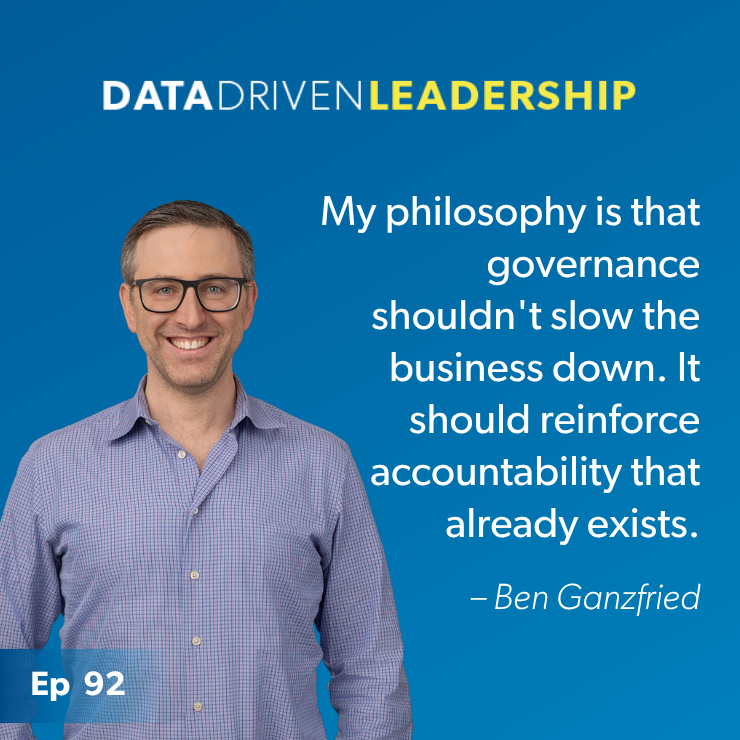
My philosophy is very much that governance shouldn't slow the business down, so it should reinforce accountability that already exists. And so I very much subscribe to the non-invasive data governance. How do we create the highest impact with being behind the scenes where possible? And so in practice, that's focusing on the fundamentals of clear ownership, shared definitions, data quality checks, and making data discoverable with a catalog or semantic layer. And so when those basics are in place, that really speeds things up and teams are spending less time debating what number is right and much more making decisions, generating future insights that delight customers. And so a fan of non-invasive data governance from my side.
Jess Carter (10:13):
Was that something that the company invested in and cared about from its inception?
Ben Ganzfried (10:18):
It's very much extremely natural for companies that are fast growing to get to that inflection point where they need that. I mean, it's certainly not the first hire. It's not the first 10 hires that ... I mean, unless it's a data or SaaS company, it's very much a function of successful growth of getting to a point where you want to make sure that you're able to deliver that. And what's really sort of fascinating about the, which I think is really the right way to design this is the operating model of platform and governance, which I think we can talk through later as well, but I think it's really been an accelerator by sort of putting the two together for sure.
Jess Carter (10:52):
Awesome. You have both the responsibilities of a platform and governance at a company where AI is central. How do you do that?
Ben Ganzfried (10:59):
Yeah, I think of platform and governance as two sides of the same system. So the platform defines what's technically possible with data while governance determines how safely and reliably that data can be used. So the way I think about it is, as I very much looked at historical analogy is the creation of the U.S. Central Bank. So before the Federal Reserve existed, financial systems, there was a ton of bank runs that would occur. Each state would have their own money, and then essentially there would be bank runs all the time, and we didn't trust that the system was stable.
And I think of organizations or data organizations is very similar. If teams don't trust the data, everyone builds their own definitions, work in silos, you get the element of runs on the bank, everyone scrambles to protect their numbers. And so governance is what stabilizes that environment. To me it’s very much shared definitions, ownership and trust so teams can move quickly without constantly questioning if the data's right. I think having platform and governance designed together where teams know where data lives and what it means and who owns it, that's increasingly even more important in today's age with AI systems and workflows.
Jess Carter (11:59):
Oh, that's maybe one of my favorite analogies I've ever heard. So congratulations. Use that everywhere you go. That makes so much sense. But then my follow-up is for a data-driven leader, for someone else who's maybe listening in, whose organization is growing fast, how do you build that trust quickly? What are the things that you think are must-haves or must-dos first versus we can do that later?
Ben Ganzfried (12:22):
I guess two ways. I mean, it ultimately does depend a little bit on where the company is, what they're looking to do next and things like that.
But at the same time, if there's no data catalog, you have to start there. I think that the highest ROI investment is, if there's not a data catalog, is to get one. It creates a shared map of data, what datasets exist, who owns them, how they're defined, how they're used. And without that visibility, it's a lot of manual personnel time to figure out what data exists, what to trust, where does data come from, how's it calculated? And so a hundred percent, that would be the first place.
Jess Carter (12:55):
That's great advice. And then I don't know that people have been having this dialogue. I'm interested in it if people are, but I've ran complex projects for over a decade now. And at first it would be like I'd run the project a big company had, the one project at a time. Right now, it's like every company has seven critical projects at once, and they're all really, really important. And so there are things that, especially with AI now, there are initiatives or things that might be serving you for a time, but maybe you don't need them forever. So a catalog to me is something I would imagine you would be of the opinion that you’ve got to make it and you've got to maintain a catalog. That's not something you just let go of one day. Is that right?
Ben Ganzfried (13:38):
A hundred percent. It's never fully done. At the same time, I would say that you don't have to boil the ocean. So if you have a million tables, you don't have to curate all of them. Probably one percent of them are used regularly for reporting. So those are the ones you want to start with. At the same time, pretty much every company I've ever been with is always creating new metrics, thinking through better ways of looking at the business. And so it's never done, but you might do the bulk of the enrichment at the beginning. But to your point, you never want to go into a library and not know where to find anything. So it's the same with their data, right?
Jess Carter (14:11):
Your analogies are killing me. They're so good. That's right. One of the things I wanted to touch on, I read your piece recently on lessons and ambiguity and chief data officers and CAOs and chief AI. I mean, I had a gentleman that I worked with for a long time who helped run the office of management and budget for a state in public sector. And all of a sudden these public sector agencies started having chief data officers. And I remember him saying, "Gosh, how many of these agencies need this? Are we just adding another chief head to every agency? How much is that going to cost citizens? How do we do that? When is it necessary? When is it not? " And so you kind of said, hey, that's not a sign of progress. What is it a sign of in your opinion and who's in charge these days?
Ben Ganzfried (14:58):
Corporations, nonprofits, government, it’s figuring out the right operating model for data. And so I think that's sort of what we're seeing is the explosion of titles means that different companies are trying to figure out the right operating model because these roles sit at the intersection of technology, analytics, business decision making, finance, and responsibility overlaps across those teams, engineering, product, leadership. And what they really reflect is companies working through who owns the data, who owns the metrics and who's accountable when decisions are made from them. Increasingly, there's a push to move around traditional BI tools to sort of enable natural language access on data itself, data warehouses. And I think that brings up a lot of other questions then about some of the guardrails that have been put in place already. And so I think the organization that does well focus more on the operating models and ownership and decision rights, because I think at the end of the day, trusting the intelligence you're putting into action is going to be critical there.
Jess Carter (15:53):
And that reminds me a little bit of your role. You've got the platform and the AI. So part of it is, if I'm hearing you correctly, which tell me if I'm not, part of it is what is your operating model and who has what skills in your leadership team? So if you have a great CIO who's also really great at AI and can manage a lot of those things or data governance, maybe they have an expanded role or an expanded team. And sometimes IT and data go together and sometimes you want a really clear line depending on your operating model. But is that fair that it's sort of the operating model and the skills that you have in your leadership right now?
Ben Ganzfried (16:24):
Totally. I think that's exactly right. I mean, I don't think there's one model that works for every company. It's going to depend on, as you mentioned, the skillsets that you have there as well as the scope. And just being clear about what we're doing by introducing new AI workflows and what the implications are of that. And I think having the perspective on that, I think you framed it very well.
Jess Carter (16:45):
You also talk about making data foundations explicit and that can be uncomfortable because it forces decisions about ownership and authority across silos. Could you share just a little bit behind the curtain of what do those conversations actually look like in practice? Why are they so hard?
Ben Ganzfried (17:01):
Part of it is that ownership and accountability touch on authority, budgets, incentives, performance reviews. And so in practice, they usually start with who owns the data, who defines the metrics, who's responsible for quality when something goes wrong. And when you really ask who owns the metric, you're asking a lot of questions about authority, incentives, accountability, and they sound technical, but that's sort of why they become difficult. I have another analogy. Both of my in-laws are psychiatrists. And so I think that good data leadership requires very similar skills. Listening carefully, empathy, understanding different perspectives and helping work through conflicts about ownership and responsibility. And so I think that's part of it. I think the other part of it is that every single person at a company, at an agency is using data in some capacity. And ultimately, in a corporation, it's the board or the CEO that owns the data.
(17:54):
It's not the CDO, it's not the CIO. And so recognizing the ecosystem that you operate is also super helpful.
Jess Carter (18:02):
So again, I'm just making sure I'm hearing you. So in my world, we've rolled out some changes in our sales and our delivery in a services firm, a professional services firm. And a lot of what we're doing right now is the wrestling through month one of that, which is, hey, did the fields we created with the incentives behind them generate the behavior we wanted in the first place? And so there are some wrestling matches that I think are really healthy where we're saying, hey, maybe people are arguing to get their name in a certain field. And it's like, well, we saw who ended up in the fields. Are they the people that should have based on what we intended when we brought the policy? So there's this combination of intention, governance and data, and then outcome of like, hey, is this all with behavior? Is this all working the way we intended? And so for me, those are uncomfortable conversations because there's this world where we're all one team, but we are trying to incentivize certain behaviors from certain departments differently.
(19:00):
And so we have to stop and call a timeout and look and say, Is this working the way we intended? Do we have to make any adjustments? Did people get overexcited and they doubled down in the wrong way and we have to adjust our policies? Am I aligning a little bit to what you're explaining?
Ben Ganzfried (19:14):
Yeah, hundred percent. It's sort of that cross-functional alignment on some of the complexities that inherit in the data and the logic behind it, for sure.
Jess Carter (19:23):
I just think this is really interesting because in that exact instance, we have gone years in ambiguity, years without just being like, can we get in a room and just figure this out? Why do you think as human beings we allow that? Why would we prefer, or seem to prefer, tolerate this ambiguity versus the consequences that clarity brings?
Ben Ganzfried (19:45):
Yeah. I mean, so when you make definitions and ownership explicit, it affects budgets, incentives, how teams are evaluated, what people are working on. And so it's sometimes easier to leave things slightly unresolved. But I think that's also where as systems scale, that becomes even more of a problem because it kind of became operational risk overnight with a lot of the content generation agents that are out there. And so ambiguity isn't accidental, but I think we do have to confront those trade-offs sooner than everyone would want in some ways.
Jess Carter (20:18):
Yeah. Yeah. It's interesting. I like to play sports. I'm an intramural girl. I'm not actually talented at one sport, but it is funny that the longer I work, the more a business, just the sports analogies ring true. We are just a team and some people are on offense and some people are the defensemen or women and understanding these analogies of this is a system and we're trying to figure out what's all the data the system needs or the business needs and is it operating the way it should? And to your point, I think acknowledging that these are sort of living organisms, they're going to adapt to the macroeconomics and the microeconomics. And we're just sort of constantly tweaking some things that are never quite done. Which I think in society I think is a little bit fatigued by that. I think we just want to finish some stuff, but I also think it's a maturity to admit that there's a lot more that's amorphous than maybe we wish.
Ben Ganzfried (21:09):
Yeah, no, I think that definitely resonates a lot. Many years ago, I worked as a early data scientist for the New England Patriots on the business side. And one of the insights there was like, if you miss three or more games, you're much more likely to cancel your subscription. And so what they would then do is if you miss two games, they'll try to give you a bunch of perks and stuff. But at that point in time, you have a ML model that basically help predict who's likely to renew or not. And it's an output, it's an Excel sheet. You can figure out and hand it over to marketing and figure out how to solve for that to get better engagement. But today, those are largely, in a lot of places, that whole process is fully automated. And so I think it's a big change that sort of happened recently.
Jess Carter (21:54):
Yeah. Yeah, absolutely. Well, and again, I think some of that comes back to what we're talking about without really calling it out is just leadership. What does it look like to lead these organizations and lead them through change, lead them through. I mean, you talked about how long ago were you doing that?
Ben Ganzfried (22:11):
Patriots, that was about ten years ago.
Jess Carter (22:14):
Yeah, that's crazy. Some people didn't even know that what an LLM was ten years ago. Most people probably didn't, right? And so I look at what machine learning was. And so I look at some of this and think certainly most leaders didn't think they needed to know that, wouldn't you argue? And so it's crazy that these are sort of brass tacks now. You have to understand some amount of data and how to lead with it to be a good leader. So maybe one of my last few questions for you is, you talk about AI moving from operating around workflows to operating inside of them. And I'm just thinking about the leaders that are listening. What does that mean to you? And maybe what's an example of something you've seen or built around at Hungryroot?
Ben Ganzfried (22:56):
As you mentioned, historically, AI helped people make decisions and now it's starting to make the decisions itself. And so when they're inside workflows, a good example at Hungryroot is a SmartCart. It's just actually helping construct the cart the customers see when they open the app. When AI moves inside workflows like that, the quality of underlying data foundations becomes much more important. I mean, if we were recommending stuff that nobody wanted or was not on their goals and designed to them, then they wouldn't come back. And so making sure that we're designing that experience for them. And I think the moment that AI does operate inside workflows, data quality is less of a reporting issue, becomes operational. And I think having the investments and the right data foundation, I think are very important these days.
Jess Carter (23:38):
Yeah. Yeah. Well, and as we look at some of this and we look at building a culture for a business today that has data, at least part of it, I'm not going to say it the central, but a lot of modern data infrastructure is built around control, like governing, validating, monitoring. And you have written specifically a lot about the risk of losing the spirit of inquiry and all of that really resonates with me. Again, I've obviously grown to accept ambiguity. And so knowing that it drives most of us, including me, crazy at times. Again, I just want to finish something. How do you keep curiosity alive in an organization as it matures?
Ben Ganzfried (24:18):
I think it boils down to one word, which is leadership. I think that's what it really comes down to. So I think absolutely modern data infrastructure is very much focuses on control, monitoring, validation, governance, because businesses need trusted data to run on. For probably the last seven, eight years, I've just been really interested in the history of databases. And Charles Bachman was one of the early developers, I think was at IBM. He sort of said the primary function of data systems is inquiry, helping organizations ask better and better questions. And I think maybe the two leadership examples that jump out to me, I've been very fortunate. I've seen that style of leadership, strong leadership with data really. So at Wayfair, Nira Shaw as the CEO, he would always have dashboards open and constantly asking new questions about the business and his teams would then ask a lot of questions.
(25:06):
And I think that sort of encouraged that. And very much at Hunger, it's the same. Ben McKeon is a very much like a customer-first mindset. So sort of focusing on how do we design the right experiments and giving customers the food that they love? And so the strong data foundations that enable experimentation to continuously answer those questions are sort of how you go about that. So I guess I would just leave it, just that curiosity mindset coming from the top is incredibly powerful for sure.
Jess Carter (25:34):
Demonstrating it. Yeah, to your point. I love that. I think I had a board member once, of mine. So to your point about great mentors, great examples, he'd always ask me when we talked, "What are your hypotheses that you're testing right now?" And if I mentioned more than two, he'd be like, "You probably can't do more than two, maybe three." But he was always like, "What's the one or two things that you're like, you're not sure about you're holding in loosely and you're testing it to see what you're going to think and in a couple quarters you'll come back and have some insights?” Because you have to think about, do you have the data to even understand your hypothesis and your curiosity? And then do you have to collect the data and do you have to add it to the catalog? And so maybe that's the place to put a pin in it today, Ben, is just the invitation for others to think, what are your hypotheses?
(26:14):
And for me and you, too. So there's a few that I've got in my back pocket, but it's always nice to write those down and evaluate how those are going out. So this has been an absolute pleasure. You're a very deep thinker, aren't you?
Ben Ganzfried (26:25):
I'd have to think more about the way. No, I appreciate that. No.
Jess Carter (26:28):
You’re going to think deeply about if you're a deep thinker. Yes. I appreciate your interest in history of how these things came to be in the first place. To your point, there's this natural curiosity about you. And I think I appreciate the way there's clear history and study, but also practitioner in you. It's always nice to me that sometimes it can feel like a rat race in technology and data. And it's nice to meet people who have some anchors to them that are, yes, let's move quickly, but let's also move with curiosity and intention. So I really appreciate your time to talk through some of these topics today.
Ben Ganzfried (27:02):
Yeah, absolutely. Thank you so much, Jess.
Jess Carter (27:04):
Yeah, absolutely. Okay. If people want to find you and keep learning from you, what's the best way for them to get ahold of you?
Ben Ganzfried (27:09):
Probably following on LinkedIn would be the best for sure.
Jess Carter (27:11):
Okay. We'll add a link to your LinkedIn in the show notes as well, okay?
Ben Ganzfried (27:15):
Sounds great.
Jess Carter (27:16):
Great. Thanks, Ben. Thank you all for listening. I'm your host, Jess Carter. And don't forget to follow the Data-Driven Leadership wherever you get your podcasts. Rate and review, letting us know how these data topics are transforming your business. We can't wait for you to join us on the next episode.
Insights delivered to your inbox