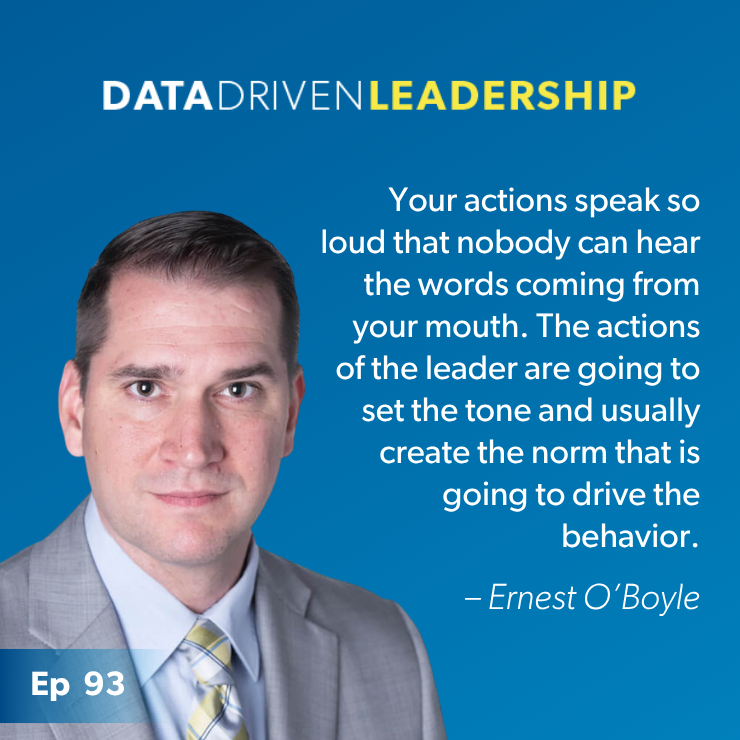
Can Certain Personality Traits Undermine Leadership? Understanding the Dark Triad with Ernest O’Boyle
Listen On




Transcript
This has been generated by AI and optimized by a human.
Jess Carter:
The power of data is undeniable and, unharnessed, it's nothing but chaos.
Various speakers:
The amount of data was crazy.
Can I trust it?
You will waste money.
Held together with duct tape.
Doomed to failure.
Jess Carter:
This season, we're solving problems in real time to reveal the art of the possible. Making data your ally, using it to lead with confidence and clarity, helping communities and people thrive.
This is Data-Driven Leadership, a show by Resultant.
Hey guys. Welcome back to Data-Driven Leadership. Today we're going somewhere most leadership podcasts don't, and that's why you need to hear this. Our guest today is Ernest O’Boyle, a professor at Indiana University who studies the darker side of workplace dynamics.
We're talking manipulative leaders, teams that quietly fall apart and the way organizations bury data that doesn't say what they want to hear. We get into the dark triad, narcissism, machiavellianism, and psychopathy, and why these traits show up so often in leadership. We talk about workplace deviance and what it actually looks like in data and knowledge work. Spoiler, it's not stealing from the supply closet.
And we dig into what Ernest calls questionable research practices, which honestly sounds academic until you realize that you've watched it happen in your own org. This one is gonna stick with you, I promise. Let's get into it.
Welcome back to Data-Driven Leadership. I'm your host, Jess Carter. Today we have Ernest O’Boyle, Dale Coleman chair of management and professor at Indiana University. Ernest, welcome.
Ernest O'Boyle:
Thank you very much. It's great to be here. I really enjoy the opportunity to come on Data-Driven Leadership.
Jess Carter:
Well, I'm excited to have you. So I heard you speak, I think it was a couple years ago at a Tobias Fellows event. What was really impressive to me, everything you said was fascinating. Okay. That's just a standard. However, or in addition, it was, you were speaking right after lunch, which is usually kind of a tough spot, and you could hear a pin drop. So everyone was fascinated, and I was like, I kind of waited politely, but I was dying to get you on the podcast ever since that moment.
So thank you for joining.
Ernest O'Boyle:
Well, thank you for letting me know. I really appreciate the kind words. I love talking with the Tobias Group. They're such an engaged, successful sort that a lot of times those conversations, after I gain a tremendous amount from it. So thank you again for the kind words.
Jess Carter (02:25):
Absolutely. Well, so we have to get started with the dark triad. So this is something that you have studied in great deal for, or length as well. But for people who aren't familiar, what, what is that?
Ernest O'Boyle:
In some sense we're talking about just bad stuff. Uh, it's kind of, there's a lot of social aversion all wrapped in there.
So they, people high on any one of these traits tends to be a little selfish, or on average more selfish. They tend to be a little, maybe a little manipulative on average. Maybe mean spirited, oftentimes kind of sore losers, not very good winners, either. So they all kind of share that.
(03:08)
So in some, you're like, we’re just talking about bad stuff in a workplace, or in my case, the workplace. But how these traits manifest, what shows, how they operate in a workplace, especially at different levels of it, you know, as leadership position versus a direct reporter, individual contributor position does differ.
(03:27):
That's why we do treat these as distinct categories. Okay. And just to kind of knock the definitions out, hopefully quickly. Uh, narcissism, I think it's what most people think of. It's this big, grandiose sense of self. It's the, it's that ego that's really inflated and because it's inflated, it's also pretty sensitive.
People high-end narcissism tend to struggle sometimes with feedback, negative feedback that starts to push against their part of what's keeping this big, inflated balloon steady, which is, or inflated, which is cognitive distortions as well as this kind of external scaffolding. You know, I need a lot of praise. I need a lot of attention because that's what's kind of keeping this grandiose sense of self justified.
Jess Carter (04:12):
So the three tri, there's kind of these three, and to your earlier point, they are overlapping a bit, right? Your point was that they're not these perfect separate things. Is that right?
Ernest O'Boyle (04:21):
The three traits, the three components of the dark triad, these are machiavellianism, narcissism, and psychopathy.
So just in broad strokes, if we start with narcissism, say we're talking about that big, grandiose sense of self, that very large ego, and it's an ego that because it's overinflated, it tends to be very fragile. So you can imagine in a workplace these folks struggle a little bit with getting negative feedback.
(04:50):
They also tend to require a lot of external validation, so they seek praise. They seek the reinforcement. And as a result of that, sometimes they're, they're not great with the, you know, sharing credit. So in the workplace, again, you can, you can see them as teammates and as leaders, struggling a bit at certain times. When the narcissism gets the best of them, we should say.
(05:11):
The next trait here, machiavellianism. These are people that rely a lot on interpersonal manipulation. And they're doing it…they're both driven by, and the justification is this cynical worldview. They really do believe the world is a bad place, dog eat dog. You know, I'm gonna cheat you before you get a chance to cheat me.
(05:35):
And that kind of mentality can lead them to believe that, you know, really manipulation is the only way to advance. You always have to be keeping an eye out that you never really have friends, you have resources to be exploited at some later date.
So if I go to work, if Data-Driven Leadership were to hire me and I'm really high in machiavellianism, let's say, I might try to do everything I can to really get close to you because you're, Jess, you're at the top of that pyramid.
(06:04):
So if I can slowly become valuable to you and I then can watch your relationship, oh, you're a marketing specialist, uh, Kendall. I noticed you have a really good relationship there. Slowly but surely, I might try to get to become the intermediary. But getting in that middle there, now I control not just the tone and the timing of messages, I can control the message itself.
(06:27):
That's how so much, tend to rely so much on that kind of machiavelli and or the, and on that manipulation strategy. Then last you have your people that are high, and I wanna stress subclinical psychopathy. I don't study anything clinical. So these are all people that are below clinical thresholds for stuff like, uh, antisocial personality disorder.
(06:48):
But these folks, um. A lot of impulsivity. They can be pretty antisocial at times. The thrill-seeking behaviors. Interpersonally, they're not great. They can be glib, they can be pretty manipulative again. So kind of like the machiavellians, they're, they have a amoral, sensibility. So not immoral. They're not doing evil for evil's sake generally, it's just amoral. The ethics of a situation doesn't factor into their decision making. And that couples with also this callous affect, this more flat emotionality and much has been made over the past, like ten, fifteen years about, oh, there could be value.
(07:30):
To these last two. For somebody who doesn't get bogged down by the sentimentality of, you know, firing somebody on Christmas Eve. I think that that is incredibly optimistic and I think you are, you know, like dysentery as a great weight loss tool. It's not one I would recommend to people. And I, when I look at the kind of the celebration of this very thin silver linings on these very dark storm clouds, I push back.
But in general, those are the dark tri. That's what we call the dark triad.
Jess Carter (08:03):
This is so interesting. My, one of my first questions was like, well, I can be a little antisocial and sometimes I look out for myself, and sometimes I…like, am I one of those things? And so if someone's wondering, am I, do I have more of those traits than I should? How do you answer that? Do you get that question often?
Ernest O'Boyle (08:23):
Certainly. And wrestle with it yourself, and you start to, you know, reckon every time you're anything other than a saint out there, you can start to script in your head about it. But in terms of the extreme versions of this. In terms of what we would consider clinical thresholds for psychopathy and narcissistic personality disorder.
You have a large audience, so statistically speaking, yeah, probably there's like some portion of it that crossed that, but the vast, vast majority of the people that would hear about that would be listening to this, you're not. You're within the normal range. In fact, anybody who buries the needle on one of the types of measures I use really scores, you know that even the max possible, that means you're on the upper end of normal.
Jess Carter (09:08):
Okay
Ernest O'Boyle:
So, I wouldn't ever look at these things as hard and fast dictates for a few reasons. One, they're not clinical measures. Two, they're measuring personality traits. So these are, they're not dictates. You're never gonna be able to go into a court of law and plead not guilty by reason of machiavellianism. So then they like nudge your behavior a little here and there. Okay. And then the last thing that the last solace somebody could take if they felt they were above average on one of these traits is they're malleable.
(09:41):
They change over the lifespan. So we, there's a really well-documented one, the case of narcissism. It falls over time. You peak in your teens, and that makes sense. You're kind of exerting yourself onto the world. There has to be a certain amount of, hey, I'm gonna look after myself. And then over time, for most people, you then see a drop off of narcissism throughout the lifespan. And the same's gonna apply to these other characteristics too.
You know, I, I worked in corrections for a brief amount of time. And that, one of the considerations when you had a offender who really was, you know, scoring exceptionally high in psychopathy is it's really hard to work on this person's morality and their compass, but their impulsivity, which does decrease over time.
Ernest O'Boyle (10:30):
That's something we can work on with them. So just over the lifespan, there was a natural drop off in some of the really extreme behaviors that might be caused by extreme version of these traits.
Jess Carter:
Okay, so then here's elephant in the room for me. Ernest, how long have you been studying these things?
Ernest O'Boyle:
Let's see. So around 2006. I was in social psychology, so I was studying moral judgment under my advisor and great friend Don ForSight. So it's been, yeah, it's been 20 years I've been starting this.
Jess Carter (11:00):
So you're not in the clinical side. You're studying this and you do focus, I think on leadership and the workplace. Why? Why spend 20 years studying this?
Ernest O'Boyle:
It's always fascinated me. The dark style has that, hopefully not like in a neck beard, edge sword kind of way, but in it's really cool, or it's fascinating to me that we have these rules, these agreed-upon things that we're all gonna do as, as a group, as a society. And some people, some of the time will look at that and just say, ah, screw it. I'm, I'm gonna ignore that norm, I'm going to engage in this. Yeah. So the exception always be seen has, uh, generated more interest for me than the, than the rule has.
Jess Carter (11:42):
Okay. Okay.
Ernest O'Boyle (11:43):
So it just, and as I start to look at, you know, why does this person, this perfectly normal person, why did they just engage in something that's really abnormal and really deviant? Well, is that something about them? Is that one of these traits that we're talking about? Is it something about the group they're in and they just got…slowly but surely this group that may have started out really aligned with the organization's interest over time starts to deviate and they start to metamorphosize into something that's really counter to the organization.
(12:17):
Or is it the organization itself? You put in dumb policies. You know, these are policies that work great for angels. You don't have angels working here. Yes. You know, hard work and determination is one way to achieve these carrots you’re dangling, undercutting everybody else around me, lying, cheating, stealing. That's another way.
Well, that's not a bad person. That's not a bad team. That's a bad policy. So I, so that's because I saw, or because I began to study more of this idea that these negative behaviors are so multifaceted and so multi causal. I'm interested in unpacking that.
Jess Carter (12:54):
This is amazing. So, we could spend the rest of the podcast with questions I have just following up on that. This was one of my questions and you've started to get into it, is I love that you seem to approach these things that most people immediately cast judgment. And you show up with insane amounts of curiosity. You're genuinely curious about that behavior. You find it fascinating versus judging it as morally bad and ergo cast it away. This isn't…you're inquisitive. And then you kind of talked about policies or cultures. So one of my questions was, is it nature? Is it nurture?
Ernest O'Boyle (13:30):
Thank you again. Uh, it's both. But that's a, that's a really tough question and I, it's spot on. And it's the one that we all wrestle with is how much of this behavior is driven by, you know, the…like Greek tragedy, you know, fatal flaw, hubris-type things. And how much of it is that the organization begins to shape these sort of things. So there's a… The quote, and I think maybe in our emails back and forth initially talking about this idea, you know, power corrupts and Lord Acton or whoever it was, the one who say it so the internet can correct me.
(14:09):
The idea that the nature of powerful roles starts to give you this opportunity, that just as your personality's changeable over time, you know, hopefully and more ways towards the good. Well, what if there's no pushback when you do engage in some of these selfish behaviors? Greedy behaviors or manipulative, or mean-spirited behaviors. Over time, the trait begins to activate more and more, perhaps.
And the narcissism that may have just been a seed starts to grow and dominate. But that's the same quote. You know, power corrupts, absolute power corrupts absolutely. That same person has another one that I love probably more, which is at some point he said, great men are never good men.
(15:00):
The idea that early on, and this is something that the literature does back up, narcissists crave power. They crave the leadership role. Well, when somebody just throws it open like, hey, somebody pick a team leader here. I think a lot of people who aren't high on that trait, who might be really well qualified, really intelligent folks, they're probably going through, but let me consider everybody's qualification here, regardless of my own ego, who here would be the right person to run this?
That doesn't go through the mind of a narcissist. They're already advocating, campaigning for themselves, and those that campaign early and often tend to win.
Ernest O'Boyle (15:35):
So, is it that you start to attract a certain type of person that may become great through enough of these selection filters, but in the end they're not necessarily a very good person because it was all, only a certain type of person is drawn to that.
I think that's such a tension that's so difficult to unpack.
Jess Carter (15:54):
Is it safe to say that every human experiences moments of these traits, like every human is gonna be selfish sometimes, every human… So I think about, you know, if you're talking to a normal person, I don't know what define what defines normal these days, but Ernest, if you're talking to somebody on the street, are we all narcissistic at some point? Is there a healthy amount of selfishness that everyone must have? I mean, what are your thoughts on some of that?
Ernest O'Boyle (16:20):
I don't, and I've already violated this a few times, just in our conversation here. When I talk about a narcissist or a machiavellian or a psychopath…man, if you tell me I’m the problem, don't you dare ask me to be part of your solution.
So once we start labeling the person as, okay, well, those types of people do this type of behavior. I think it gets us in trouble, right? From that sense, they're, once you paint 'em that way, they're certainly not gonna be working with you to help things out. It also absolves you because you're not a narcissist and you're not a psychopath.
(16:52)
So those things don't come into your purview. There's no factor in, you don't need to worry about that when it's your decision making. I get hesitant about where some of these, uh, where some of these labels come from because you got it spot-on: Everybody acts in narcissistic in some ways, some of the time. Everybody.
So even these bad behaviors that we point out with, you know, I wouldn't break. I'm not a rule breaker. Well, if it was to save somebody's life, would you jaywalk?Would you cut across? Of course you would. So there are always going to be circumstances that bring out your worst instincts or bring out those things that are a little selfish, are a little manipulative, are a little mean-spirited, let's say.
Jess Carter:
Okay.
Ernest O'Boyle (17:34):
What we want to do is try to put in from, if we're running the organization, if we have a lot of control over our environment. I guess I shouldn't say that, anywhere in the organization of, uh, some control over your environment. I wanna set up situations that are going to elicit the best out of me and not the worst.
I think that yes, there are some really successful people that are high in psychopathy. By and large, they're successful in spite of it, not because of it. So I want to create situations and my policies that are going to encourage collaboration are going encourage a right to constructive conflict.
(18:14):
We vet ideas hard here. We don't necessarily try to tear each other down like crabs in a bucket. And so it is, again, I'm trying to monitor my environment, trying to also know myself that if I score high on one of these traits, you know, we don't need to get a straight jacket. What we need to do is have some degree of consideration that, you know, I scored kind of high on this machiavellianism trait.
(18:38):
That means that I tend to look at other people's motives with a little more skepticism and maybe in an unfair way. When I'm in negotiations in the future and the person says, may I have a glass of water? Maybe that's not them stalling or trying to introduce a power move. Maybe they're just thirsty.
Maybe with my judgment in the future, it's gonna need to align a little bit closer with trusting people. And if that starts to get enforced over time, well guess what happens in ten years when I measure somebody's machiavellianism again? It's actually dropped a little bit.
Jess Carter (19:11):
I mean, that's what I was gonna ask you too, is, so when you think about the work you've done in, in the workplace, you know, so the goal or objective, if I'm hearing you right, isn't casting judgment: “Oh, I found one! Let's get him outta here.” It is understanding the structures you're putting in place. So I actually, I kind of do think about like a country, like a culture. It's what are your behavior norms, what are your mission, vision, values? What are your KPIs? What are your policies? Are you directing traffic?
(19:38):
And in a smaller company, I am suggesting things that you can correct here. A single individual would have more influence over the culture, especially coming in at a certain level or role. And so as a leader beside maybe somebody that has more of these behaviors than not, what advice would you give them?
Are we now customizing policies to try to drive that behavior out of somebody who showed up and you didn't see it during the interview process and now you're trying to control it through policy or, what advice would you give someone?
Ernest O'Boyle (20:07):
A few different angles here. One would be that we have somebody who's been hired and they are very high on one of these, or one or all of these traits that we've talked about here.
Are we talking about, I’m stepping into this organization or onto this team and I'm noticing that our norms have shifted? And now what? You know, five years ago we would've never been okay with the product that just left this team. Yesterday, we signed off on it. What has changed over there?
(20:37):
So there can be that kind of open and frank conversation. So to me, that's always my go-to is the norms. More served than the policy, more so than you have a bad apple on your team. My Occam's razor, and I think the literature would largely support this. Is going to be that this is the team dynamics have changed.
It's not a bad team. There's some norms that have been created here that need adjustment. They may have started out emotionally. There's been times that we've chosen the cohesion and the preservation of the team over the goods of the organization or even our own ethical codes in the case of, you know, really bad behaviors.
Jess Carter (21:14):
And that was the other thing I was gonna ask you is, I, in leading a data-driven leadership podcast, I routinely hear people talk about the leadership gap we have today in society. That there's just, are there kind of good leaders? Are there enough good leaders, good sound judgment, ethical? And so my curiosity to you is what's a bigger leadership dilemma in society, corrupt leaders or incapable ones?
Ernest O'Boyle (21:38):
I can just reframe the question away from the incompetent leader to incompetent behaviors to incompetent leader. Or corrupt leadership behaviors. I think the incompetent ones are probably a lot more prevalent. It's a, there's a tendency for that, but the corrupt ones can be, uh, can be a lot more destructive.
I would try again to focus on, where are the particular behaviors that we're most concerned about and what are the interventions that target that? So if we're talking about a incompetent set of leadership behaviors, that may be related to some of the traits that we may have talked about.
You know, we've set it up so that somebody can really go off and just have their own glory projects with no kind of oversight.
(22:26):
Alright, well let's, let's figure out some ways to reel that in, because that becomes a very tempting thing for somebody who's high in narcissism. If it is a norms issue, I'm going to, especially as a leader, I'm gonna recognize that one, an open, frank conversation’s an important thing that we need to have here.
But more important than that is my behavior. And I think for probably most of your listeners, the you trying to do good things, you want to be successful and you want to be a good leader out there. So you hear that and you're like, yeah, that's exactly right. I'm the role model for my direct reports and that they can look at me and they can see that I don't steal, and I don't defraud, and I treat people with respect and all those sort of things.
(23:10)
My MBAs are the same way. The one area I'll push back on that a little bit is, what about work-life balance? Because that's often pitched. You tell me that hey, that's a priority for me. I care about that and my organization cares about that. And it's an ethical thing. It's moral that people have a time to have a personal life.
All right. Well, that's cool that you said that. Norms change. Norms are based on your behavior. Are you answering emails at 10:00 p.m., 2:00 a.m., and 6:00 a.m.? When they drive by or when they pull into the organization do they always see your car when they get there and they always see it when they leave?
(23:44):
Because if so, your actions are speaking so loud, nobody can hear any words coming outta your mouth. And I've been in really top-notch organizations, you know, F-10 organizations, and they brag on, uh, you know, look, you know, this food court with 20 different flavors and the massage rooms over here in saunas and this and we give unlimited PTO.
(24:01):
And then you walk around and you talk to people. First off, all those places are empty. Nobody's in 'em. Then you talk to people, when was the last time you took a day off and they're, you know, this was in, you know, three years ago or something like that. So again, the actions of the leader are going to set the tone for this and usually create the norm that is gonna drive the behavior.
You got a problem with incompetent behaviors, you gotta problem with corrupt behaviors. Look at those norms and try to make efforts there before we start looking for, you know, the Hannibal Lecter in your organization or trying to say that this is an Enron, you know, start-to-finish corrupt.
Jess Carter (24:39):
You talk quite a bit about in research, workplace deviance, and so when we say, “workplace deviance,” will you do a quick definition? What are we talking about?
Ernest O'Boyle (24:48):
Any voluntary act that hurts the organization or its members that violates norms. So if there has to be a baseline norm in play and you have to willingly violate it in a way that is going to cause harm or is in all likelihood gonna cause harm. So if I work as a, I'm a forklift driver and I’m in a factory and I accidentally one day bump into a bunch of chemicals and it clears the factory floor, costs a whole bunch of money to clean up, and that's not workplace deviance, okay. It was an accident.
(25:21):
Now if I had a couple drinks in the parking lot on my lunch break and then I decide to jump behind the the forklift, okay, well that is workplace deviance at that point, you know, ideally I violated the norms that you're not supposed to be drinking at work.
Jess Carter (25:35):
A lot of the people listening are in like IT, tech, data. So what does that look like in like, knowledge work or data environments? What is that, are we avoiding a policy to hit a KPI, maybe? So they want to win and get their incentive structure, but they don't wanna follow all the process to do it.
Ernest O'Boyle (25:51):
Sure. I think that's a great one. I think there's a lot of, anytime that one result is favored over the other there's going to be a motivation to maybe monkey with the numbers a little bit. And that's kind of another area of my own research. So in terms of the reports that so much of your audience's time is probably spent preparing, you know, and presenting, there can be a tendency to maybe rose tint things a little bit in non-ideal ways.
You're dealing with a commodity. What it's a, it's a cliche, I know, but data is a bigger commodity than oil is, right?
Ernest O'Boyle (26:27):
So when, when we have something that's highly valuable, highly prized, there's going to be an incentive to potentially access that or use that commodity in non-ideal selfish ways. I look at the fact that your listeners have a lot of direct access to that commodity as being opportunities for problems.
So I'm not…I'm a Luddite. We've…even before this podcast started we had some, we're going through a bunch of these trials and tribulations by lack of tech, but still. When I go in, if it's a manufacturing, you know, old-school 20th century. Well, if it's a place that processes gold or silver, well, we put in metal detectors outside because we know we don't want people leaving with the product.
What's your version is the question I want to talk to a tech company. What's your version of the metal detectors? How close…you see now that gives you instant information and it tells you exactly who has the product or the resource with them, and what are some of the things that we can do to have, what amounts to these types of metal detectors when it comes to your data?
Jess Carter (27:34):
Oh, that's great. So pragmatically, if I'm a leader in a position where I start to see this workplace deviance or, or acts of that, or, I see some behaviors that are, you know, outside or against some of the norms, or introducing, you know, room for people to start to have some norm slippage, I'll call it. I'm making up a word.
What pragmatic advice would you have for a leader as they think about some of these things?
Ernest O'Boyle:
I like that. I like the term norm slippage. I think that would be great. I think having those occasional open…because norms are inherently informal rules, they're not discussed, not openly discussed. You, you kind of go along to get along with them to draw people together.
(28:15):
And especially as in, in a leadership role, you have the power or the authority to do that. To talk a little bit about, okay, what's changed? And is that the change we want? Is that, is there anything that we need to change, be proactive about? You know, norms are, yes, they're established by these reactive things.
They can also be proactively manipulated. What are we going to do? What are the things that we might become even more effective on? And understand that's not gonna be us getting smarter overnight. That's gonna be us using different processes and having different standards, and that's normative.
(28:50):
So that's really, again, where leaders can work with that. And if you have a, if you have somebody who is narcissistic, if you have some bad policies, then it's the idea of, okay, how do we work around that? How do we make sure that if there is any silver lining, we leverage that, but more importantly, we mitigate any sort of potential negativity that might come from these, you know, negative traits or these policies that don't really work well.
Jess Carter (29:16):
Yeah. Okay. This is helpful 'cause I think one of the things that is a hypothesis of mine is that some of these things happen, and I'm assuming, whether it's inordinately more in leadership positions because the power is there and they want the power, there is a tipping point I imagine, where it's like, hey, you know, the, the goal isn't to cast judgment and it can be very fluid, and some people I think really need the direct, hey, we need you to stop doing these things. This is not productive for our culture. And they don't like that feedback.
And so I sometimes imagine there's tension there. So, I think one of the things I get curious about is it's like there's a thousand variables, Ernest, and it feels hard to, it feels like sometimes this is all whoever's controlling the narrative has the power.
(30:02):
And sometimes—I guess I'm on a diatribe here—what I'm trying to say is, sometimes some of the people who are best at the KPIs, they're best at closing the deals in sales. It's easy to villainize sales. They'll take shortcuts to do it. They're really good at hitting their numbers, so it gets really hard to hold them accountable to these things because you want the outcomes for the business, but you don't want the behavior.
Have you, have you seen that lived out and do you have advice about some of that? Like at what point is it really not recoverable? Or do you kind of not believe that that's the case?
Ernest O'Boyle (30:33):
I think that's very much the case. I think we're moving away from the idea, we're moving away from traits or some of the stuff we talked about earlier, talking about our top producers that might be, that might bring some really bad behaviors with them. How much good, how much do we do, can we celebrate the fact that they do these things exceptionally well? Sales being an example. Or you mentioned, you know, the state of Indiana, obviously where I am, too, and I work at a place where Bobby Knight was. “Well, we're not gonna tolerate these sorts of behaviors.”
(31:05):
Well, now you don't tolerate these sorts of behaviors. Now that the championships aren't coming in every year, that's when we start tolerating those behaviors. That's one of the mistakes that people make when it comes to leading star performers or dark star performers. Or starting to make this idea we're gonna accommodate this person's really narcissistic behavior because they have these other positive qualities.
(31:29)
Just those sort of things start to, I think generally distort and are moves away from the goodness.
I don't think, it's not up to us to change the norms to accommodate someone's bad behavior. I think it's up to us to ensure that the norms are gonna curb and mitigate and eventually correct that sort of bad behavior.
Biggest mistakes we can make is—and where those rules actually become hard to enforce is not the terrible worker. The person who doesn't do, doesn't contribute hardly anything. When they break the rules, when they steal something, oh, it's so easy. Righteous indignation. We can come down on them hard, fire them on the spot, make a whole theater of it.
It's our top performers when they start to press against it, when we start to get into that, you know, power corrupts absolute power corrupts absolutely situations. That's when the rule enforcement becomes important. We have to have a hot stove approach to our HR and to our performance management when it comes to bad behavior.
(32:27):
And as soon as the hot stove approach it’s one, it's fast. You know right away when you have touched a hot stove, right? It also doesn't care who touched it. If you touch a hot stove and you're the top rep, or you're the worst rep, you're still getting burned by this. And every time you touch it, it's going to burn you.
So I look at that, those standards in place, those aren't moved. Those norms and those policies don't shift. That as a function of having a really, uh, top performer because you start to move those norms, it just spreads. Like, it's problematic. It's gonna spread like the flu through your organization.
Jess Carter (33:04):
You have done a lot on research integrity and organizational decision making. And so I think, I think we talked a little bit about that, and you kind of advise, like making sure when you have data and reports, you're not cherry picking, you're not running your knowledge. So to me that's a key part of data-driven decision making, too is not everybody has gone through an ethics class, right?
But a lot of leaders present reports about their content. And I think having just enough either ethics or statistics around you to say, here are the outcomes, and I'm not taking the outliers out. I can call them out and I can show you that I truly believe they're outliers and this is what it would look like if you removed them.
(33:40):
But I like, I think there's just a little bit of good intentions without great clarity on statistics or ethics can create a monster on accident. And so back to your, maybe it's not intentionally devious or conscious, but it is a incapability problem that we need to be cautious of. So is there anything on that kind of research integrity, organizational decision making that you wanted to share that we didn't already cover?
Ernest O'Boyle (34:02):
That's a really good example there where we have somebody who wants to, for the good of the group, for the preservation of the team, because I wanna show that this team's work really is good. And even though the results aren't quite where they need to be at this point, I could put a certain amount of shine on it.
Well, the ethical violation is not wanting to protect the team. It's, if you're going to use evidence, there's a belief, an inherent belief anyway, that you're presenting something that's impartial. Independent of me. Here's the provenance. Here's the evidence that shows you that my team's been doing good work.
(34:39):
Anything that's presented as a statistic is often presented as something that's unbiased and something that is an accurate representation. If you're talking to people, I hate the phrase where people say, “Lies, damn lies and statistics.” You know, it's just that people don't have a ton of experience with statistics.
You could say something about books for people who are illiterate. So we know as data-driven leaders that we can twist the numbers in a lot of different ways. We have to recognize that that's where, again, that kind of role modeling and norms come into play, that I want to be known as the person who always gives an honest assessment.
(35:19):
That actually is a value added and competitive advantage for me and my team, that the people above me know that they can always get an accurate estimate from me. That I'm not gonna shine them, I'm not gonna do what's best just because it's what's gonna get me promoted or get my team more glory.
Jess Carter (35:35):
We had an instance where, uh, we had a key metric in our company in the last year that was really struggling and there were a few months of data that I really wanted to leave out because it wasn't…when I was over the data and it, they really were outliers.
We did work pretty hard to tell that story clearly, and I could do that, not 'cause I'm a statistician and not because I took some super-rich ethics class, but because leaders around me when I was kind of growing up underneath them, to your earlier comments, modeled it and I worked under them.
(36:05):
And I would pull reports together, and they'd be like, that's not, that can't be right. What about these months that were thrown off? And I'd be like, well, I just took that out. And I didn't even know I was making a decision that was so critical. And they'd say, no, no, no, you can't do that. If you're the commissioner of whatever agency and you see that report with those out, what decisions are you gonna make? What thoughts are you gonna have? You're gonna think we've got it all under control in a way that we can't control that. We didn't have that story. So we have to show them, to your point, you want trustworthiness built on accuracy and, and accurate storytelling. Not perfect, you know, self-oriented narratives that make me shine.
So I think what's neat, too, is there this culture that we can create in our companies of honesty, integrity, truth and excellence can all be created. And excellence can be imperfect KPIs. I mean, I had that same metric months later, I had a financial analyst come over to me and say, hey, you keep telling us this is getting better.
(36:59):
The data does not say that. Like it still looks like it's very much the same problem. And I was like, oh, I didn't really lay out for you all, the things we changed aren't gonna impact this number for three months. You're not gonna see an impact because fixing the template for our contract isn't gonna solve next month's issue. It's gonna solve the issues that come in three to six months when we have a bunch of new contracts and we're building momentum and a snowball. And so I had to go align my stakeholders to say, it's not that it's not getting better, it's not getting better instantly, and I didn't realize you were expecting that.
(37:32):
So let me align and explain. We're not failing. The changes haven't stuck yet in a meaningful way. But it would've been so easy for me to say, well, let me go ahead and put together a deck that shows you in some way that it is. The data doesn't exist. It's gonna be a minute. And so it was nice to be able to have a culture in our company that I didn't curate that was open to tolerating that it doesn't look better for a minute and it's not going to, and you've got, you've gotta kind of sit with me and let me get these changes out the door before you're gonna see. But if I felt pressure to just show immediate impact on this very big problem, you know, maybe I would've behaved differently. Right?
Ernest O'Boyle (38:08):
And that's so spot on. And when we see these org change initiatives and they go sideways and they become ineffective, a lot of times it's because they're, we're not focusing on the right metrics. We're expecting this instant return on things, and it's not going to be that, or at least not instantly going to happen.
That's absolutely key. And then in terms of maybe the shining of results. It's a human emotion, but where that test—or human reaction—but it's where that test has to be, does this influence this person's understanding or confidence in import? And if it is a meaningful influence, then it should be reported.
If dropping these three statistics or the three outliers really changed the overall conclusion that you would make, well then we need to explain why we dropped those three outliers. So it's never about telling people how to do their job, what to report. It's about what to do in their research. It's about the reporting factor. Just tell us what you did and why you did it,
Jess Carter (39:08):
Ernest, if people want to follow along with you and keep up with you, what's the best way for them to do that?
Ernest O'Boyle:
I'm on LinkedIn and then probably the best…honestly, if you have request just to email me, I'm on the Indiana's website. I'll be more than happy to take a few minutes to talk with you or hopefully send an article or two your way that might be helpful.
Jess Carter:
Awesome. I am so appreciative of you joining us.
Ernest O'Boyle:
Thank you again so much for allowing me to come on.
Jess Carter:
Thank you for listening. I'm your host Jess Carter, and don't forget to follow the Data-Driven Leadership wherever you get your podcasts. And rate and review letting us know how these data topics are transforming your business.
We can't wait for you to join us on the next episode.
Insights delivered to your inbox