The data warehouse dilemma
Your business moves fast. New acquisitions close in months. Regulations shift overnight. Cloud platforms promise limitless scale. AI initiatives demand trustworthy data. But there’s a problem: Your data warehouse can’t keep up.
You’re not alone. Enterprise leaders across industries are discovering that traditional data warehousing approaches built for stability struggle in an era defined by change. When your competitive advantage depends on turning data into decisions quickly, architectural rigidity becomes a business liability.
This is where Data Vault 2.0 enters the conversation. You don’t need to replace everything you’ve built. Data Vault is a modern approach designed for the pace and complexity of today’s enterprise data challenges.
The business problem: Why traditional data warehouses struggle
Consider these real-world scenarios:
The M&A Integration Challenge: A regional bank acquires three competitors in 18 months. Each brings different core systems, customer databases, and reporting requirements. The bank’s traditional star schema data warehouse needs six months and a team of consultants just to integrate the first acquisition’s data. By the time it’s done, two more acquisitions are waiting. The business is moving faster than the architecture can adapt.
The Compliance Audit Gap: An insurance carrier receives a regulatory inquiry about policy pricing decisions made 18 months ago. The compliance team needs to trace every data point back to its original source system. But the data warehouse has been updated, transformed, and aggregated. The original values are gone, overwritten by more recent data. What should be a straightforward audit becomes a crisis.
These scenarios reveal three fundamental limitations of traditional data warehousing approaches:
What is Data Vault 2.0 (in plain English)?
Think of Data Vault 2.0 as the LEGO system for enterprise data. Just as LEGO blocks snap together in countless configurations without breaking existing structures, Data Vault allows you to add new data sources, integrate acquisitions, and adapt to business changes without re-engineering what you’ve already built.
Beyond a mere modeling technique, Data Vault 2.0 is an integrated system with three core components:
The Model: How Data Is Structured
Data Vault organizes data around three building blocks:
This separation matters because business relationships are more stable than business details. Your customer’s ID doesn’t change, even when their address does. Data Vault embraces this reality.
The Methodology: How It’s Built
Data Vault 2.0 aligns with agile development principles. Instead of spending months designing a complete data model before loading any data, you build incrementally. Start with the most critical business entities, deliver value in weeks, then expand. Each addition strengthens the foundation rather than requiring a rebuild.
The Architecture: How It Scales
Data Vault is built for cloud-native, parallel processing environments. Because there are no foreign key constraints between tables during loading, data can flow in simultaneously from dozens of sources. One delayed feed doesn’t hold up the others. This architectural choice becomes critical at enterprise scale.
The key principle underlying all three components is that Data Vault is business-centric, not technology-centric. The model reflects how your business actually works, not how your databases are organized.
Why Data Vault 2.0 matters to business leaders
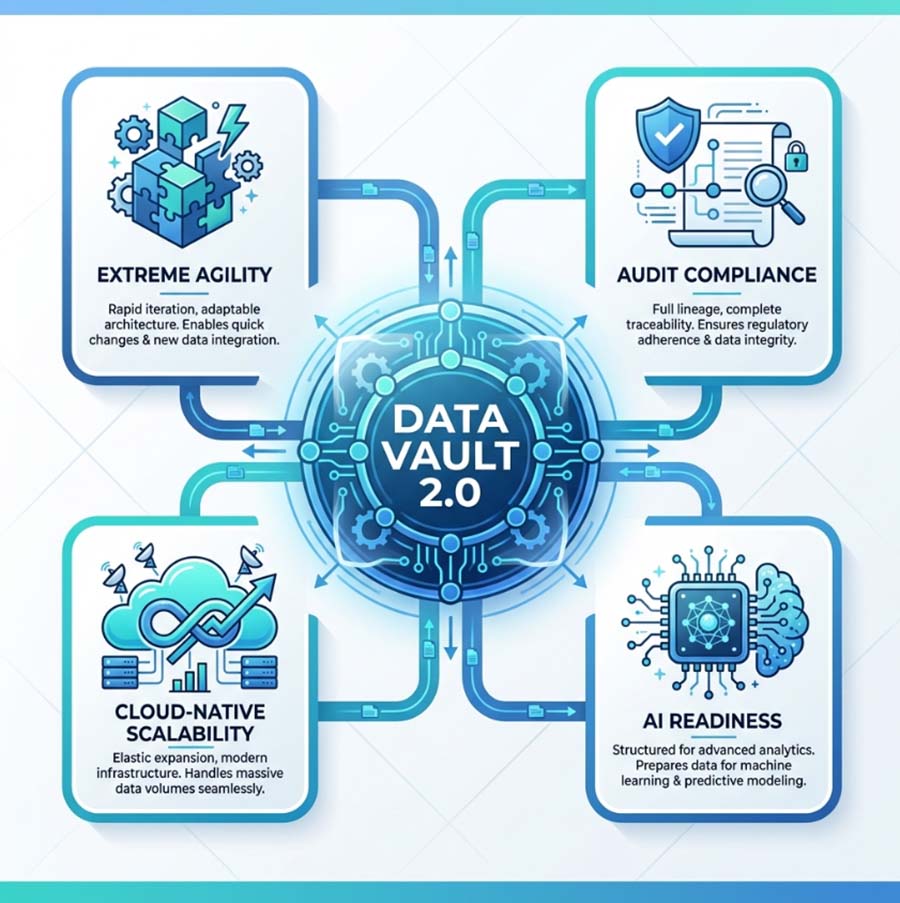
Extreme Agility
When a healthcare system begins capturing real-time patient vitals from connected devices, it needs to integrate this streaming data with existing clinical records, billing systems, and research databases. In a traditional data warehouse, adding this new data type means schema changes that ripple through every dependent system—a project measured in quarters.
With Data Vault 2.0, the healthcare system can add new Satellites to capture the streaming vitals data without touching existing structures. The new data integrates with current patient records through existing Hub and Link structures. Time to value: weeks instead of months.
Business Impact: Data architecture bends with business change instead of breaking under it. M&A integrations happen faster. New product launches get data support immediately. Digital transformation initiatives don’t wait for infrastructure rewrites.
Cloud-Native Scalability
Data Vault 2.0 was designed for the cloud era. The methodology leverages hash keys instead of sequential keys, enabling massive parallel processing. The lack of foreign key constraints during loading means you can simultaneously ingest data from 50 systems without orchestrating complex dependencies.
One financial services firm processing millions of daily transactions found their traditional data warehouse hitting performance walls. Nightly batch loads stretched into morning business hours because table load dependencies forced sequential processing. After implementing Data Vault, they achieved 10x faster loading through parallelization and the architecture now handles petabyte-scale growth without fundamental redesign.
Business Impact: Scale data infrastructure along with business growth. Handle real-time data feeds alongside batch processing. Leverage cloud platforms’ elastic compute without architectural constraints. Build once, scale infinitely.
Platform Independence
In a traditional data warehouse, moving from one cloud vendor to another often requires a complete rewrite of complex code. With Data Vault, your core business model remains stable even if the underlying technology shifts. You’re building an asset that belongs to the company, not the vendor.
Business Impact: Technology evolves effectively every three to five years, which is why today’s “hot” platform can become tomorrow’s legacy tech. Because Data Vault is a methodology, not a specific software tool, it insulates your business logic from your database platform.
AI Readiness
A major retailer investing in AI-powered personalization discovered a critical gap: Their data warehouse had only 13 months of customer behavior history, and what existed had been aggregated and transformed so many times that the original granular data was gone. Training accurate machine learning models requires historical depth and data fidelity, neither of which their traditional approach provided.
Data Vault 2.0’s time-travel capability changes the equation. Because every data change is preserved with timestamps, you can reconstruct the exact state of your business at any point in history. Need to train a model on how customers behaved during last year’s holiday season? The raw, unaggregated data is available. Need to understand how a pricing algorithm performed last quarter? You can replay the exact data conditions.
Business Impact: Accelerate AI initiatives with trustworthy training data. Meet regulatory requirements for AI explainability. Avoid the “garbage in, garbage out” trap that dooms many machine learning projects. Build a foundation that supports the AI capabilities your business will need tomorrow, not just today’s requirements.
Long-Term ROI
The most expensive part of a data warehouse isn’t building it; it’s maintaining it. Traditional data warehouses often evolve into large, legacy codebases that require expensive specialist teams simply to maintain. Data Vault’s modular, pattern-based approach automates roughly 80 percent of required coding.
Business Impact: Delivery is far faster with this methodology, and it drastically reduces the technical debt that can accumulate over time. Your maintenance costs stay flat even as your data grows, resulting in a lower total cost of ownership compared to a traditional data warehouse.
Is Data Vault 2.0 right for your organization?
Data Vault isn’t the right choice for every organization. Here’s an honest decision framework:
Consider Data Vault 2.0 if:
Traditional approaches still work fine if:
Your data sources are stable and predictable, your requirements rarely change, you’re operating at small to mid-market scale, or you need immediate reporting with limited technical resources. Not every organization needs enterprise-scale data architecture, and that’s perfectly appropriate.
The truth is that many modern enterprises use both approaches. Data Vault serves as the integration and historical layer, the system of record that captures everything. Then data flows into star schemas or dimensional models for business intelligence and reporting. Rather than thinking of Data Vault as an all-or-nothing decision, think of it in terms of having the right tool for each job.
Conclusion: Can your data architecture keep up with your business strategy?
Data Vault 2.0 is architecture designed for the pace of modern business. When acquisitions happen in quarters instead of years, when regulations change overnight, when competitive advantage comes from AI-powered insights, and when data volumes grow exponentially, your data warehouse needs to be a business enabler, not a bottleneck.
Data Vault 2.0 provides that foundation: agile enough to bend with change, auditable enough to explain every decision, scalable enough to grow without limits, and robust enough to support the AI initiatives that define tomorrow’s competitive landscape.
The question isn’t whether Data Vault is perfect for every scenario. The question is whether your current architecture can support where your business needs to go.
Evaluating data architecture options for your enterprise?
Let’s discuss your specific needs.
Our team has implemented Data Vault 2.0 across industries from financial services to health care, and we can help you assess whether this approach aligns with your business challenges and strategic priorities.
About the author